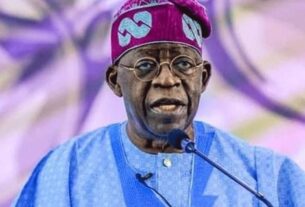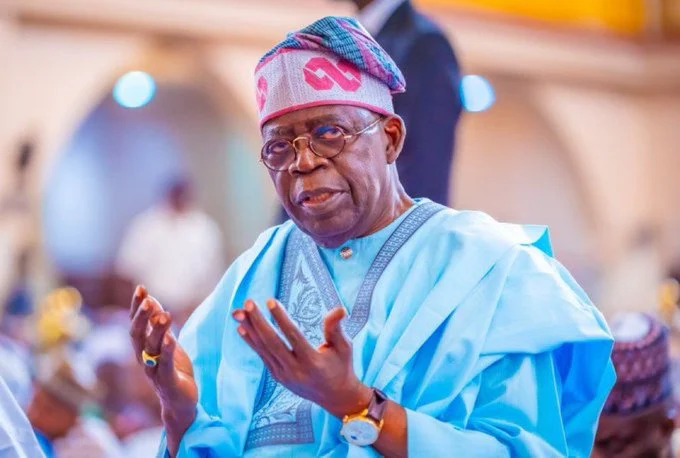
President Bola Tinubu
President Bola Tinubu has disagreed with former President Olusegun Obasanjo over claims that the state-owned Port Harcourt, Warri and Kaduna refineries may never work.
In what appeared to be Tinubu’s first clear position on the viability of the three refineries, which have remained moribund despite billions spent on turnaround maintenance, the President insisted that the facilities will return to operation.
Tinubu made his position known on Thursday when he received the Executive President of the Nigeria Union of Petroleum and Natural Gas Workers, Salimon Oladiti, and members of the union at the Presidential Villa, Abuja.
The President’s declaration is coming against the backdrop of repeated doubts expressed by Obasanjo about the ability of the Port Harcourt, Warri and Kaduna refineries to operate successfully, despite the huge sums that have been committed to their rehabilitation over the years.
“The refineries you mentioned are going to come back to work. We’re just building a very firm research and structural reworking of the economy of it. Ordinary flame and smoke of a refinery doesn’t mean it’s working, until it’s profitable and yields the value for which it is built,” Tinubu stated.
He said he would not bother to look back into what has happened in the past about the failed rehabilitation of the refineries, saying, “I am not a man who looks back because I have accepted the asset and liability of my predecessor, no matter what has happened in the years past. It is my responsibility now to fix it and make it work for the largest common value of our population. I take responsibility for that, and I’m going to do it.”
Tinubu’s position is different from Obasanjo’s long-standing argument that the Nigerian National Petroleum Company Limited cannot successfully operate the government-owned refineries.
Obasanjo recently reiterated his position in an interview aired on television by Sony Irabor Live, arguing that public-private partnerships offered a better model for running major government assets.
“One of the lessons that I learnt is that PPP works. Look, one project that has not been destroyed by the government in Nigeria is the NLNG, where the private sector has 51 per cent, and the Nigerian government has 49 per cent. See what we did with Nigerian railways.
“See what we did with the national shipping company. See what we are doing now even with the NNPC. The NNPC has refineries, and I said to people that it will never work. And a man had the audacity to say, ‘Am I a chemical engineer?” he said.
Obasanjo’s position was based partly on his experience as President between 1999 and 2007, when his administration attempted to transfer the management and ownership of the refineries to private investors.
According to him, he approached Shell to take a 10 per cent equity stake and run the refineries, but the oil major declined. He subsequently asked the company to operate the facilities without taking equity, but it also rejected that proposal.
“When I was there, I called Shell. I said, ‘Look, please, I beg you, come and take 10 per cent equity and run the refinery for us.’ They said no. I said, ‘Okay, if you don’t want to take equity, don’t take equity. Come and run the refineries’. They said no,” he stated.
Obasanjo said he later invited a top Shell official to explain why the company had rejected his proposals. He said the official told him that Shell’s major profits came from upstream operations and that the downstream business was more of a service than a major profit-making venture.
But beyond profitability, Obasanjo said the official identified the small size of the Nigerian refineries, poor maintenance and corruption as other reasons for Shell’s reluctance to operate them.
“He said our refineries are too small. This was when I was an elected president. He said our refineries are too small. One is 60,000 barrels and another 100,000 barrels. He said refineries at that time were in the range of 250,000 barrels to 300,000 barrels.
“He also said our refineries are not well maintained. We call quacks and amateurs to come and maintain our refineries. The refineries are not in good order. He said there’s too much corruption around our refineries, and they don’t want to be part of that,” Obasanjo stated.
The former President also recalled that Dangote had offered $750m for a 51 per cent stake in two of the refineries while he was in office.
“Until one day, Aliko (Dangote) came and offered $750m to take two of the refineries; that will be 51 per cent. I said, ‘Wow, God, you are really a God of miracles.’ I told Aliko to bring the money quickly. They brought the money, and they paid,” he said.
However, Obasanjo said the transaction was later reversed by his successor, the late former President Umaru Musa Yar’Adua, following pressure from the NNPC. He noted that he subsequently warned Yar’Adua that the government could eventually lose the opportunity to recover substantial value from the plants.
“When I left office, NNPC went to my successor and convinced him. So I got up. I went to Umar. I said, ‘Look, Umar, maybe you don’t know; this is why we did what we did.’ He said, ‘Well, NNPC came to me.’ I said, ‘But you know that NNPC cannot run this thing. He said he knew.
“I asked, ‘Then why did you give in? He said because of pressure. And I said, ‘Look, when you sell these refineries, you will not get 200 million (dollars) for them, because you will sell them as scrap.”
The expenditure on the state-owned refineries has remained one of the most contentious aspects of the rehabilitation programme. Obasanjo said he learnt the government had spent about $16bn to fix the refineries, “which is only $4bn short of what Aliko used to build Africa’s largest refinery”.
Recall that the President of the Dangote Group, Alhaji Aliko Dangote, once expressed pessimism about the NNPC-managed refineries.
Dangote’s scepticism is rooted partly in his own experience with the government refineries. He recalled that his group had acquired the facilities in January 2007 but returned them to the government after a change of administration. According to him, the decision by the Yar’Adua administration to reverse the transaction ultimately led to the construction of his own refinery.
He also criticised the turnaround maintenance approach adopted by the government, arguing that modernising old facilities could create another set of technical challenges.
“(The turnaround maintenance) is like you trying to modernise a car that was built 40 years ago, when technology and everything have changed. Even if you change the engine, the body will not be able to take the shock of that new technology engine,” he stated.
The disagreement, therefore, is not simply over whether the refineries should be restarted. Tinubu is insisting that they can be made to work and has accepted responsibility for fixing the inherited assets and liabilities.
Obasanjo, based on his experience in government, believes the NNPC should not be entrusted with running the facilities and has advocated private-sector involvement.
Related News
Morning recap: Adeleke extends olive branch, Kwankwaso explains Obi alliance, other top stories
2027: Opposition urges Adeleke template to oust Tinubu
Osun defeat signals Tinubu’s 2027 loss to Makinde – APM
Aside from Obasanjo, stakeholders like oil marketers, manufacturers and the organised private sector have also requested that the facilities be sold off.
But Tinubu’s latest statement suggested that he is with the NNPC boss, Bayo Ojulari, who recently announced a memorandum of understanding with two Chinese companies to fix the Port Harcourt and Warri refineries.
The challenge before the administration will, therefore, be to demonstrate that the facilities can move beyond periodic restart announcements to sustained, commercially viable refining operations.
Expert kicks
An energy expert, Dan Kunle, faulted the continued rehabilitation of Nigeria’s old government-owned refineries, arguing that the President should privatise the facilities and redirect public funds to other areas of the economy.
Kunle said the country had spent years attempting to revive the refineries without making them profitable, stressing that the president should not continue along the same path adopted by previous administrations.
Kunle faulted the information being presented to Tinubu on the rehabilitation of the old government-owned refineries, arguing that the managers of the facilities may be influencing the president’s decision to continue investing in them.
Kunle said the president was likely making his pronouncements on the refineries based on information supplied by the managers of the facilities, but insisted that such information was driven by self-interest.
“Logically, let us just say the information at the disposal of the President on those refineries, I’m sure, was as presented to him by the managers of those refineries. I can tell you those pieces of information are not the truth. They are driven by self-interest, and that self-interest can be achieved through other legitimate means; not by deceiving the president to go ahead with the rehabilitation of those refineries,” he said.
Kunle maintained that Nigeria had travelled the same road in the past without successfully restoring the refineries to profitable operations. “Because we have passed through that road before, those refineries will never work. If they ever work, they will not work at profit. They will remain problematic,” he stated.
He challenged the government to establish a new refinery alongside any of the existing facilities to demonstrate the viability of the old plants. He added that such a comparison would expose the operational and financial problems associated with the old facilities.
“If they want to bet it, let the president get an investor to build a new refinery by the side of Warri or Port Harcourt refinery. Let them run the old one by the side and run the new one on the other side, and they will see what we are talking about. They will see how many times they will have problems with the old refinery and they will run the old refinery at a loss,” he said.
Instead of spending on the refineries, Kunle urged Tinubu to open up several sectors of the economy to investment rather than concentrating government resources on the old plants.
He said, “He has power to open up the upstream of the oil and gas industry for himself and all his associated friends, and all businessmen in Nigeria that want to enter there. He has power to open up the gas and the gas infrastructure business in Nigeria as he wishes. He has power to open up agriculture for the country in all shapes and manners. He has power to open up everything in Nigeria.
“But for him to take his power to still be concentrating on those refineries that have been technically insolvent for the last 25 years is very strange,” he stated.
Kunle argued that the government should accept the recommendations of Nigerians who have concluded that the refineries should be privatised rather than continue spending public funds on them.
“If you aggregate the total wisdom of Nigerians and the intelligentsia of Nigerians who said you should not go ahead to rehabilitate those refineries with government money, that you should privatise them and sell them as is, it means the wisdom of those people is supposed to be taken by the president. He should respect them and say, ‘Okay. I will privatise these refineries. Let him use the government money to develop education, to develop agriculture, to open new opportunities, the new frontiers,’” he stated.
He questioned why successive administrations had failed to revive the refineries despite repeated assurances that they would be restored.
“They convinced Umar Yar’Adua to cancel the privatisation; he did. They convinced Goodluck Jonathan that they could fix. They convinced Muhammadu Buhari that they could fix the refinery. None of them have achieved it. So, what makes President Tinubu think that in the next four years, he can fix those refineries and make them profitable?” he asked.
Kunle also raised concerns about accountability for previous spending on the refineries, particularly the rehabilitation of the Port Harcourt facility and the involvement of foreign contractors, saying such concerns should not be dismissed in a democratic setting and public officials should be held accountable for their actions.
Marketers back Tinubu
However, the Port Harcourt Refinery Host Community Bulk Petroleum Retailers Association pledged to work towards doubling the votes Tinubu received in Rivers State in the last presidential election if the refinery resumes full and sustainable operations before the next general election.
HOSCOM said the revival of the refinery would not only be politically significant but would also create jobs, stimulate businesses, strengthen local capacity and improve energy security in Rivers State.
The association, in a statement issued after an emergency review meeting, said more than 200,000 people were estimated to depend directly and indirectly on the refinery and its associated economic activities.
It said the prolonged inactivity of the facility had displaced workers, businesses, contractors and petroleum marketers whose livelihoods were linked to its operations.
HOSCOM also backed the proposed technical equity partnership between NNPC and Chinese firms for the restart and expansion of the refinery, urging stakeholders to ensure reliable crude supply, efficient management, proper maintenance and technical competence.
The association said it would mobilise its members and supporters to support Tinubu if the refinery becomes fully operational before the election.
“The association further pledges to work towards doubling the votes President Tinubu received in Rivers State in the last election, should the Port Harcourt Refinery become operational before the election,” it stated.
The Punch