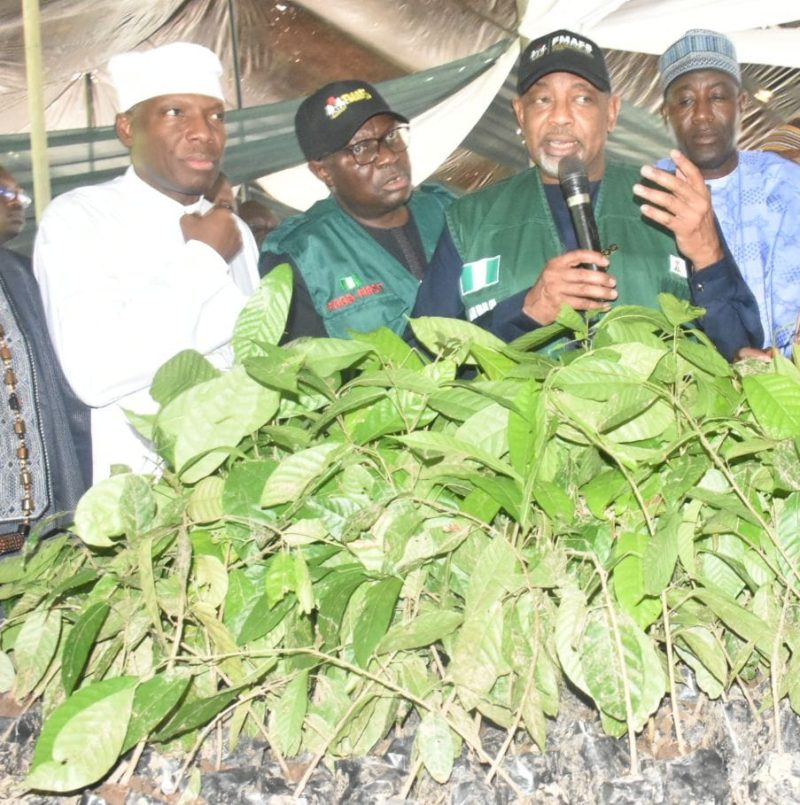
The Federal Government has flagged off the One Million Improved Cocoa Seedlings Roll-Out Programme it called a landmark intervention to restore Nigeria’s cocoa industry and reclaim the country’s position among the world’s leading cocoa-producing nations.
Launching the programme at the Cocoa Research Institute of Nigeria (CRIN), Ibadan, Oyo State, Agriculture and Food Security Minister, Senator Abubakar Kyari, said the initiative marks the first major step towards rebuilding the cocoa sector through the replacement of ageing plantations with improved hybrid seedlings.
He said the programme is designed to increase cocoa yields, provide farmers with improved planting materials, enhance rural livelihoods, boost export earnings and strengthen Nigeria’s competitiveness in the global cocoa market.
The minister recalled that Nigeria ranked as the world’s second-largest cocoa producer in the 1960s, noting that proceeds from cocoa financed iconic projects including Cocoa House in Ibadan, the then University of Ife, now Obafemi Awolowo University, and the free education programme in the old Western Region.
Though he lamented the ecountry’s decline in global cocoa production, he expressed confidence that Nigeria possesses the land, favourable climate, experienced farmers and research capacity needed to regain its lost position.
He said the initiative is in line with President Bola Tinubu’s Renewed Hope Agenda, which identifies agriculture as a key driver of food security, economic growth, value addition, employment generation and increased farmers’ incomes.
Describing cocoa as a national crop, Senator Kyari noted that while the South-West remains Nigeria’s traditional cocoa belt, cultivation has expanded to the South-South and is gradually spreading to emerging producing areas in the northern part of the country.
He explained that the Federal Government’s cocoa revival strategy is anchored on three major priorities: increasing productivity through improved planting materials, research and extension services; expanding local processing and value addition; and ensuring greater economic benefits for cocoa farmers.
The Minister disclosed that the improved cocoa seedlings, developed by the Cocoa Research Institute of Nigeria (CRIN) under a Federal Government-approved Public-Private Partnership framework, mature earlier, produce higher yields, resist major pests and diseases and are more resilient to climate change.
He said the seedlings would be distributed across cocoa-producing states to rehabilitate ageing plantations and establish new commercial farms nationwide.
Senator Kyari further revealed that under the National Cocoa Development Plan, the Ministry is implementing measures to increase cocoa production, improve bean quality, strengthen agricultural extension services and expand domestic processing into finished cocoa products.
He added that government is also strengthening Nigeria’s compliance with international sustainability standards through improved cocoa traceability, farm mapping and implementation of the European Union Deforestation Regulation (EUDR), aimed at securing premium international markets for Nigerian cocoa.
The Minister called for stronger collaboration among federal and state governments, research institutions, financial institutions, development partners, private investors, processors, exporters and cocoa farmers’ associations to accelerate investment across the cocoa value chain.
He described cocoa farmers, particularly smallholder producers, as the backbone of the industry and urged them to adopt improved agronomic practices, embrace modern farming technologies and work closely with extension officers to maximise productivity.
Earlier, the Permanent Secretary, Federal Ministry of Agriculture and Food Security, Dr. Marcus Ogunbiyi, described the programme as a strategic intervention to reposition Nigeria’s cocoa sector for economic diversification, increased exports, rural development and sustainable national growth.
He noted that years of ageing plantations, declining productivity, climate change, pests and diseases, poor access to improved planting materials and limited investment had weakened the industry’s global competitiveness.
Dr. Ogunbiyi said the one million improved hybrid cocoa seedlings produced by CRIN would deliver higher yields, earlier maturity, greater resistance to pests and diseases and improved resilience to changing climatic conditions.
According to him, the intervention will replace ageing cocoa trees, increase farmers’ incomes, encourage youth participation in cocoa farming, stimulate investment across the cocoa value chain and create employment opportunities in production, processing, logistics and marketing.
The Permanent Secretary attributed the success of the programme to the collaboration among the Federal Ministry of Agriculture and Food Security, the Cocoa Research Institute of Nigeria (CRIN), the National Agricultural Seed Council, the National Cocoa Management Committee, state governments, development partners, farmer organisations and private sector stakeholders.
He reaffirmed the Federal Government’s commitment to sustaining reforms through research, mechanisation, extension services, climate-smart agriculture and value chain development while urging beneficiaries to make effective use of the improved seedlings.
In separate goodwill messages, Chairman of the Cocoa Association of Nigeria, Mututau Olayinka Abolarinwa; Executive Secretary of the Agricultural Research Council of Nigeria, Professor Adamu Dabar; the Ajiroba of Ibadanland, Professor Soji Adejumo; Acting Executive Director of CRIN, Dr. Rasheed Adedeji; and cocoa farmer, Dokun Thompson, commended the Federal Government for the initiative.
They expressed optimism that the programme would rejuvenate Nigeria’s cocoa industry, improve farmers’ productivity and incomes, attract greater investment into the sector and guarantee sustainable cocoa production for future generations.