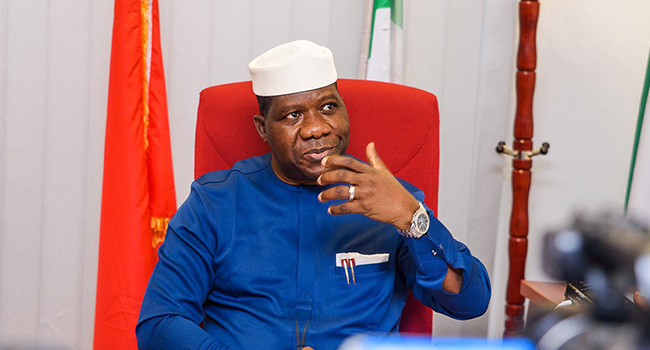
Senate Leader, Senator Opeyemi Bamidele
The Senate has outlined a series of safeguards aimed at preventing state governors from abusing state police powers as the Red Chamber passed constitutional amendments to establish decentralised policing across Nigeria.
The Senate Leader, Senator Opeyemi Bamidele, disclosed the measures while leading debate on the Constitution of the Federal Republic of Nigeria Alteration (State Police) Bill, 2026, on Wednesday.
The Senate passed the bill following a rigorous clause-by-clause consideration and after more than two-thirds of senators voted in support through a manual voting process conducted on the floor of the chamber.
It now requires passage by the House of Representatives, presidential assent, and approval by a majority of state Houses of Assembly to become law.
Bamidele, in a statement from his office, said the proposed constitutional amendment seeks to create a decentralised policing structure while ensuring that governors cannot deploy state police for “partisan, ethnic, religious, sectional, or personal purposes.”
He said the bill, submitted to the National Assembly by President Bola Tinubu, was designed to balance local policing autonomy with national cohesion, accountability, and effective oversight.
The statement, titled “Senate Adopts Measures to Prevent Abuse of State Police by Governors,” read in part, “The bill is intended to retain the Nigeria Police Force for federal policing duties while providing for the establishment of state police services in states that choose to adopt them.
“Bamidele further broke down the details of the proposed decentralised police structure, noting that state police would be responsible only for enforcing state laws, maintaining public safety and public order, preventing and detecting crimes within their jurisdiction, protecting lives and property, and carrying out other local policing responsibilities.
“On the responsibilities of the federal police, Bamidele noted that the federal police would be in charge of protecting federal institutions, counter-terrorism, organised crime, cybercrime, border security, arms trafficking, interstate criminal activities, and other national security matters.”
Bamidele also highlighted circumstances under which federal police could intervene in state security matters.
He explained that “the interventionary powers of the federal police could only be activated when there is an outright breakdown of public order in a specific subnational entity; when a state police service is incapable of functioning; when there is a serious violation of fundamental rights; when there is an established record of electoral intimidation; and when national security is under threat.”
Bamidele added that “such intervention could only come after the President and Commander-in-Chief of the Armed Forces authorises it in writing. It would be limited in scope and duration, subject to Senate oversight and open to judicial review.
“The bill generally seeks to balance local policing autonomy with national cohesion, accountability with operational effectiveness, and federal oversight with state responsibility.
“The bill provides robust safeguards against abuse, preserves federal authority where necessary, protects constitutional rights, and creates a modern policing framework capable of addressing contemporary security challenges.”
Speaking in support of the bill, Senator Enyinnaya Abaribe, Chairman of the Senate Committee on Power, said he had initially opposed the creation of state police but now believed prevailing security challenges made it necessary.
“However, the prevailing security situation across the federation necessitated the establishment of state police in order to tackle security problems,” Abaribe said.
Also backing the proposal, former Sokoto State Governor, Aminu Tambuwal, said he had consistently supported the establishment of state police.
The Senate Chief Whip, Senator Tahir Monguno, also urged lawmakers to support the constitutional amendment, arguing that it would strengthen efforts to address security challenges at the subnational level.
The Punch