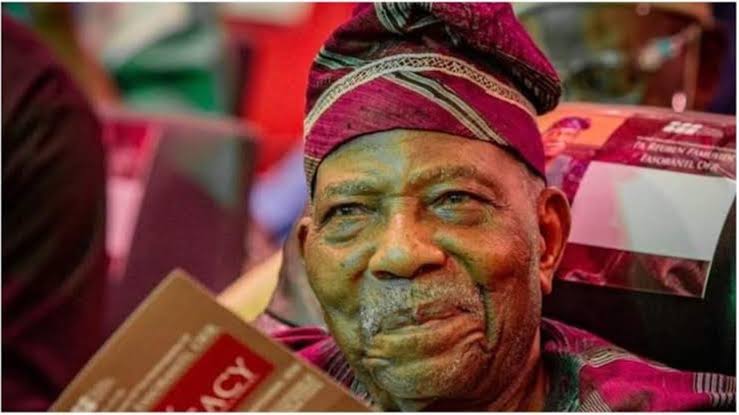
High Chief Oladimeji Reuben Abitogun, the Odopetu of Ayede-Ogbese, speaks with The Hope on the ancestry of the late Afenifere leader, Pa Reuben Fasoranti, his political career, exemplary character and legacy.
High Chief Oladimeji Reuben Abitogun began his journalism career with The Hope in 1990, where he served as a features correspondent and State House correspondent in Abuja. He later worked as a researcher and reporter with The Comet, which subsequently became The Nation. He also published a community newspaper, Wait and Get News, in 1996 and 1997. Throughout his career, he benefited from the experience of veteran journalists, including Mr Femi Kusa, who served as editor-in-chief of The Guardian and later The Comet; Prince Kayode Fasua, the current chairman and managing editor of The Hope newspaper and Mr Yemi Olowolabi, a former Ondo State Commissioner for Information.
Excerpts:
Question: Following the death of the late Afenifere leader, Pa Reuben Fasoranti, some people in Akure have argued that he was not an indigene of Akure but was originally from Uso in Owo Local Government area. Could you shed light on this?
Answer: Both sides have a point, depending on how they understand the history. However, Chief Reuben Famuyide Fasoranti was an authentic indigene of Akure by ancestry. He represented the quintessential Akure personality. Please underline that: he was an original Akure native.
People sometimes define Akure narrowly, limiting their understanding of the town to certain parts of the metropolis. Some regard the area stretching from Oke-Eda to Igan-An, including the Gbogi axis and the Ondo bypass, as the extent of Akure. However, Akure’s historical and ancestral identity extends beyond those boundaries.
Chief Fasoranti was born in Uso in March 1926, but his ancestry traces directly to Akure.
According to the history I have researched, his great-great-grandfather was Odopetu Adugbolu of Akure. The Odopetu family represents one of the ancient lineages of Akure, predating the establishment of the present Deji institution as the town’s central traditional authority.
When the Asodeboyede lineage arrived in Akure, its members traced their descent to the Oduduwa dynasty. They settled in Akure and established their authority. The Odopetu leadership accommodated the emerging order and made concessions as the community developed. According to the historical account passed down through the community, the Odopetu family made several sacrifices to accommodate the new traditional structure.
For the sake of brevity, Asodeboyede underwent certain tests of manhood before establishing his kingdom. Legend has it that his bead broke at a place now known as Akure. That location remains significant in the town’s history.
In those days, brave hunters, known in Yoruba as Ode Aperin, travelled across hills and rivers in search of new settlements. Asodeboyede eventually arrived in Akure, where he encountered people who were already living there.
During his period of seclusion, he reportedly faced disturbances from the Ekueda, which he struck and killed with his aja. This incident is said to have contributed to Akure’s praise name, “Akure Ajapada.”
Legend also has it that, during his endurance test in Ife, he survived on just one grain of alligator pepper.
Having proved his bravery and endurance, he set out with the blessing of his grandfather, Oduduwa, and eventually settled in Akure. His bead reportedly broke at Alakure, an area some people identify with present-day Car Street, around Eru Oba. That is said to be where the town of Akure began.
When Asodeboyede arrived in Akure, the Odopetus were already the heads of the community. Generations of tradition and prophecy held that Akure would grow bigger and that its leadership would have to accommodate more people.
When the Asodeboyede lineage arrived, certain demands were made, and negotiations took place. The Odopetu leadership made concessions to accommodate the new traditional structure.
Consequently, the Deji became the head of the Akure community. At another point, the Odopetu leadership made a further sacrifice by accepting the second position.
There were further negotiations based on the prophecy that Akure would continue to grow only if its leaders accommodated more people. The Odopetu leadership again yielded ground, allowing the Lisa to become the second-ranking traditional chief.
However, if you want to trace the history of the original owners and settlers of Akure, you must begin with the Odopetus.
The Odopetu family also made land available for various developments, including educational and religious institutions. These contributions form part of Akure’s history.
To understand Fasoranti’s connection to Akure, we must trace his family history through several generations.
One of Odopetu Adugbolu’s children was Fakurude, who travelled extensively for business between Akure, Warri, Owo, Ikare and Uso. During his travels, he established a family connection in Uso, where Famuude was born.
Famuude, in turn, remained aware of his ancestral connection to Akure through Fakurude and Odopetu Adugbolu.
Famuude later settled in Uso, where his family suffered greatly during the era of slave raids. Several of his children were reportedly captured and taken into captivity.
When slave raiders attacked, Famuude, who had established his family in Uso, became a major victim. He was captured, his settlement was attacked, and his first set of children were taken into captivity and enslaved. Only one survived.
The surviving child, a girl, was reportedly enslaved in the palace of the Olojoda of Oda. Famuude, who had embraced Ifa-related practices, travelled widely and eventually rediscovered her.
She later escaped from the palace and reunited with her father in Uso.
That woman eventually became the grandmother of the late Abel Ayeni, who lived for many years.
The painful experience forced Famuude to rebuild his life and family.
According to an account given to me by the late Baba Abel Ayeni, Famuude returned to his devastated settlement and began clearing the overgrown land to start afresh. Some people reportedly mocked him as he struggled to rebuild his household.
However, Famuude was said to have made a prophetic declaration that the stick he was using to clear the land would symbolically destroy poverty in his family and that his descendants would no longer experience such deprivation.
The settlement was in the Idemo quarters of Uso, where the family’s history remained part of the community’s heritage.
Famuude later had another set of children. Among them was Jacob Fasoranti, the father of Pa Reuben Famuyide Fasoranti. He also had Samuel Adebayo Fagboyegun, the father of the Reverend Canon Olajide Fagboyegun, and Chief Joseph Sunday Fagbuyi.
Another of his children was Mama Christianah Emilola Abitogun, one of my father’s wives.
Apart from the Fasoranti and Fagboyegun families, Famuude also had the late Baba Daniel Fagbaigbo, the father of Mr Bode Fagbaigbo, who is married to one of our senior colleagues, Mrs Dunni Fagbaigbo, née Okunfolore. Mrs Ebun Fagbaigbo’s father was Archdeacon Okunfolore.
Famuude’s descendants included the Fasoranti, Fagboyegun and Fagbaigbo families, among others. One of them was Jacob Fasoranti, the father of Pa Reuben Fasoranti.
Question: How did Pa Fasoranti’s immediate family eventually return to Akure?
Answer: In 1931, when Pa Reuben Fasoranti was five years old, his father, Jacob Fasoranti, decided to leave Uso and return to his ancestral homeland.
Jacob Fasoranti was a successful farmer and a committed church lay reader who maintained close relationships with the early Anglican missionaries.
At the time, he was cultivating farmland along Ise Road in Uso. There was reportedly a disagreement over the land, which belonged to a member of the Uso royal family. Following the incident, Jacob became determined to return to Akure, although some members of his family chose to remain in Uso.
His close friend, the late Chief G.O. Adefoye, who was the Obanla of Uso, agreed to accompany him.
Pa Fasoranti personally told me that his father carried him on his neck during the journey.
They crossed the Ogbese River and settled at Ayede-Ogbese, where they were welcomed by a prominent farmer known as Baba Olugbuyiro.
The Ogbese River later became an important geographical boundary in the historical dispute between Akure and Owo over territorial claims.
The Olowo of Owo claimed ownership of the stretch of land extending to the present-day Akure Airport junction. However, the Olowo lost the case, and the Ogbese River was established as the boundary between Akure and Owo.
That was how Uso, which should have been part of Akure based on geographical descriptions and judicial pronouncements, became part of our division in those days.
Although Fasoranti’s family moved to Ayede-Ogbese in 1931, he returned to Uso for his early education.
Contrary to some reports that he attended St Andrew’s Primary School in Owo, he returned to Uso to begin his elementary education. He attended St Andrew’s Primary School in Uso and later proceeded to Ondo Boys High School.
He subsequently continued his education and, according to the account available to me, graduated from the University of Ibadan in 1951 at the age of 25. His educational journey helped shape the man he became.
Pa Fasoranti was not merely an accomplished scholar. He also mentored many people and contributed to the development of his community.
He told me that Bola Ige was his student at Government College, Ibadan, alongside Professor Wole Soyinka, the Nobel laureate in Literature.
Question: Pa Fasoranti is remembered for his exemplary character and achievements. What qualities made him stand out?
Answer: There were many.
Following Nigeria’s independence, the country experienced difficult political periods, particularly the crisis in the old Western Region. Pa Fasoranti was firmly associated with the political ideals of Chief Obafemi Awolowo and the progressive movement.
He was not simply a politician. He was also an educator and administrator who believed in practical solutions to society’s problems.
He was soft-spoken, easygoing and personally disciplined, but firm in his convictions. He was known for his neat appearance and fondness for African-print fabrics, particularly Ankara.
He was sometimes called “Totomo”, a nickname reportedly associated with his light complexion.
One of his notable political experiences was his election as chairman of the Akure Municipal Government in 1964. However, he was denied the opportunity to assume the position under the administration of Chief Ladoke Akintola.
That setback did not discourage him. He remained committed to the progressive political movement and its ideals.
His contributions to education were also significant. At the age of 29, he established Anglican Grammar School in Iju/Ita-Ogbolu, where he served as principal. He later established Akure High School and, following the death of his wife, Frances, founded Frances College at Igoba.
These initiatives reflected his belief that education was essential to individual advancement and community development.
His integrity was also tested during Nigeria’s military era. Following the overthrow of the Unity Party of Nigeria government on December 31, 1983, he was arrested alongside Chief Michael Adekunle Ajasin.
They faced investigations, but allegations of financial impropriety could not be established against them, and they were acquitted.
For me, that outcome remains an important part of the assessment of his public life. He went through difficult political experiences but remained committed to the ideals he believed in.
His life also intersected with major political controversies in Ondo State, including disagreements involving prominent political figures. These episodes require careful historical examination, but they do not diminish his importance in the history of progressive politics in the state.
Question: How would you compare Fasoranti’s political philosophy and policies with what is prevalent in Nigeria today?
Answer: Pa Fasoranti and his contemporaries, including Chief Michael Adekunle Ajasin and other progressives, were driven by a clear political philosophy.
The transformation of the Committee of Friends into the Unity Party of Nigeria ahead of the return to civilian rule in 1979 reflected a commitment to a defined programme of governance.
I remember when Chief Awolowo, Chief Ajasin, Chief Akin Omoboriowo, Senator Nimbe Farokanmi and other political leaders visited Ayede-Ogbese during the 1979 campaign.
As a young boy, I remember the campaign songs and the enthusiasm surrounding their message, ‘Yo se bo ti wi o, Yo se bo ti wi, Awolowo yo se bo ti wi’, that was the song then
Their programme was built around the Unity Party of Nigeria’s four cardinal principles, including free education, free health services and social welfare. These policies were intended to improve the lives of ordinary people.
Implementing them was not always easy. There were disagreements over funding and differences between the state and federal governments, but the leaders remained committed to their philosophy.
Politics in those days was not characterised by the frequent movement from one party to another that we see today. Political affiliation was closely tied to ideology, loyalty and belief in a particular programme.
Today, politicians often defect from one party to another without sufficient consideration of the principles they once professed. This weakens the foundations of democracy.
People now defect from one party to another at will. Such behaviour would have been considered a serious mistake in those days, when political disagreements sometimes came at a great personal cost. The experiences surrounding the 1983 political crisis are an example.
In those days, people were expected to remain loyal to their political convictions, even when their party was struggling.
The Unity Party of Nigeria government in Ondo State, for instance, faced challenges in funding its programmes. This was an experiment in financing popular welfare policies pursued by political movements committed to social welfare. It was a struggle for the government to sustain those programmes.
In the First Republic, taxation was imposed on both men and women. The Unity Party of Nigeria later sought to sustain its welfare programmes despite the financial difficulties involved.
When Chief Ladoke Akintola moved to the opposing political camp, he sought to remove certain policies to make himself popular.
He was deeply unpopular in parts of the Southwest because many regarded him as a stooge of Northern political interests, particularly those associated with Ahmadu Bello and Tafawa Balewa. Chief Awolowo discussed these issues in his book, Travails to Democracy and the Rule of Law.
Despite the difficulties, the progressive leaders remained committed to their ideology and philosophy.
You do not find that level of commitment in Nigerian politics today. That is why many people are concerned that Nigeria may be drifting towards a one-party state.
In the case of Pa Fasoranti, his character and personality reflected the political philosophy and ideology he represented.
It was the same spirit that sustained the progressives when Awolowo was sentenced to 10 years in prison on a charge of treasonable felony, which his supporters regarded as politically motivated. They remained steadfast in their support for him.
Their commitment continued through subsequent struggles for democracy and constitutional government.
When Major Chukwuma Kaduna Nzeogwu led the military coup of January 15, 1966, one of the major expectations among Awolowo’s supporters was that he would be released from prison and possibly restored to political leadership at the national level.
Major-General Johnson Aguiyi-Ironsi reportedly delayed his release, despite having prepared the necessary papers. There were demands that Awolowo renounce claims to political victory and other rights.
When General Yakubu Gowon later came to power, one of the first steps taken by the new military leadership was to release Awolowo from prison in Calabar. He was subsequently appointed Vice-Chairman of the Federal Executive Council and Minister of Finance. The progressives of Fasoranti’s generation stood by their convictions, even when doing so came at a personal cost. When Awolowo was imprisoned, many of his followers continued to support his political ideals.
That commitment was also reflected in later struggles for democracy and constitutional government.
For me, the lesson is that political leadership must be based on ideas, integrity and consistency rather than personal ambition.
Question: What was Pa Fasoranti’s understanding of Afenifere, and what lessons can today’s political leaders learn from his approach?
Answer: Pa Fasoranti believed strongly in the ideals of Afenifere and the need to preserve its founding philosophy.
In my conversations with him, he emphasised the importance of maintaining the movement’s identity and ensuring that its leadership remained accountable to its members.
He believed that Afenifere should not be reduced to a political platform or treated simply as the Yoruba equivalent of a political party. He described it as a Yoruba sociocultural movement that should provide an umbrella for Yoruba people, irrespective of their political affiliations.
That distinction is important. A sociocultural movement should be broad enough to accommodate people with different political interests while remaining committed to its cultural and social objectives.
He was also concerned about the relationship between political leaders and the organisations that supported them. Leaders, in his view, needed to consult their constituencies and remain accountable to the structures that brought them to power.
I recall discussions about the relationship between Afenifere and the Alliance for Democracy administration in Ondo State under the late Governor Adebayo Adefarati.
There were disagreements over the extent to which the government should consult party structures and the movement’s leadership when making decisions. Fasoranti believed that the principles of accountability and collective responsibility should not be abandoned simply because a member of the movement had become governor.
His position was that leaders must remain faithful to the philosophy that brought them to public office.
That is one of the major lessons contemporary politicians can learn from him: political power should not become a licence to disregard the people and institutions that made it possible.
Question: What should Nigerians remember most about Pa Fasoranti’s years of public service?
Answer: They should remember his commitment to education, integrity, community development and the progressive ideals he shared with his contemporaries.
As chairman of the Akure council, he contributed to the development of the community at a time when local authorities operated under very different economic circumstances.
His achievements demonstrate that public office should be measured by its impact on people’s lives, not merely by the position a person occupies.
Today, many governments struggle to provide basic services and finance development projects. Economic pressures, including the depreciation of the naira and the loss of purchasing power, have made public administration more difficult.
Nevertheless, the fundamental responsibility of government remains the same: to improve the welfare of the people.
Fasoranti’s generation understood that public office came with an obligation to serve. Their commitment to education, healthcare and social welfare was rooted in the belief that government must make a tangible difference in the lives of ordinary citizens.
I also believe that institutions must remain accountable to the public. A newspaper owned by the government, for instance, should still serve the interests of the people and provide credible information. Public ownership should not remove the responsibility to inform citizens and hold those in authority accountable.
The legacy of Pa Fasoranti and his contemporaries deserves greater attention through public lectures, workshops, seminars and historical research.
Their experiences offer lessons about leadership, political consistency, integrity and community development that younger generations should understand.
THE HOPE