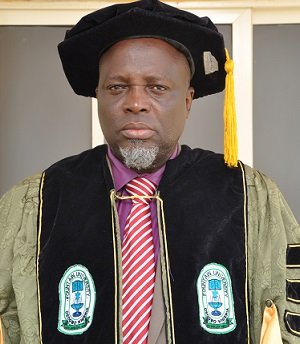
Immediate former JAMB Registrar, Prof Ishaq Oloyede
By Farooq A. Kperogi
I didn’t get a chance to write a retrospective evaluation of Professor Ishaq Oloyede’s tenure as JAMB registrar when most people did after his departure in July because the time of his exit competed with more pressing national discourses that invited my intervention. But I have always been haunted by a gnawing guilt that I haven’t shared my own assessment of a man who, though fallible like the rest of us, transformed a consequential educational institution in remarkable ways.
I have met Professor Oloyede only once in my life, and it was at the Ilorin airport in 2023 when I visited Nigeria for the first time in seven years for the formal presentation of a book that I co-wrote with colleagues Prof. Moses Ochonu and Dr. Osmund Agbo.
While waiting for my delayed Lagos flight, I saw someone who looked distinctly like him. Because I had heard several great things about him from mutual friends, I summoned the courage to go and say hello to him. I was shocked that he knew me. I found him to be a warm, lively, friendly, intellectually alert yet generous and humble person.
People who knew him closely had told me he embodied several curious contraries. He is a profoundly intelligent and innovative person who is nonetheless self-effacing to the point of giving you permission to underestimate him.
And although he had a First Class degree in Arabic and is deeply religious, I was told, he is wary of people who flaunt public displays of religiosity, who pepper their conversations with performative Arabic phrases that they barely understand. He himself keeps it plain and simple when he relates with Muslims outside religious contexts.
In my short interaction with him at the Ilorin airport, I instinctively activated my Arabic vocabularies to punctuate my conversations, knowing that I was speaking with a professor of Arabic and Islamic studies. He didn’t requite my performative zealousness with superior Arabic phraseology, like many people with his Arabic erudition and deep Muslim faith would do. He spoke plain English. Then I recalled what I had heard about his indifference to or even suspicion of such behavior. I quickly adjusted.
That’s why I think the most unfair charge often hurled at him by his detractors is the charge that because of the depth of his Islamic faith and his scholarly investments in Arabic and Islamic studies, he is a Muslim bigot. It isn’t only that he self-consciously chooses not to mix the profane and the divine in everyday contexts even when he relates with fellow Muslims, he takes it as an article of faith to be scrupulously fair to Christians and other people who don’t share his faith.’
There are probably people who will attribute disadvantages they suffered from him to their faith. I don’t know. Being humans, all kinds of things are possible, but people who know him intimately and whose judgment I trust, both in and out of JAMB, tell of a man who is animated by and concerned with justice and fair treatment for all irrespective of faith or other primordial variables, whose passion for making a difference is consuming.
This is the background behind his success at JAMB. When Oloyede assumed leadership of JAMB in 2016, he inherited an organization in which astonishing large amounts of money routinely disappeared into bureaucratic sinkholes. In his first full year, JAMB remitted N7.8 billion to the federal government. The government had expected a remittance of about N500 million. The ICPC later publicly commended the anti-corruption reforms that produced this result.
I initially had a slightly different reaction to JAMB’s newfound capacity to generate billions of naira. I thought there was something morally perverse about an examination body boasting of revenue generated largely from poor young people seeking admission into universities.
In a July 13, 2021, article titled “Why Must Students Take UTME Every Year?” I argued that compelling students to retake UTME every year was “needlessly exploitative.” A student who scores well and fails to secure admission for reasons unrelated to academic competence should, I argued, be able to use the score for at least two years and ideally for up to five years, as is possible with the SAT in the United States. I still stand by that argument.
In fact, the enormous surpluses JAMB began to remit under Oloyede helped make the case that the examination fee itself was too high. The federal government eventually reduced the basic application fee from N5,000 to N3,500 in 2019. Then Education Minister Adamu Adamu explicitly cited the extraordinary rise in JAMB’s remittances as evidence that the agency could charge candidates less and still cover its expenses. Oloyede himself later said a suggestion from the Nigerian Guild of Editors prompted him to formally recommend the reduction.
With time, however, I came to see another dimension to the revenue story. The billions JAMB suddenly started remitting were also an index of the stupendous scale of the leakages that had existed before Oloyede arrived.
The infamous story of the JAMB official in Benue who claimed that a snake had swallowed N36 million illustrates this perfectly. Many Nigerians remember the story as evidence of JAMB’s corruption. The actual story points in the opposite direction. The money disappeared years before Oloyede became registrar. It came to light because he ordered an unusually thorough audit of JAMB’s finances after assuming office. The audit exposed old thefts, led to recoveries and triggered prosecutions. I made this point in my 2023 column on the controversy over Mmesoma Ejikeme’s forged JAMB result.
By the time Oloyede left office, JAMB said it had remitted more than N50 billion in operating surpluses over his decade in office. Before his appointment, the comparable remittances were almost risibly insignificant. Whatever disagreements one may have with specific JAMB policies, the financial transformation is difficult to explain away.
And financial probity was only one part of the story. Oloyede abolished the scratch-card system that had nourished fraud and profiteering and replaced it with electronic PIN vending. His JAMB introduced the Central Admissions Processing System, or CAPS, which made admissions more transparent and gave candidates the ability to track, accept or reject admission offers electronically. CAPS also made it harder for tertiary institutions to conduct admissions completely outside JAMB’s view.
His administration strengthened biometric verification, tightened the accreditation and monitoring of CBT centers and created the JAMB Equal Opportunity Group to make the UTME more accessible to blind candidates and other people with disabilities. These were tangible institutional innovations with consequences for ordinary people.
This is where Oloyede’s record reinforces a point I have repeatedly made about Nigerian institutions. In a March 30, 2019, column titled “INEC as Greatest Danger to Nigeria’s Democracy,” I observed that the weakness of our institutional structures causes government agencies to take on the character and temperaments of the people who head them. Dora Akunyili stamped her energetic vigilance on NAFDAC. Yemi Kale’s analytical rigor gave the National Bureau of Statistics unusual credibility. Attahiru Jega’s personal reputation for integrity rubbed off on INEC.
Oloyede’s JAMB belongs in that tradition. His personal frugality, intolerance of financial opacity, obsessive attention to processes and concern with institutional reputation became attributes people increasingly associated with JAMB itself.
ALSO READ An Analysis of JAMB’s Crisis Communication Efforts
That is simultaneously reassuring and troubling. It is reassuring because it shows what a conscientious leader can do even within the severe constraints of the Nigerian public service. It is troubling because institutions should eventually acquire virtues that survive the people who temporarily lead them. A system whose integrity depends entirely on the moral fiber of one individual remains dangerously vulnerable to regression.
Oloyede’s tenure certainly had its failures. The gravest was the catastrophic 2025 UTME error that compromised the results of 379,997 candidates in 157 centers in Lagos and the Southeast. The scale of the error was horrendous.
I wrote at the time that the disaster deserved outrage while also pointing out that comparable technology failures had disrupted standardized examinations in the United States, Britain and India. JAMB investigated the complaints, acknowledged its error, apologized and organized a resit for the affected candidates. Oloyede accepted responsibility publicly.
We later learned that his first instinct when the scale of the failure became clear was to resign. People around him persuaded him that leaving in the middle of the crisis would amount to abandoning the students whose results had been compromised. He stayed to supervise the remedial process.
For me, that episode revealed as much about him as his successes did. Anyone can bask in the reflected glory of institutional success. Character becomes more legible in moments of humiliating failure. Oloyede did what Nigerian public officials almost never do: he admitted that his institution had grievously failed, apologized without hiding behind a committee and took personal responsibility for an error he did not personally cause.
Professor Segun Aina, a professor of computer engineering and systems expert, succeeded Oloyede on July 31. Aina has said that protecting JAMB’s integrity will be a central priority of his tenure. That is a promising starting point.
My hope is that he will build on Oloyede’s achievements, correct the flaws that became apparent during his tenure and institutionalize the habits of transparency and accountability so deeply that they cease to depend on who occupies the registrar’s office.
Farooq Kperogi
Farooq Adamu Kperogi is a Nigerian-American professor, author, media scholar, newspaper columnist, blogger and activist. He was a reporter and news editor at many Nigerian newspapers including the Daily Trust, Daily Triumph and the now defunct New Nigerian.