Osogbo, the Osun State capital, on Tuesday, witnessed massive deployment of security personnel as the state entered the final days ahead of Saturday’s governorship election.
This was just as Inspector-General of Police (IGP), Tunji Disu, deployed Mr Ishyaku Mohammed, a Deputy Inspector-General of Police (DIG), to coordinate security operation for the election.
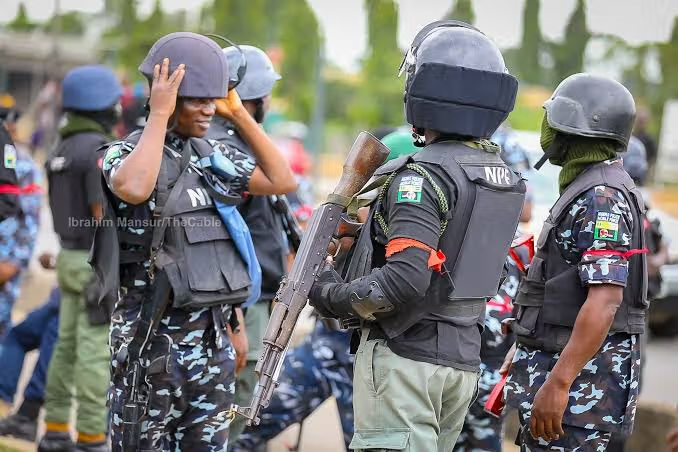
Across major roads, streets and strategic locations, soldiers, conventional policemen, Police Mobile Force personnel, Nigeria Security and Civil Defence Corps (NSCDC) operatives, and other security personnel maintained a visible presence.
The heightened security came amid preparations for the election, with sensitive electoral materials already in the state and authorities seeking to prevent violence, intimidation, disruption of voting and other forms of electoral malpractice.
No fewer than 25,310 security personnel have been officially deployed across the state, comprising 15,000 personnel of the Nigeria Police Force, 10,210 NSCDC personnel, and about 100 officers of the Economic and Financial Crimes Commission (EFCC).
The personnel are expected to cover the state’s 30 local government areas, with deployments at polling units, registration area centres, collation centres, critical infrastructure, electoral facilities and other strategic locations.
In Osogbo, the security presence was particularly noticeable, with patrol teams and security vehicles moving through major parts of the metropolis, while officers were stationed at strategic locations.
The security operation also extended to the state headquarters of the Independent National Electoral Commission (INEC), where military personnel have taken over security duties following the arrival of sensitive electoral materials, including ballot papers and BVAS devices.
Military vehicles and other security patrol vehicles were also seen around sensitive government and electoral facilities as preparations intensified for the movement of materials to local government offices and registration area centres.
The NSCDC deployment constituted one of the largest components of the operation, with more than 10,000 personnel mobilised from 10 neighbouring state commands, including Oyo, Ondo, Ekiti, Ogun, Lagos, Kwara, Edo, Kogi, Delta and the Federal Capital Territory (FCT).
The corps said both uniformed and undercover personnel had been deployed, alongside specialised formations, including the Commandant-General’s Special Intelligence Squad, Special Weapons and Tactics Unit, Specialised Female Squad, Mining Marshals, Special Strike Force, Crack Squad and K9 Unit.
The police, which have the largest single deployment, have also spread personnel across the state, with conventional, mobile and tactical formations assigned to polling locations and other vulnerable areas.
The EFCC has deployed personnel to monitor and respond to vote buying, financial inducement and other financial crimes that could undermine the credibility of the election.
The security agencies are expected to operate under an inter-agency framework, coordinating their activities throughout the election period.
The NSCDC Commandant-General, Professor Ahmed Audi, directed personnel to remain professional, neutral and respectful of citizens’ rights.
The deployment of Mohammed was contained in a statement on Wednesday, in Abuja, by the Force Public Relations Officer (FPRO), CSP Ani Iniedu.
Disu said the deployment was part of operational measures of the police to ensure a peaceful, secure, and credible electoral process in the state.
“The DIG will coordinate the police component of the election-security arrangement and work closely with other security agencies under the Inter-Agency Consultative Committee on Election Security (ICCES).
“He will be supported by Assistant Inspectors-General of Police and Commissioners of Police strategically deployed across the three senatorial districts of the state.
“The senior police officers will supervise operations, strengthen intelligence-led policing, and ensure prompt response to emerging threats,” he said.
The IGP added that the Force had put adequate security arrangements in place to protect the voters, INEC personnel, election materials, polling units, collation centres, accredited observers, and media practitioners before, during, and after the election.
Tribune