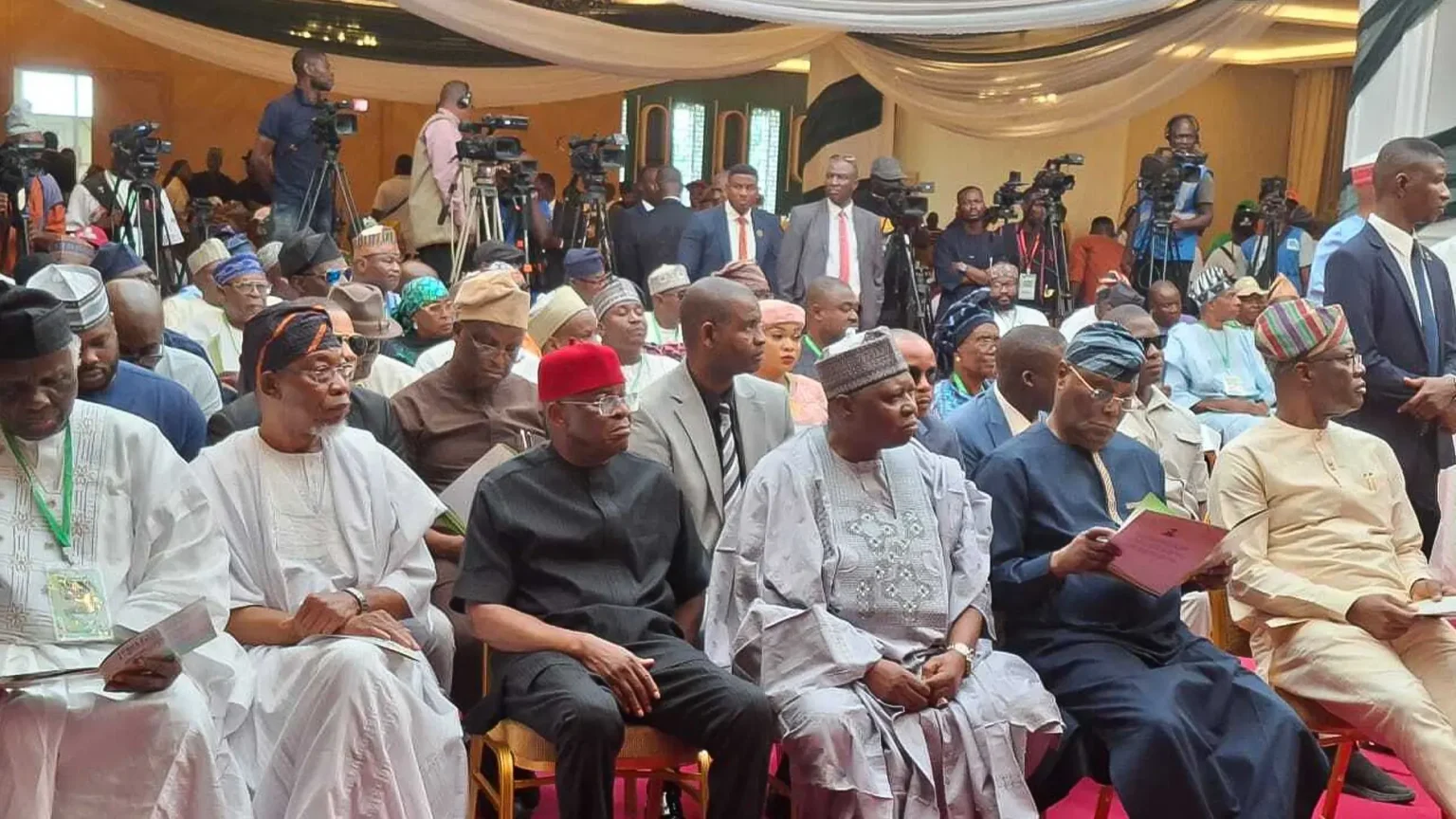
Prof. Jerry Gana, Secretary of ADC, Rauf Aregbesola; National Chairman of ADC, Sen. David Mark; former Vice President Atiku Abubakar and Governor Seyi Makinde of Oyo State during the National Summit of Opposition Political Party Leaders hosted by Governor Makinde in Ibadan
With less than seven months to the 2027 presidential election, Nigerians hoping for a formidable challenger to President Bola Tinubu and the ruling All Progressives Congress (APC) are instead watching an increasingly divided opposition.
Already, 22 registered parties have entered the race and 11 presidential candidates have emerged, signalling another potentially fragmented contest.
The fractures represent a dramatic reversal from the mood at the 2025 political summit organised by Governor Seyi Makinde, where opposition leaders projected unity and promised Nigerians a single platform against the APC.
Meanwhile, for many Nigerians, the growing divisions within opposition parties ahead of the 2027 election have reinforced doubts about whether politicians are more interested in power struggles than addressing the country’s worsening economic and security challenges.
A lecturer in the Department of Marketing at the University of Port Harcourt, Dr Lawrence Bekwele, lamented what he described as a growing disconnect between political leaders and ordinary Nigerians, arguing that many politicians appear more concerned with personal and political interests than the welfare of the people.
The coalition African Democratic Congress (ADC) has produced three rival presidential candidates, while the major opposition Peoples Democratic Party (PDP), Social Democratic Party (SDP) and Labour Party (LP) have each produced two. Only the African Action Congress (AAC) has settled for a sole candidate, Omoyele Sowore.
Oyo State Governor, Seyi Makinde, is pursuing his own presidential ambition on the platform of the Allied Peoples Movement (APM), while Gbenga Olawepo-Hashim, once an advocate of a united opposition front against Tinubu, has emerged as the presidential candidate of the Accord Party.
The People’s Redemption Party (PRP) has also nominated former Cross River State Governor Donald Duke as its presidential flagbearer for the 2027 poll.
The growing list of contenders reveals a fragmented opposition confronting an incumbent seeking re-election, a far cry from the optimism generated in 2025 when political stakeholders gathered under the ADC coalition with the stated objective of wresting power from Tinubu and the APC.
The divisions within the PDP, ADC, SDP and LP underscore deep cracks that could significantly influence the outcome of the presidential race.
The ruling APC has named President Tinubu as its sole flagbearer, while the Nyesom Wike-backed faction of the PDP has announced Senator Sandy Onor as its presidential candidate, and the Kabiru Turaki-led faction has offered its presidential ticket to former President Goodluck Jonathan.
The situation appears even more complicated within the ADC. The faction led by former Senate President David Mark has announced former Vice-President Atiku Abubakar as its presidential candidate.
Atiku, a long-time PDP stalwart, is a serial presidential contender who flew the party’s flag in both the 2019 and 2023 elections.
However, Dumebi Kachikwu has emerged as the presidential candidate of another ADC faction. At the same time, a separate faction led by the party’s acclaimed National Chairman, Bala Gombe, has announced Prof Chris Uba as its sole presidential candidate.
Following Atiku’s emergence from the Mark-led faction, a prominent party member and former Secretary to the Government of the Federation (SGF), Babachir Lawal, resigned from the ADC, alleging that the primary election that produced Atiku was manipulated.
Meanwhile, Atiku has reportedly been shuttling between Abuja and Lagos in a bid to reconcile with his defeated rivals in the primary, former Rivers State Governor Rotimi Amaechi and businessman Mohammed Hayatu-Deen.
On the SDP platform, businessman Adewole Adebayo has secured one faction’s presidential ticket, while the faction led by Shehu Gabam has announced Abimbola Akeem Atanda as its presidential flagbearer.
Beyond the emergence of rival presidential candidates and the fragmentation of opposition parties, several of the major parties are also embroiled in legal battles over their leadership structures. Rival factions continue to contest control of party machinery and legitimacy.
The PDP is facing litigation over its leadership and convention decisions, particularly disputes surrounding the office of the National Secretary and the legitimacy of some party organs.
The Labour Party remains entangled in a prolonged leadership tussle involving rival executives, a crisis that has weakened party cohesion since the 2023 elections.
Similarly, the SDP is grappling with disputes over party administration and the recognition of some executives, while the National Democratic Congress (NDC) has faced legal battles over its registration, recognition, and internal administration.
These pending court cases could have far-reaching implications for the 2027 elections. Beyond exposing deep divisions within the opposition, adverse rulings could further complicate candidate nominations, weaken party structures and create uncertainty over legitimate leadership.
With less than a year before the election season gathers momentum, the legal distractions threaten to undermine coalition efforts, erode voter confidence and ultimately benefit the ruling APC if opposition parties remain consumed by internal battles rather than presenting a coherent and credible alternative to Nigerians.
Opposition divisions fuel voter concerns over 2027 leadership
FOR many Nigerians, the deepening divisions within opposition parties ahead of the 2027 election have heightened concerns about whether the political class is focused on governance or personal ambition, as citizens continue to grapple with economic hardship and insecurity across the country.
Respondents who spoke with The Guardian identified economic recovery, improved security, stable electricity supply, job creation and accountable leadership as the key expectations from whoever emerges as president in 2027.
A lecturer in the Department of Marketing at the University of Port Harcourt, Dr Lawrence Bekwele, said Nigerians need a president who prioritises public interest and remains responsive to the needs of the people.
Bekwele noted that government policies should be designed to address citizens’ concerns and inspire confidence, particularly among grassroots citizens.
He lamented what he described as a growing disconnect between political leaders and ordinary Nigerians, arguing that many politicians appear more concerned with personal and political interests than the welfare of the people.
Similarly, a trader at Mile 3 Market in Port Harcourt, Mrs Elizabeth Amadi, said Nigerians need a president who understands the suffering of ordinary citizens and is committed to addressing their challenges.
According to her, many Nigerians are struggling under harsh economic conditions, with rising food prices and transportation costs making life increasingly difficult.
“There is hunger in the land. We are suffering. The prices of goods have gone up, transportation costs are high, yet the government keeps making promises without corresponding action. We are tired of the situation.
“We need a president who is people-oriented, who can genuinely feel the pain of the masses and take deliberate steps to improve their living conditions, not leaders who think only about themselves and their families,” she said.
In Lagos, a Mushin-based trader, Adeleke Adebayo, said his expectations for the next president centre on urgent improvements in electricity supply, security and the cost of living.
“I expect a president who can fix the basic things. Electricity, security and the cost of living are the biggest problems for people like us. If those three are not improved, everything else is secondary,” he said.
Reflecting on developments over the past three years, Adebayo expressed concern over rising inflation and insecurity, noting that business conditions have become increasingly unstable.
“The rise in prices worries me most. Food, transport, everything keeps going up. Even small profits in business are no longer stable. Also, insecurity — you hear disturbing stories every week,” he said.
Also speaking, a private school teacher in Yaba, Yusuf Zainab, said she expects greater accountability and structured economic planning from the next administration, particularly policies aimed at addressing youth unemployment and promoting national development.
“I expect more accountability and real economic planning. The country needs direction, especially for young people trying to build careers,” she said.
Zainab called for a president who demonstrates transparency and competence in governance.
She noted that unemployment and uncertainty remain her greatest concerns, particularly among young graduates.
Regarding the quality of individuals seeking the presidency, she expressed concern about what she described as the recycling of political actors.
“It is still too early, but from what we have seen before, it often feels like recycling. I hope new voices with fresh ideas also emerge,” she said.
An Ibadan-based artist, Prince Tunde Odunlade, stressed that protecting lives and property should remain the foremost responsibility of any government.
“That is the first assignment of any president. Only after securing lives and property can we begin to talk about welfare.
“We need a president who will provide relevant education and promote human development. The devil you know is better than the angel you have not seen.
“From time immemorial, we have been postponing the evil day. A lot happened under previous presidents. The kind of system that runs our society should change. Our problems go beyond the last three years,” he said.
IBADAN resident, David Fatobi, threw his weight behind Peter Obi.
“I am not happy with all the people contesting, but Peter Obi is my man. We want a president who will work and have empathy,” he said.
Similarly, Ibrahim Abiodun Adelabu said Nigeria needs a president who will guarantee security and improve economic conditions.
“Security is very important. Second, the hike in petroleum product prices is affecting every aspect of our lives. Third, electricity is very important. We need it to power our small businesses,” he said.
On his part, Mr. Wole Ayoola said Nigerians need a leader capable of introducing alternative policies and fulfilling campaign promises.
“He should build on what is already on the ground and deliver on his commitments to the people,” he said.
In Ado Ekiti, Kolapo Olusola said he wants a president who will provide good roads, quality healthcare, lower fuel prices and deliver results rather than promises.
According to him, salary earners can hardly survive when a bag of rice sells for about N80,000 while the prices of other commodities continue to soar.
He said the next president should stabilise the naira and reduce food prices within the first year in office.
Also, a pastor and civil servant residing in Ado Ekiti, Dr. Dickson Ibitoye, argued that without adequate security, development would remain a mirage.
“Farmers want to return to their farms without paying bandits. Students want to travel without fear of being kidnapped on their way to school,” he said.
Ibitoye described the country’s youth unemployment rate as unacceptable and said it cannot be solved through temporary interventions.
“I expect real investment in SMEs, manufacturing and technology sectors that create sustainable jobs and pay salaries regularly.
“If we are still experiencing only four hours of electricity daily by 2027, then such a government does not deserve a second chance. People expect the power and subsidy reforms to actually work by then,” he added.
Speaking on the type of leadership Nigeria requires, a lecturer at the Federal University Oye-Ekiti (FUOYE), Dr. Wole Balogun, said he expects a competent and charismatic leader with a deep understanding of the nation’s challenges.
“Our incoming president must be economically sound. He should understand why an exchange rate of about N1,300 to the dollar is hurting Nigerians and be able to explain how to fix it without delay,” he said.
A foodstuff trader in Osogbo, Osun State, Richard Akintomiwa, said he wants a president who will focus on citizens’ welfare through policies capable of addressing the prevailing hardship.
Similarly, a teacher, Mrs Eunice Ogundele, said whoever emerges president in 2027 must tackle insecurity, especially kidnapping, terrorism and other criminal activities that have created fear across the country.
“Our economy is sick. We want a president who will restore the hope of the masses in a safe and secure environment,” she said.
In Ondo State, fashion designer James Lumure called for a transparent electoral process that reflects the genuine will of the people while demanding a leader capable of addressing Nigeria’s foundational challenges.
Lumure urged Nigerians to assess presidential aspirants based on competence, track records and concrete manifestos rather than party affiliation or ethnic considerations.
“I expect the authorities to ensure a free and fair election where every vote counts and the choice of the people emerges as president.
“I want a president who will tackle insecurity, prioritise electricity generation and support SMEs so that Nigeria can become a productive economy rather than one that imports nearly everything it consumes,” he said.
Also, a secondary school teacher, Oluremi Ogungbemi, identified insecurity, hunger and the decline in the education and health sectors as some of the most troubling developments in recent years.
She lamented that innocent lives continue to be lost while many citizens struggle to make ends meet, stressing that the next president must place the welfare and security of Nigerians at the centre of governance.
The Guardian