

By Olusola Adeyegbe
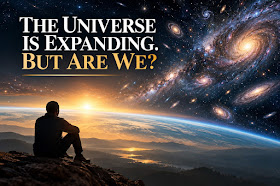
For centuries, humanity gazed into the heavens believing that the universe was an immense but essentially unchanging arrangement of stars and galaxies. Then came a discovery that shattered that picture: the universe itself was expanding. In 1929, the American astronomer Edwin Hubble published compelling observational evidence that distant galaxies were receding from one another as space expanded. The cosmos was not a motionless structure. It was dynamic, evolving and growing on a scale almost beyond human comprehension. And in 1998, astronomers made an even more astonishing discovery: the expansion was accelerating. Nearly a century after Hubble’s findings, the forces shaping the universe’s evolution remain among science’s deepest mysteries.
Yet there is another perspective on expansion that deserves thoughtful consideration. In In the Light of Truth, the Grail Message written by Abd-ru-shin, Creation is presented not as a finished, motionless structure but as an unfolding reality governed by immutable Laws. In his lecture Submission, Abd-ru-shin declares: “Creation originated only in the Will of God, in His Laws.” He describes the continuous movement and development arising through the operation of these Laws, referring also to “the further expansion of Creation.” These words invite reflection, particularly because the Grail Message began emerging during the same historical period in which modern cosmology was undergoing its transformation.
The Grail Message presents Creation in its fullest and most comprehensive sense, encompassing both the visible material universe and the invisible realms beyond it. In this understanding, the vast cosmos revealed by astronomy constitutes only a portion of an immeasurably greater Creation. These different realms, though distinct in their nature and constitution, are governed by the immutable Laws arising from the Will of God. Creation is therefore neither static nor confined to what our physical senses can perceive. It is a living, ordered and continually unfolding reality, whose immensity challenges the limits of human perception and invites deeper reflection upon existence itself.
Humanity has developed extraordinary instruments for examining the universe, detected gravitational waves and traced cosmic history across billions of years. Yet has our understanding of ourselves advanced with comparable seriousness? Have our discoveries made us more truthful, more just, more compassionate or more conscious of our responsibilities? We have learned to measure phenomena almost unimaginably distant from us, but how carefully do we examine the motives concealed within our own hearts? We celebrate intellectual achievement, as we should, but intelligence and inner maturity are not necessarily the same accomplishment.
There is a danger in mistaking the accumulation of knowledge for the development of character. A person may understand the mechanics of the heavens and remain governed by envy, vanity or selfishness. A civilisation may possess astonishing technological power yet lack the moral discipline to exercise it wisely. Knowledge increases what we are capable of doing; spiritual development must address what we ought to do, why we do it and what our actions make of us. The more powerful humanity becomes, the more consequential this distinction grows.
The expanding universe should awaken wonder at the grandeur of physical existence. The Grail Message invites contemplation of a Creation greater still, ordered by Laws that also concern our personal conduct. Perhaps the greatest challenge confronting humanity is not simply to discover how far existence extends, but to discover whether we are growing inwardly worthy of our place within it.
The universe is expanding without our permission or effort. But the expansion of our consciousness demands something of us. As Creation unfolds in its grandeur, are we ourselves becoming greater in truth, justice and love, or merely growing more knowledgeable about a universe whose deepest lessons we have yet to learn?


