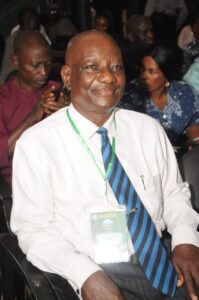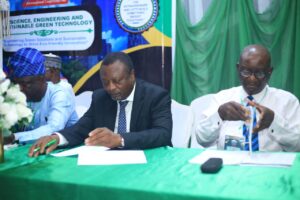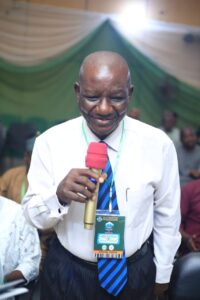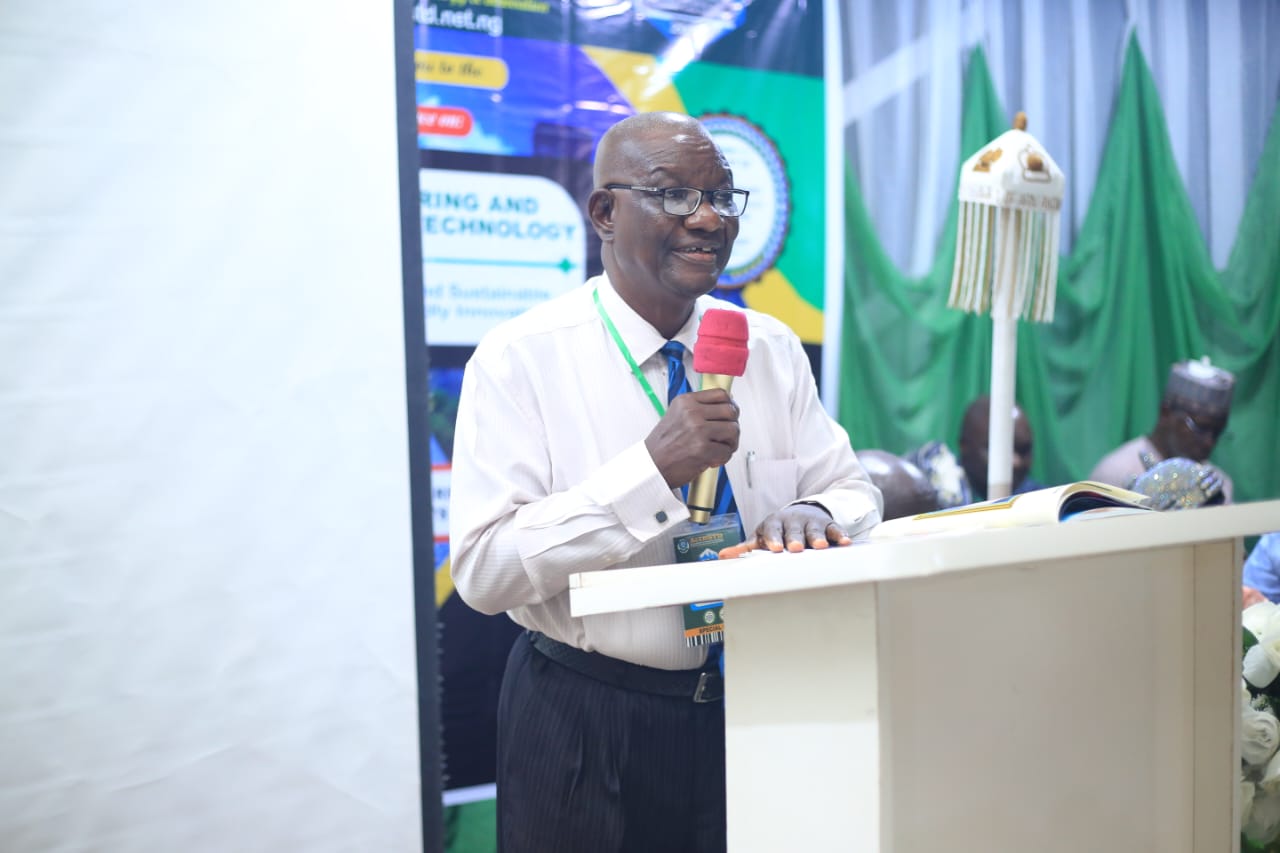
The Special Assistant to the Minister of Regional Development, Engineer Abubakar Momoh on Southwest/Southeast Regions, Chief Wole Iroaye, delivering the Minister’s Keynote Address on behalf of his Boss on Thursday in Abuja at the International Conference on Science, Engineering and Sustainable Green Technology
By Banji Ayoola
The Minister of Regional Development, Engineer Abubakar Momoh has identified foundation pillars for a new Nigeria being envisioned.
He said that the nation’s planned future will be built on innovating responsibly, truthfully, and genuinely today rather than consuming the resources of tomorrow now.
Momoh spoke on Thursday in Abuja at the International Conference on Science, Engineering and Sustainable Green Technology, themed: “Advancing Green Innovations for a Sustainable Future,” and organised by the Academy of Innovative Research, Science and Technological Development.
It was a gathering of reputable national and international scholars and the cream of the academic society, including vice chancellors, deputy vice chancellors, professors, doctors, engineers, and scientists, who have distinguished themselves in their various fields.
The minister, who was represented at the occasion by his Special Assistant on Southwest/Southeast Regions, Chief Wole Iroaye, described the suggested terms forming the foundation of the new Nigeria being envisioned as the key message of the confluence, which he said captures the urgency of the confab’s theme.
He noted that when nations are confronted with interlinked challenges, which include climate change, environmental degradation, energy insecurity, unemployment, food insecurity, and the growing demand for sustainable infrastructure.
Momoh stressed that these diverse challenges require more than conventional approaches, and demand scientific creativity, engineering excellence, technological innovation, and responsible leadership.
He said, “For us in Nigeria, green innovation transcends a mere environmental necessity. It is an economic opportunity, a development strategy, and an investment which will result in the future development of our people.
On green innovation, he said this “revolves around our efforts to develop and apply technologies, products, services and systems that promote economic progress while mitigating environmental harm and protecting natural resources.
“This includes but is not limited to renewable energy, energy-efficient buildings, sustainable agriculture, waste recycling, clean transportation, water conservation, climate-resilient infrastructure, and environmentally responsible industrial production.
“On the other hand, the true value of innovation is not measured only by the sophistication of an invention. It is measured by its ability to solve real-life problems, improve human lives, provide decent employment, and engender lasting benefits to society.”
Citing instances, Momoh said that, “A solar-powered community is not simply a technological achievement; it presents an opportunity for children to study after sunset, small businesses to thrive more efficiently, and health facilities to provide more reliable efficient and effective services.
“A modern waste-recycling system goes beyond a mere environmental intervention; it helps to create jobs, support small enterprises, reduce pollution, and turn discarded materials into valuable economic resources.
“Similarly, climate-smart agriculture helps farmers to improve productivity; conserves water, reduces avoidable losses, and strengthens food security, thereby growing and developing the economy.”
According to him, “this is the kind of innovation Nigeria needs at this critical time of our nation-building: innovation that transitions from the laboratory to the market place, from research establishments to our communities, and from promising ideas to measurable improvements in people’s quality of lives.”
On the core roles of regional development in fostering green innovation, the minister said, “As minister of regional development, Momoh said that he attaches a great importance to the confab because Nigeria’s Development challenges and opportunities are neither identical nor the same across all regions of our country.
He said that each region possesses unique geographical features, natural resources, agricultural strengths, human capital, cultural assets, and economic opportunities distinctions that should not divide the Nigerian people, but should be sources of strength for complementary development.
He said that the ministry’s task is to harness these regional strengths through strategic planning, appropriate technology, infrastructure development, and effective collaboration.
In Momoh”s words, “In areas with strong solar potential, renewable energy can support rural enterprises, such as SMEs, healthcare facilities, educational establishments, and agro-processing centres.
“In agricultural communities, green technology can bring about improvement in irrigation, storage, processing, and transportation while helping farmers preserve more of the value they create.”
He said, “In urban and industrial centres, energy-efficient buildings, cleaner transport systems, and effective waste management can be employed to improve productivity and environmental planning.”
He said, “In communities facing erosion, flooding, desertification, and other environmental strains, scientific research and engineering innovation can support more resilient infrastructure and better-informed development planning.
“The Ministry of Regional Development acknowledges the importance of addressing regional disparities and unlocking the economic potential of our communities.
“It is for this reason that we must envision a country in which no region is left behind, no community’s potential is wasted and no technological breakthrough lies beyond the reach of the people who need it the most.
“Green innovation must, therefore, be inclusive. Its benefits should be extended to major cities and established industries to rural communities’ small businesses, farmers, artisans, women, and young people. “
On the nexus between science, engineering and the green economy, Momoh said, “it is correct to to say that: Science generates knowledge, Engineering converts knowledge into practical solutions, and Technology makes it possible for those solutions to reach society on a grand scale.”
According to him, “these critical specialities must work together if Nigeria is to build a competitive, thriving and sustainable green economy.
“Not only that, our academic community and research institutes must be encouraged to offer solutions that respond directly to Nigeria’s Development Priorities.
“Our engineers must come up with technologies that are reliable, affordable, and suitable for local demands.
“Our industries must invest in cleaner production methods. Our governments at all levels must provide an enabling environment through appropriate policies, infrastructure, standards and incentives.
“Equally important is the strengthening of the relationship between research institutions and private sector. Distinctive innovations should not remain indefinitely in academic publications or conference presentations.
“They must be tested, financed, commercialized and made accessible to the public to grow the economy by serving the neglected, low-end, or completely unserved market with a simpler or cheaper option.”
He urged the AcIRSTD to promote partnerships among researchers, government institutions, investors, entrepreneurs, and communities.
His words, “It is expected that such partnerships will not only help to transform scientific discoveries into viable enterprises but also attract investments, develop local manufacturing capacity and create meaningful employment.
“In the same vein, we must invest adequately in technical education and skills development so that our young people can participate in emerging green industries, such as renewable energy, environmental engineering, sustainable construction, and resource recovery.
“Nigeria must desist from being merely a consumer of green technologies developed elsewhere. It must develop the knowledge, skills enterprises, and industrial capacity to design, produce and export solutions of our own.”
Noting that conferences are important because they have the capacity to bring together knowledge, experience, and fresh perspectives. he said the real test of a successful conference is what happens after the delegates have dispersed.
His therefore proposed five practical priorities saying:
“We must work assiduously to strengthen research and innovation. We must scale up support for research and development, encourage and ensure locally relevant inventions, and create opportunities for promising technologies to be tested and improved.
“We must prioritize promotion of green investment. Governments at all levels, financial institutions, development partners, and private investors should collaborate to mobilise funding for viable renewable energy, sustainable infrastructure, clean technology, and environmental restoration projects.
“There must be an urgent need to empower young innovators and local enterprises. We should create pathways for young scientists, engineers, technology entrepreneurs, and small businesses to have access to mentorship, technical facilities, finance and markets.
“In our plans, we must integrate sustainability into regional development. Emerging infrastructure and economic project should be designed with due consideration for environmental impact, climate resilience, resource efficiency, and long-term community benefits.
“Results must be measured and accountability demanded. Green initiatives should have clear targets for employment creation, energy access, reduction of emissions, recovery of waste, environmental protection, and improved livelihoods. In addition, progress must be assessed against evidence, not merely promises.”
He said, “These priorities will help ensure that green innovation becomes a practical instrument of national development rather than an aspiration confined to policy documents.”:
On call to solidarity, the minister said ‘This is a critical way to invite people to act as a unified front.
“Today, it is true that the responsibility for building a sustainable future does not rest with governments at all levels alone. There is a need for a united front.
“Therefore, Scientists must continue to expand the boundaries of knowledge. Engineers must convert ideas into workable solutions. Universities must get ready a new generation of innovators. The Private Sector must contribute to it boldly and responsibly. Financial institutions must support viable green enterprises. Communities must participate in decisions that affect their environments and livelihoods. Governments at all levels must provide directions, coordination and enabling policy environments.”
He noted that environmental sustainability and economic prosperity are not opposing objectives, but when properly employed and pursued, they reinforce each other.
His words, “In this regard, a cleaner environment can support better health. Reliable renewable energy can strengthen businesses. Efficient resource use can bring down production costs. Sustainable agriculture can lead to food security. Green industries can reduce unemployment and unlock new markets.
“As a nation, the opportunity before us is to build an economy that generates prosperity without pointlessly subverting the natural systems on which generations will depend.
“Therefore, it is important we come to the reality that this is not a responsibility we can dilly-dally about. We must remember that the decisions we take today will definitely shape the opportunities available to our future generations.”
The minister left the gathering with three significant thoughts as follows:
“We must invent with purpose, grow with responsibility, and evolve with inclusion.
“Our laboratories must produce solutions for our communities. We must ensure that our Engineering designs strengthen our infrastructure.
Our investments must create sustainable industries, while our regional development strategies must unlock opportunities for every part of Nigeria. “
Momoh said, ‘We must ensure that the success of our green transition be measured not only by the technologies we invent, but also by the lives we are able to improve, the jobs we create, the environment we protect, and the present we secure without compromising the ability of future generations to meet their own needs.
“As a nation, the challenge before us is evident: we must transition from awareness to action, from isolated innovation to strategic collaboration, and from short-term benefits to long-term sustainability.”
He reiterated the ministry’s appreciation for the role of Science, Engineering, and Technology in building a more inclusive, resilient, and prosperous Nigeria.
As one of the takeaways from the conference, he said the participants should remember that “a sustainable future goes beyond something we simply hope for.. It is something we must design, finance, build, and protect together.
He commended the Academy of Innovative Research, Science & Technological Development, Abuja, for convening the important international conference, saying, “I am convinced that our deliberations of today will bring about fresh ideas, meaningful partnerships, and practical recommendations that will amplify Nigeria’s green development aspirations.”
He wished the audience successful deliberations and a phenomenally fruitful conference.
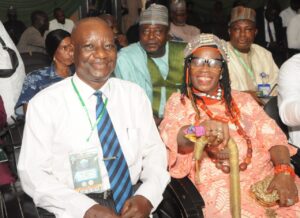
The Minister’s Representative with Emeritus Professor Queen V.H.A.A. Adeyeye, Chairman, Governing Council, The Academy of Innovative Research, Science & Technological Development, AcIRSTD, Abuja.
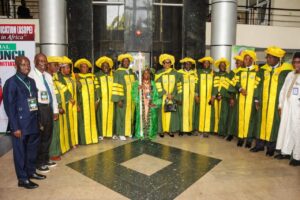
The first newly inducted Fellows of the Academy with the Ministers’ Representatives.
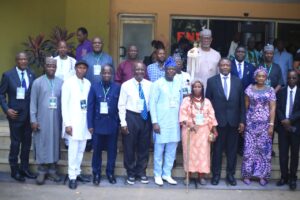
Standing 6th from left, front row, is Professor Olusegun Omoniyi Ige, President, AcIRSTD/ Director General, NGSA.