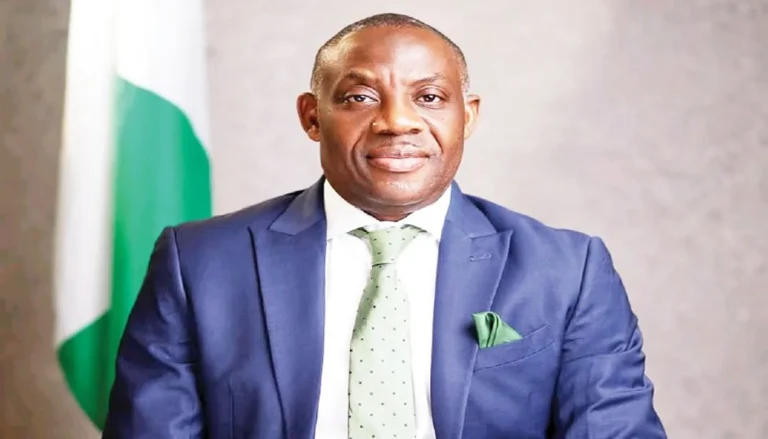
Education minister, Tunji Alausa
By Kolade Adeniyi
decision to phase out the policy separating junior secondary schools from senior secondary schools deserves genuine credit. The Minister of Education, Dr Tunji Alausa, has been unusually candid about a system that manages roughly 80,000 public primary schools but only about 15,000 junior secondary schools, a mismatch he says has left millions of children stranded between levels, unable to make the transition into senior secondary education.
He is right to call this unacceptable, and right to name administrative self-interest, rather than the interests of the Nigerian child, as part of what has kept the arrangement alive for so long. A government willing to dismantle its own bureaucratic architecture in the name of access is a government worth acknowledging.But as someone who has spent years working alongside educators inside Nigeria’s public school system from fellows who are sitting in classrooms to training teachers, and talking to headteachers about where children actually fall away, I have to ask the harder question: will removing an administrative wall be enough to keep 20 million children from disappearing between primary and secondary school? I don’t believe it will, not on its own. Structural reform can remove a barrier. It cannot, by itself, give a child a reason to stay once they are through the gate.
The evidence points to something more fundamental than administration. National data show that fewer than three in ten Nigerian pupils meet minimum literacy or numeracy standards by Primary 3, and UNICEF estimates that roughly seven in ten primary-age children cannot read with comprehension or solve simple arithmetic. Children who cannot yet read a sentence in Primary 4 rarely thrive by JSS3, no matter how seamless the walk to the senior secondary building becomes. Dropout, in other words, is often the visible end of a problem that began years earlier in the classroom, not at the school gate. These averages also hide deeper regional wounds: government data cited by the Ministry itself put literacy rates in some northern states in the single digits, compared with well over half in parts of the south. A national policy applied evenly across such uneven ground risks improving transition rates on paper while leaving the children furthest behind exactly where they started. If we do not close the foundational literacy and numeracy gap in the early grades, region by region, we will simply relocate where children give up, rather than prevent it.
The second, related piece is teachers. I am extremely passionate about this one. Both how many we have and how well-equipped they are. UBEC’s own data show a shortfall approaching 200,000 teachers at the primary level, against a national pupil-teacher ratio of roughly 1:35, well above the UNESCO benchmark of 1:25. Layered on top of that scarcity is a quality gap: UBEC figures indicate that close to a third of basic education teachers do not meet minimum qualification standards.
Safe schools: FG to strengthen security in vulnerable communities — Coordinator
This is not a call to simply hire more bodies for classrooms. Quantity without capacity building repeats the same failure in a different form. I have seen firsthand, in pre-service teacher training, how much preparation it genuinely takes to walk into a classroom of forty or fifty children and teach a foundational skill well and how thin that preparation often is for teachers already serving in under-resourced public schools. Recruiting to fill vacancies matters, but recruitment alone does not produce a teacher who can diagnose why a ten-year-old still cannot read and correct it.
None of this is an argument against the ministry’s reform. It is an argument for sequencing it correctly. Removing the JSS-SSS wall should sit alongside, not ahead of, sustained investment in early-grade reading and numeracy instruction, which we call Foundational Literacy and Numeracy, and a teacher strategy that addresses both the deficit and the development of those already teaching. Structural fixes are visible and politically satisfying; they photograph well. Foundational learning and teacher capacity are slower, less photogenic, and considerably harder to reverse once neglected.
Nigeria has shown, through this announcement, that it is willing to make bold, even uncomfortable, administrative decisions in service of retention. The ministry’s parallel push to get idle Smart Schools and Bilingual Schools fully staffed and operational is a welcome sign that access is being treated as a systems problem, not a single fix. That same boldness is now needed where it is harder to see in the classroom, in our colleges of education, and in the everyday competence of the teacher standing in front of the child. Anything less risks solving the transition problem while leaving the learning problem, the one actually driving dropout, largely untouched.
Molade Adeniyi is the CEO of Teach for Nigeria
The Punch