

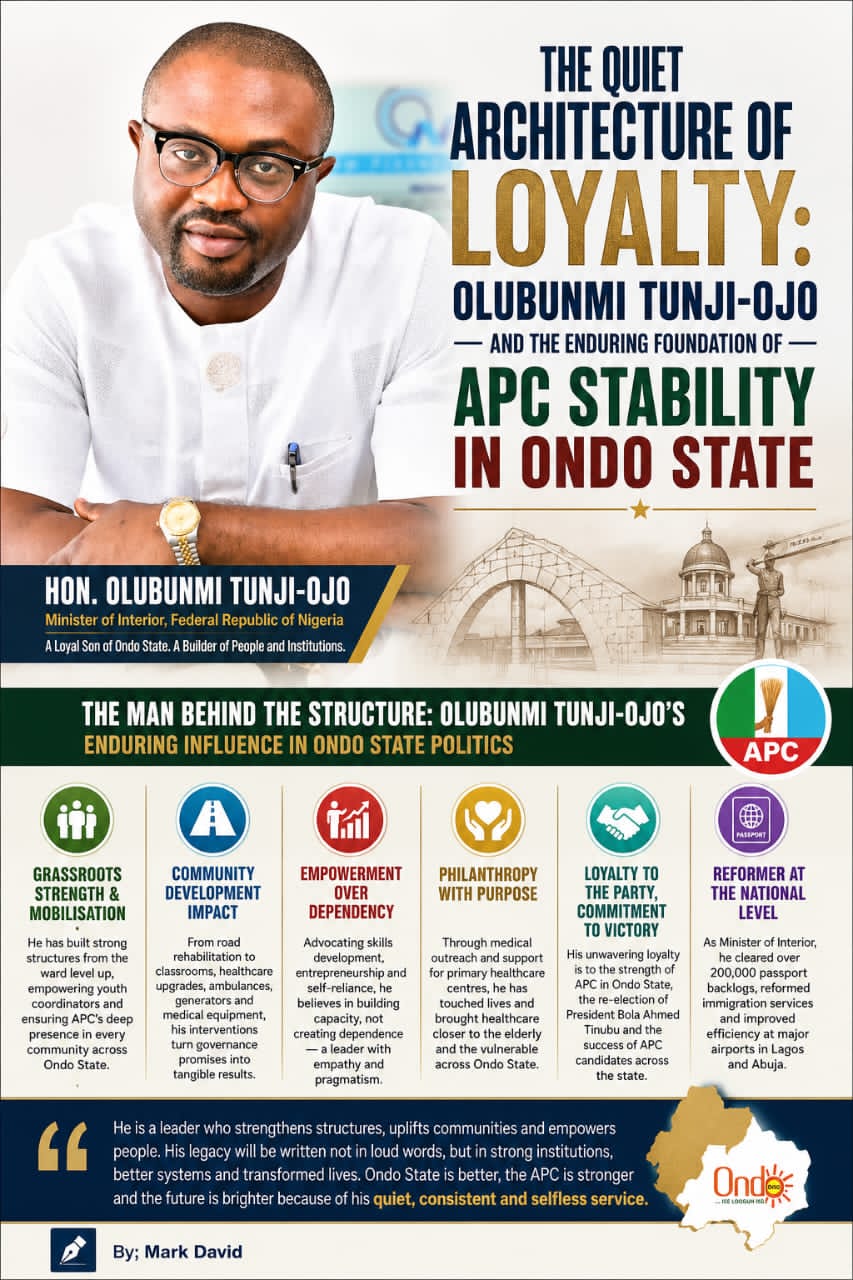
By Mark David
There is a longstanding proverb that states: “The tree that provides shade for the traveller does not ask for payment in the heat of the day.” In the political landscape of Ondo State, few figures reflect this principle as clearly as Hon. Olubunmi Tunji-Ojo (BTO), Nigeria current Minister of Interior, whose contributions to the stability and grassroots strength of the All Progressives Congress (APC) in the state have been quiet, strategic, and enduring.
While others have pursued visibility and electoral contestation, Olubunmi Tunji-Ojo, has focused on the less visible but more demanding task of institutional reinforcement. His sustained support for mobilisation structures across Ondo State has strengthened ward-level organisation, empowered youth coordinators, and ensured that the party maintains deep grassroots presence even during politically challenging periods. He has demonstrated a clear understanding that the strength of a political party is not only reflected in its leadership at the national level, but also in its acceptance and relevance within local communities, markets, and rural settlements. His approach reflects consistent political stewardship aimed at strengthening the party’s foundational structures.
His community development initiatives further reinforce this philosophy. Across various communities in Ondo State, his interventions in infrastructure- ranging from road rehabilitation to the provision of functional classrooms and the upgrading of healthcare facilities with ambulances, generators, and medical equipment- have translated governance objectives into tangible outcomes. These efforts are not driven by personal political competition, but rather complement the developmental agenda of APC-led administrations at both federal and state levels. Tunji-Ojo has consistently positioned himself as a partner in governance, directing personal resources and influence toward initiatives that enhance public welfare and expand access to basic services.
At the core of his approach is the belief that sustainable leadership is rooted in empowerment rather than dependency. He has consistently advocated for skills development, entrepreneurship, and self-reliance as pathways to long-term progress. In a political environment where citizens are often positioned as passive recipients of benefits, he has emphasised capacity building and personal development. This reflects a leadership philosophy that combines empathy with pragmatism, prioritising long-term human development over short-term political gain.
His philanthropic engagements across Ondo State have also been widely acknowledged. Through medical outreach programmes and support for primary healthcare centres, he has contributed to improved access to healthcare services for vulnerable populations, including the elderly. These interventions, which include the provision of medical equipment and operational support, form part of a consistent pattern of community-focused service. Observers frequently note that his contributions are characterised by sincerity and continuity rather than transactional intent. Within the state’s political history, his sustained commitment to social welfare stands out for its consistency and scale.
Importantly, these individual efforts are aligned with a broader political objective. Those familiar with his work recognise that his primary focus is the continued strength and relevance of the APC in Ondo State. His efforts are directed toward ensuring that the party remains associated with development and opportunity, supporting the re-election of President Bola Ahmed Tinubu, and contributing to the electoral success of APC candidates across the state. His political loyalty is consistent and structural rather than episodic.
As Minister of Interior, he has applied the same results-oriented approach to national service. The significant backlog in passport processing, previously exceeding 200,000 applications, was addressed through targeted reforms and largely resolved within a short period. Through process re-engineering, technological improvements, and enhanced operational oversight, passport issuance and immigration services have become more efficient. Improvements have also been recorded at key service points, including major international airports in Lagos and Abuja. These reforms have been widely acknowledged by citizens both within Nigeria and in the diaspora as a marked improvement in service delivery.
His leadership approach reflects a governance philosophy that prioritises accessibility, efficiency, and responsiveness. Like reform-oriented leaders who emphasised the importance of delivering tangible benefits to citizens, he has treated public service as a practical responsibility rather than a symbolic role. His tenure demonstrates that institutional reform is achievable when supported by discipline, innovation, and sustained commitment.
In assessing leadership impact, history often places greater emphasis on outcomes and institutional legacy than on public acclaim. Across Ondo State, his influence is reflected in the voluntary support and recognition he receives from a broad range of political actors. Such support is typically earned through consistency, competence, and demonstrable results. Ultimately, his legacy will be defined not by public rhetoric, but by the strength of the institutions he has supported, the communities that have benefited from his interventions, and the systems he has helped to improve. His approach has been to strengthen governance structures rather than compete with them, thereby contributing to their effectiveness and sustainability.
The work continues, the foundations are strengthened, and the prospects for both party and people remain significantly enhanced by his continued service.


