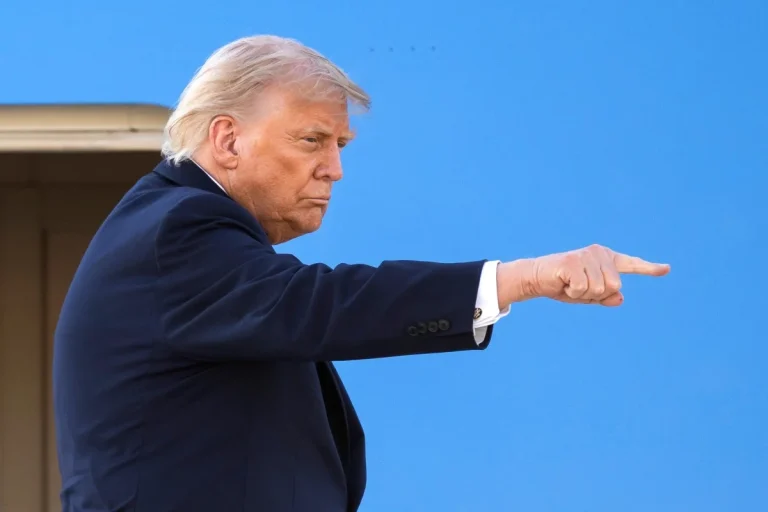
US President Donald Trump gestures as he boards Air Force One at Geneva Airport en route to Versailles after attending the G7 summit, in Geneva on June 17, 2026. (Photo by MARTIAL TREZZINI / POOL / AFP)
Agency Report
Oil prices tumbled on Thursday again after US President Donald Trump and his Iranian counterpart signed off on a deal to end their war and reopen the Strait of Hormuz.
The news boosted optimism for a lasting peace between the two nations after more than three months of war that has rattled energy markets and fuelled a fresh spike in inflation.
However, the upbeat mood on trading floors was tempered by expectations that the US Federal Reserve will hike interest rates before year’s end, after its new boss held his first policy meeting and acknowledged “persistently high prices are a burden for the American people”.
Trump put his signature to the memorandum of understanding in Versailles after a G7 summit, telling reporters: “Just signed it.”
Iranian foreign ministry spokesman Esmaeil Baqaei, quoted by state news agency IRNA, said the document “was finalised with the signatures of the presidents”.
All eyes are now on the strait, through which a fifth of the world’s oil normally passes and which Tehran effectively closed after the United States and Israel launched their war on Iran on February 28.
“As a first step, the Islamic Republic of Iran will instantly reopen the Strait of Hormuz and the United States of America will immediately lift the naval blockade,” Pakistan’s Prime Minister Shehbaz Sharif, whose officials mediated the agreement, said on X.
The deal will see Washington commit to immediately waive oil sanctions and facilitate the release of a $`300 billion reconstruction fund, while Tehran agrees to dilute its enriched uranium as talks on a longer-term agreement are held.
Crude fell more than three per cent Thursday, extending the losses sustained since news broke at the weekend. Both main contracts have plummeted more than 15 per cent since last week, when talk of an agreement began swirling.
“A signed MOU and a faster path toward reopening the Strait of Hormuz should pull some of the panic premium out of crude,” wrote Stephen Innes at SPI Asset Management.
“That matters because oil was not just trading war risk. It was trading the possibility that reserve drawdowns and blocked Gulf flows would create an energy cliff.”
Equities were mixed as they struggled to maintain the positive momentum seen this week.
Seoul was again at the forefront of the gains, surging more than two per cent and ploughing past 9,000 points for the first time thanks to another surge in chip titans Samsung and SK hynix as the AI boom continues apace.
“South Korea supplies around 80 per cent of the world’s memory chips, and artificial intelligence is expected to continue growing for at least another decade,” Kim Dae-jong, a professor at Sejong University, told AFP.
“Semiconductors account for roughly half of South Korea’s industrial output, and this is seen as the biggest reason why Kospi broke through the 9,000-point mark.”
Tokyo finished above 71,000 for the first time, while Singapore, Taipei, Mumbai and Manila also rose.
Hong Kong, Shanghai, Sydney, Wellington, Bangkok and Jakarta fell along with London. Paris and Frankfurt rose.
The mixed performance followed the Fed’s latest policy meeting that saw it hold rates as expected but indicated it could hike in the next six months.
The gathering was the first for new boss Kevin Warsh, who flagged the fact that inflation has been well above the bank’s two per cent target for years but vowed to “deliver price stability”.
“Persistently high prices are a burden for the American people, but the recent past need not be prologue,” he said after the meeting at which he also wanted wide-ranging reforms at the bank.
Warsh was appointed by Trump, who has launched an unprecedented assault on the Fed’s independence and called previous boss Jerome Powell incompetent for not cutting rates enough.
Analysts pointed out that the Fed’s post-meeting statement did not make mention of an easing bias, as it had done previously.
The fact that there was more emphasis on prices rather than jobs was also noted.
Data this month has shown inflation at a three-year high, while the labour market remains healthy.
“While there is no suggestion the Fed’s dual mandate has shifted away from unemployment as well as price stability, markets have been left with a view (that) the emphasis appears to have shifted to the latter for now,” wrote National Australia Bank’s Gavin Friend.
• Key figures around 0810 GMT –
West Texas Intermediate: DOWN 2.4 per cent at `$74.98 a barrel
Brent North Sea Crude: DOWN 2.2 per cent at $`77.83 a barrel
Tokyo – Nikkei 225: UP 1.7 per cent at 71,053.49 (close)
Hong Kong – Hang Seng Index: DOWN 1.6 per cent at 23,924.81 (close)
Shanghai – Composite: DOWN 0.4 per cent at 4,090.48 (close)
London – FTSE 100: DOWN 0.6 per cent at 10,450.60
Euro/dollar: UP at $1.1516 from $1.1494 on Wednesday
Pound/dollar: UP at `$1.3302 from $1.3282
Dollar/yen: DOWN at 160.60 yen from 160.71 yen
Euro/pound: UP at 86.58 pence from 86.53 pence
New York – Dow: DOWN 1.0 per cent at 51,492.55 (close)
AFP