By; Steve Otaloro
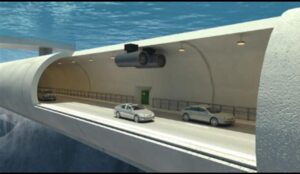
History is often kind only to leaders who dare-leaders, whose ideas stretch beyond the convenience of the present and into the demands of the future. President Bola Ahmed Tinubu has firmly placed himself in this category. His administration’s bold plan to construct Africa’s first underwater vehicular tunnel in Lagos is more than an infrastructure proposal; it is a powerful statement of national ambition, technical confidence, and long-term economic thinking.
At the centre of this vision is a proposed 2.9 to 3.5-kilometre underwater tunnel beneath the Lagos Lagoon, linking Ahmadu Bello Way on Victoria Island to Snake Island and extending toward Badagry. When completed, it will stand as the first major underwater vehicular tunnel on the African continent- an engineering milestone that signals Nigeria’s readiness to execute projects of global complexity.
The strategic logic of the tunnel is as compelling as its symbolism. It is designed to connect two of Nigeria’s most consequential highway projects: the Lagos–Calabar Coastal Highway and the Sokoto–Badagry Superhighway. By bridging these east–west and north–south corridors, the tunnel will significantly reduce pressure on overstretched infrastructure such as Carter Bridge and the Third Mainland Bridge, while enabling smoother movement across Lagos and beyond.
The economic implications are substantial. Improved logistics, reduced travel times, and alternative routes for commuters and commercial traffic will enhance productivity in Lagos and strengthen trade flows from the coast to inland regions. In effect, the tunnel becomes a vital artery in Nigeria’s continental highway network.
Equally noteworthy is the financing strategy. Rather than leaning on external debt, the Tinubu administration has opted for a Public-Private Partnership (PPP) framework, leveraging land assets around Snake Island and Badagry under a Build-Operate-Transfer (BOT) arrangement. This approach reflects fiscal prudence while attracting private capital for public good.
The administration has also emphasized local content and indigenous participation. Procurement policies designed to prioritise Nigerian contractors and expertise, ensuring that this landmark project strengthens domestic capacity rather than exporting opportunity.
The underwater tunnel is one pillar within a broader, coherent infrastructure vision. Flagship projects such as the Lagos–Calabar Coastal Highway (about 700 kilometres), the Sokoto–Badagry Superhighway (over 1,000 kilometres), and the proposed high-speed bullet train connecting major Nigerian cities collectively point to a country repositioning itself for scale, speed, and competitiveness.
To crown this ambitious agenda, the ongoing reconstruction and comprehensive upgrade of the Murtala Muhammed International Airport, Lagos, stands as the icing on the cake. As Nigeria’s principal gateway to the world, the Lagos airport is the first point of contact for visitors, investors, and returning citizens. Its long-overdue transformation under President Tinubu’s watch sends a clear signal: Nigeria is serious about first impressions. A modernised airport experience aligns seamlessly with the broader narrative of renewal- one where infrastructure reflects national dignity, efficiency, and readiness for global engagement.
Infrastructure alone does not transform nations; policy does. Under President Tinubu, sweeping reforms in the financial and energy sectors, alongside new tax laws and structural adjustments, are redefining Nigeria’s economic fundamentals. These reforms have already helped position Nigeria as Africa’s largest economy by Purchasing Power Parity (PPP) ahead of Egypt, South Africa, and Algeria.
The continental outlook is instructive. Africa’s future economic leadership will depend on whether Nigeria converts scale into productivity, South Africa resolves its energy and inequality challenges, and Egypt balances state control with private-sector growth. Judging by the trajectory of reforms and the scale of projects underway, Nigeria under President Tinubu is clearly charting a path toward fulfilling this projection.
There is no denying that subaqueous tunnel construction is complex and capital-intensive, requiring advanced engineering, robust safety systems, and careful environmental mitigation to protect marine ecosystems and coastal communities. While comprehensive feasibility studies and environmental impact assessments are still being finalised, government indications suggest that construction is expected to commence in this year 2026, subject to these safeguards. This measured approach reflects vision tempered by responsibility.
A Word to the Skeptics
President Tinubu’s audacity has not gone without criticism. Yet a timeless proverb offers perspective: one may dislike the drummer, but one cannot deny the rhythm that moves the village. Some may oppose the President for reasons best known to them, notably because he does not come from their region or bear their name- but progress does not wait for personal sentiment.
To dismiss these transformative projects or deny their significance is to ignore evidence of direction and intent. As Nigeria approaches 2027 presidential election, fairness demands that leadership be judged by outcomes, not origin. On infrastructure ambition, economic reform, and strategic clarity, President Bola Ahmed Tinubu is not merely governing- he is laying the foundations of a future Nigerian economic powerhouse.