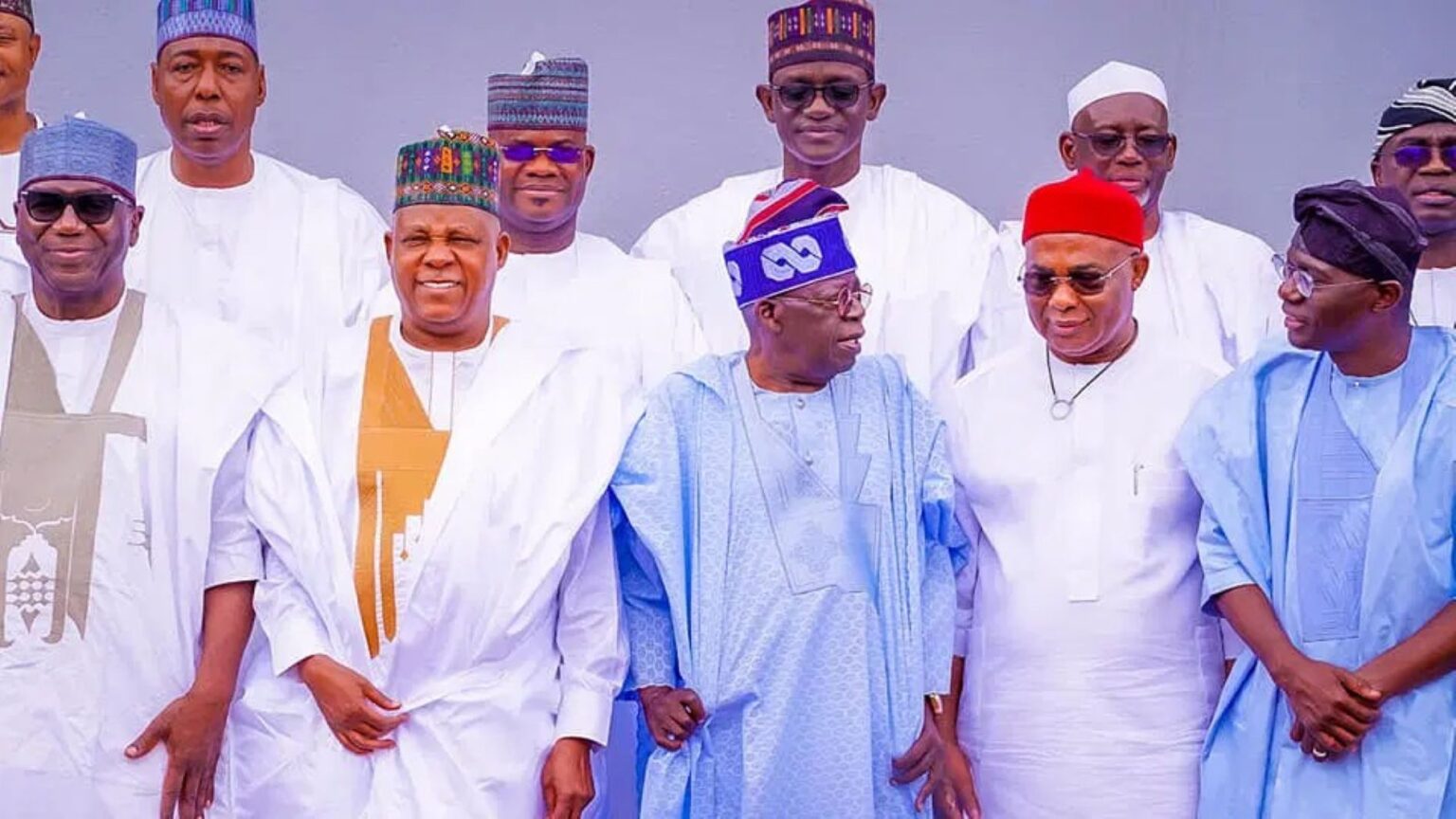
Tinubu with APC governors
• Governors reject alliance that could weaken party, candidates
• Wike insists support for Tinubu ‘sacrosanct’, coalition separate from APC
• Yilwatda raises concern, urges stakeholders to protect party unity
• PDP backs Wike, accuses APC governors of fearing electoral contest
• Tinubu support group urges APC to accommodate Rainbow Coalition
• APC member dismisses feud as manoeuvring among ambitious politicians
• Intersociety alleges political intolerance by six governors
The political alliance being promoted by the Minister of the Federal Capital Territory (FCT), Nyesom Wike, as the “Rainbow Coalition” has triggered a fresh confrontation with governors elected on the platform of the All Progressives Congress (APC), raising questions over the control of the political machinery for President Bola Ahmed Tinubu’s 2027 re-election.
The Progressive Governors’ Forum yesterday distanced itself from the coalition, declaring that its members would not support any political arrangement capable of undermining the President’s re-election, weakening the party or adversely affecting APC candidates at any level.
The development marks an escalation of what initially appeared to be disagreements between Wike and some APC governors. It has now become a wider contest over the relationship between Tinubu’s presidential campaign, the APC’s formal structure and Wike’s cross-party political network.
Advertisement
Wike, however, has rejected the suggestion that his coalition is working against the APC or its governors.
In his latest response, he maintained that his support for Tinubu’s re-election was “sacrosanct” but argued that the Peoples Democratic Party (PDP) remained free to field candidates in other elections. He also insisted that the Rainbow Coalition had nothing to do with the APC.
EFN Non Oil Export
That position has exposed a fundamental contradiction at the heart of the emerging alliance.
While Wike and his allies want politicians across party lines to mobilise support for Tinubu, APC governors insist that their priority must also be the survival and electoral success of the ruling party and its candidates.
Advertisement
The governors’ concern is that politicians could support Tinubu for president while backing candidates from other parties for governorship and legislative seats.
Such an arrangement could produce split-ticket voting and weaken APC candidates, even if Tinubu benefits from the alliance at the presidential level.
This is particularly significant because the presidential and National Assembly elections are scheduled for the same day. APC members have also expressed concern that voters, particularly in rural communities, may not easily distinguish between competing party symbols and candidates when political leaders are simultaneously asking them to support different parties.
For Wike, however, the attraction of the Rainbow Coalition is precisely its ability to transcend party boundaries.
Rather than requiring politicians to defect to the APC, the arrangement allows them to retain their political platforms while working towards a common presidential objective.
Wike has argued that the coalition is aimed at making Tinubu’s re-election possible by bringing together political actors who may have different interests at state level but share a commitment to the President.
The strategy could give Tinubu access to political structures outside the APC, particularly in states where influential opposition politicians retain strong grassroots networks.
But it also creates a potential parallel structure to the APC, which appears to be troubling the governors.
For governors, 2027 is not only about the presidential election. They must protect their control of state structures, secure legislative allies, determine succession arrangements and ensure the election of APC candidates.
A coalition that supports Tinubu but promotes non-APC candidates could therefore help the President while simultaneously weakening governors and the party that controls their states.
Advertisement
The political tension is already visible in several states.
In Kwara, Wike has openly clashed with Governor AbdulRahman AbdulRazaq, while political actors associated with the Rainbow Coalition are positioning themselves against some APC interests. In Rivers, the coalition has generated controversy over the proposed governorship arrangement and choice of candidates. Cross River is also emerging as another battleground involving politicians from different parties.
Rivers State is particularly important because it demonstrates the complexity of the new political arrangement.
Wike remains a PDP member while promoting a coalition that includes politicians from different parties, including APC elements. At the same time, Governor Siminalayi Fubara has aligned with Tinubu and the coalition after the prolonged political crisis between him and Wike.
The question now is whether such alliances can survive when the interests of the coalition conflict with those of the APC.
For Tinubu, the situation presents both an opportunity and a danger.
he Rainbow Coalition could broaden his political base beyond the APC and make it easier for influential politicians in opposition parties to mobilise support for him.
But if the arrangement alienates APC governors or creates competing political structures, it could weaken the very machinery the President needs to deliver votes nationwide.
The APC governors’ position therefore puts the presidency in a delicate position. Tinubu needs Wike’s political network, but he also needs governors who control much of the APC’s state-level machinery.
The emerging battle is consequently less about whether Wike supports Tinubu and more about how that support will be organised and who will control the political structures delivering it.
If the two sides reach an accommodation, the Rainbow Coalition could become an additional pillar of Tinubu’s 2027 campaign.
If they fail, however, the President could face an unusual situation in which politicians campaigning for his re-election are simultaneously competing against APC candidates in other elections.
That could make the coalition a double-edged sword—strengthening Tinubu’s presidential bid while weakening the APC’s wider electoral fortunes.
With the 2027 contest increasingly taking shape, the central question is whether Wike’s Rainbow Coalition will remain an external support structure for Tinubu or become a parallel political machine capable of challenging the APC’s control of the electoral battlefield.
APC national chair expresses concern over confrontation
THE National Chairman of the APC, Nentawe Yilwatda, through his spokesman, Abimbola Tooki, expressed concern over the ongoing confrontation between Wike and some APC governors over the emerging Rainbow Coalition.
Tooki said the party was particularly concerned that the disagreement should not undermine Tinubu’s political prospects ahead of the 2027 general elections.
According to him, while Wike’s activities and political engagements could be viewed as supportive of the President’s re-election bid, the APC would not want the unfolding confrontation to create divisions capable of affecting the party or its governors.
He said the situation was already generating concerns in some states, citing reported disagreements involving governors, including Siminalayi Fubara of Rivers State and AbdulRahman AbdulRazaq of Kwara State.
Tooki said the APC leadership was expected to continue monitoring the developments, stressing that all stakeholders should remain focused on the broader objective of ensuring political stability and strengthening the party ahead of 2027.
He added that the party’s leadership was committed to working towards a common goal and would seek ways of managing emerging disagreements before they escalate into issues capable of affecting the party’s electoral interests.
The spokesman noted that political differences were not unusual, but urged stakeholders to handle them in a manner that would preserve the party’s unity and prevent the current confrontation from distracting the APC from its preparations for the 2027 elections.
PDP backs Wike’s right to support Tinubu, tackles APC govs
THE Peoples Democratic Party (PDP) has described the reported rejection by the Progressive Governors’ Forum of the political support being offered by the Minister of the Federal Capital Territory (FCT), Nyesom Wike, to President Bola Ahmed Tinubu as a sign of growing anxiety within the ruling party ahead of the 2027 elections.
The PDP said the governors should focus on their records in office and the expectations of their constituents rather than attempting to determine whom Wike should support politically.
In a statement yesterday by its National Publicity Secretary, Jungudo Haruna Mohammed, the party said Wike had a constitutional and democratic right to decide whom he would support, adding that his backing of Tinubu did not amount to an endorsement of the All Progressives Congress (APC) or require him to abandon his political identity and relationships within the PDP.
The party said the APC governors initially misconstrued Wike’s support for Tinubu as an endorsement of the ruling party but were now realising that supporting the President did not mean abandoning the PDP or surrendering the political space to the APC.
The PDP described the governors’ reported demand that Wike should neither support nor field candidates capable of challenging them and their preferred candidates in 2027 as a political miscalculation.
“Elections are contests, and every political party has the democratic right to present candidates before the electorate,” the party stated.
It alleged that opposition to Wike’s political support was driven by fears that the performance of the APC governors would face greater scrutiny during the elections.
The PDP said it was particularly curious that governors who claimed to be confident of their achievements were allegedly asking their opponents not to field candidates against them.
“If they have truly performed and retained the confidence of their people, they should welcome a contest and allow the electorate to decide,” the statement added.
The opposition party also claimed that it had stabilised and positioned itself to field candidates across elective positions capable of challenging APC governors and their preferred candidates in 2027.
It said Wike’s political influence could not be wished away, citing his record as former governor of Rivers State and his current role as FCT minister, where it said he had demonstrated capacity for project delivery, political organisation and electoral mobilisation.
The PDP consequently dismissed the suggestion that Wike was a liability to Tinubu’s political project, saying his support could contribute significantly to the President’s electoral prospects.
“The Minister of the FCT is not a liability to President Tinubu’s political project. He is undoubtedly an asset, a mobiliser and a force capable of contributing significantly to electoral victory,” it said.
The PDP also questioned whether the APC governors were genuinely committed to securing Tinubu’s victory in 2027 or were primarily concerned with protecting their own political fortunes.
“A governor who truly wants the President to win should welcome every credible political force capable of contributing to that victory,” the party stated.
It urged the governors to concentrate on governance, accountability and performance rather than attempting to dictate Wike’s political choices.
Group urges APC to accommodate Rainbow Coalition, others
A group, the Asiwaju Tinubu-Shettima Independent Support Movement, has expressed concern over comments by the Chairman of the Progressive Governors’ Forum and Imo State Governor, Hope Uzodimma, distancing APC governors from any coalition or alliance ahead of the 2027 general elections.
The group said the emerging political landscape required broad-based support, strategic partnerships and cooperation among political actors to secure victory for President Bola Tinubu in 2027.
In a statement signed by its spokesperson, Musa Mohammed, yesterday, the group said the APC remained the political platform of the President, but argued that support for his re-election extended beyond the structures of the ruling party.
It cited the Rainbow Coalition movement being championed by FCT Minister, Nyesom Wike, as an example of a political initiative that had openly expressed support for Tinubu.
The group said political support for the President should not be restricted to the formal structures of the APC, arguing that efforts by political actors and support movements outside the party to mobilise support for Tinubu should be encouraged rather than viewed with suspicion.
It said, “Rather than weakening or disowning such alliances, the APC leadership should encourage every genuine effort aimed at expanding the President’s support base and delivering victory for the Renewed Hope agenda in 2027.”
The group further warned that Uzodimma’s comments, if interpreted as a rejection of working relationships with alliance parties and independent support movements, could create divisions within the wider political coalition supporting the President.
“At a time when the President needs every genuine supporter committed to the success of his administration and re-election, the focus should be on building bridges, not erecting political barriers,” it said.
APC member dismisses Wike, opposition feud as political manoeuvring
A member of the APC in Lagos State has dismissed the growing crisis within the opposition Rainbow Coalition, describing the disagreements as evidence of the difficulty of bringing together politicians with competing interests under one political platform.
The party member, who spoke on condition of anonymity because he was not authorised to speak publicly on the matter, said the development should not be interpreted as a threat to Tinubu or the APC ahead of the 2027 elections.
According to him, the coalition’s internal disagreements were predictable, given the political weight and ambitions of the actors involved.
He argued that attempts to build a broad political alliance would inevitably generate disputes over leadership, political structures, candidate selection and the distribution of positions.
The APC member said the development should therefore be viewed within the context of the intense political calculations already under way ahead of 2027.
He maintained that Tinubu and the APC would be better served by concentrating on governance and strengthening the party’s structures rather than becoming distracted by disagreements within the opposition camp.
The source said the coalition’s difficulties also underscored the challenge of sustaining an alliance built primarily around opposition to an incumbent.
He added that differences among the coalition partners could become more pronounced as the 2027 elections draw closer and individual political interests become clearer.
Group alleges govs’ intolerance threatens 2027 elections
A civil rights group, International Society for Civil Liberties and Rule of Law (Intersociety), has accused six state governors of political intolerance and actions it said could undermine democracy and restrict civic space ahead of the 2027 general elections.
The group alleged that Governors Peter Mbah of Enugu State, Charles Soludo of Anambra State, Monday Okpebholo of Edo State, Hyacinth Alia of Benue State, Francis Nwifuru of Ebonyi State and Hope Uzodimma of Imo State had shown intolerance towards dissenting voices.
In a statement issued in Enugu yesterday, Intersociety alleged that opposition party members in the affected states were being subjected to violence through the use of government machinery.
The statement, signed by the Head of Intersociety, Nigeria, Emeka Umeagbalasi, and human rights lawyers, Chidinma Udegbulam and Joy Igboeli, condemned what it described as political intolerance in the states, saying it was inconsistent with democratic principles and good governance.
The group threatened to deploy its international networks and partnerships to seek restrictions on the governors’ foreign trips to Europe and America, as well as their diplomatic engagements, if they continued what it described as portraying themselves as “enemies of ballot democracy”.
The Guardian