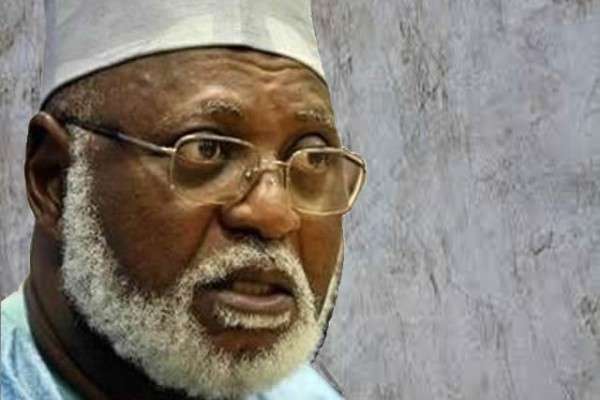
The former Head of State, Abdulsalami Abubakar, has reflected on one of the most consequential periods in Nigeria’s history, saying the decision to hand over power to a civilian government in 1999 was both a political necessity and a moral obligation to rescue the country from prolonged instability.
Speaking at his 84th birthday celebration and the public presentation of three books chronicling his life and contributions to nation-building, Abdulsalami urged Nigerians to remain committed to democracy, peace and strong institutions, insisting that the gains of democratic governance far outweigh any alternative system.
The event, held at the State House, Abuja, and titled “The Legacy of a Statesman @ 84,” featured the launch of his autobiography, “A Call of Duty: My Autobiography,” alongside “Mediating for Peace in Africa: A Festschrift in Honor of General Abdulsalami A. Abubakar,” and “Nigeria’s Grand Patriot: Abdulsalami Alhaji Abubakar, GCFR.”
The former Nigerian leader was in office for 11 months between June 1998 and May 1999, when he handed over power to a democratically elected government headed by Olusegun Obasanjo, a former head of state.
Abdulsalami, a retired general, revisited the tense circumstances under which he assumed power in June 1998 following Sani Abacha’s death.
According to him, Nigeria was deeply divided and yearning for a return to democratic rule when he took over leadership of the country.
“History has a way of defining the destiny of nations through critical moments,” he said.
“When I assumed office as Head of State in 1998, Nigeria stood at a crossroads, a nation yearning for stability, democracy and good governance.”
He recalled that demands for a return to civilian government came from political leaders, civil society organisations, the international community and ordinary Nigerians who had become weary of years of military rule.
Abdulsalami said he responded by making a solemn commitment to facilitate a democratic transition in the shortest possible time.
The former military leader said his administration worked with members of the Armed Forces Ruling Council, the Federal Executive Council, the military hierarchy and the media to deliver on that promise.
“We had to depart from the era of decrees and fashion out workable constitutional arrangements to legitimise the transition from military rule to democratic governance,” he said.
Reiterating a philosophy that guided his administration, Abdulsalami said leadership must be measured not by the exercise of power but by service to the people.
“Leadership is not about power but about responsibility, and the best way to lead is to serve with integrity.”
Abdulsalami noted that within 11 months of assuming office, his administration successfully conducted the transition programme, culminating in the inauguration of civilian rule headed by Olusegun Obasanjo on 29 May 1999.
The handover brought to an end more than 15 years of uninterrupted military rule and ushered in Nigeria’s current democratic dispensation.
He described the transition as a moral imperative aimed at restoring national stability and unity after years of political turbulence.
“True to this commitment, within 11 months, my administration midwifed the transition that restored democratic governance to Nigeria on May 29, 1999.
“This was not just a political necessity but a moral imperative to set our nation on the path of stability, unity and progress.”
He expressed hope that Nigerians would continue to strengthen democratic institutions and deepen democratic culture for the benefit of future generations.
Autobiography revisits June 12 crisis
One of the major highlights of the event was the unveiling of Mr Abubakar’s autobiography, which provides a firsthand account of several defining moments in Nigeria’s political history.
The book narrates the transition to democracy at a period when the nation was grappling with the fallout from the annulment of the 12 June 1993 presidential election, widely regarded as one of the freest elections in Nigeria’s history.
The autobiography also chronicles the Nigerian Civil War, military coups between 1966 and 1993, the annulment of the June 12 election, the political crisis that followed, the departure of General Ibrahim Babangida from office, the deaths of General Sani Abacha and Chief Moshood Kashimawo Olawale (MKO) Abiola, and the making of the 1999 Constitution.
In addition, it documents Abdulsalami’s mediation and peace-building engagements across Africa after leaving office.
The former Nigerian leader said retirement from public office did not mark the end of his commitment to national service.
Instead, he said, he redirected his efforts towards peace-building, conflict resolution and mediation.
He explained that this commitment led to the establishment of the Abdulsalami Abubakar Institute for Peace and Sustainable Development Studies in Minna, which has become a centre for research, dialogue and strategic engagement on conflict management and nation-building.
“Peace is not the absence of conflict but the presence of justice,” he said, noting that the principle continues to guide his interventions in national and international affairs.
The former Head of State also highlighted the establishment of the Abdulsalami Abubakar Resource Centre in Abuja, describing it as part of efforts to institutionalise the values of peace, dialogue and responsible leadership.
Abdulsalami also commended members of the National Peace Committee (NPC), which he chairs, for their contributions to peaceful elections and democratic stability in Nigeria.
He said the committee had played a vital role in promoting dialogue among political actors, civil society groups and security agencies.
According to him, the committee has helped oversee and facilitate peaceful electoral processes, thereby contributing to the consolidation of democracy.
“I would like to thank the distinguished members of the committee for their commitment and tireless efforts,” he said.
He called on political leaders, traditional rulers, religious institutions and the media to continue promoting peace, justice and national unity.
New resource centre unveiled
Another major feature of the event was the introduction of the Abdulsalami Abubakar African Resource Centre by a former Senate President and former Secretary to the Government of the Federation, Pius Anyim.
The centre is expected to serve as a repository of knowledge and research materials on leadership, peace-building, governance and democratic development in Africa.
Share this:
X Facebook WhatsApp Telegram LinkedIn Email Print
Membership Community
At Premium Times, we firmly believe in the importance of high-quality journalism. Recognising that not everyone can afford costly news subscriptions, we are dedicated to delivering meticulously researched, fact-checked news that remains freely accessible to all.
It’s essential to acknowledge that news production incurs expenses, and we take pride in never placing our stories behind a prohibitive paywall.
Would you consider joining our membership community by making a modest monthly or yearly contribution to help us maintain our commitment to free, accessible news?
Premium Times