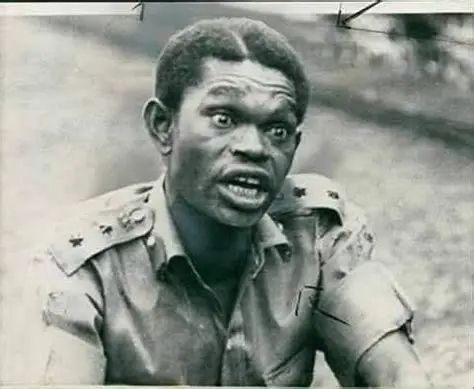
On September 13, 2014, one of the most prominent and controversial military commanders of the Nigerian Civil War, Brigadier-General Benjamin Adesanya Maja Adekunle, popularly known as the “Black Scorp1on,” d1ed in Lagos at the age of 78.
Born on June 26, 1936, in Kaduna, Adekunle was the son of an Ogbomoso father and a Bachama mother from present-day Adamawa State. He joined the Nigerian Army in 1957 and later served as aide-de-camp to Dr. Akanu Ibiam, the Governor of the former Eastern Region.
When the Nigerian Civil War began, Adekunle emerged as one of the Federal side’s most prominent commanders. He became the pioneer commander of the 3rd Marine Commando, a formation that played a major role in Federal military operations in the Niger Delta and the Biafran theatre. His aggressive battlefield reputation earned him the nickname “Black Scorp1on.”
The war, however, left a complicated legacy around his name.
To many on the Federal side, Adekunle was a determined soldier who fought to preserve Nigeria’s territorial integrity. But to many people on the Biafran side, he remains a deeply controversial figure because of the role he played in the Federal war effort against Biafra.
After the war, Adekunle was promoted to Brigadier in 1972 and was given another difficult national assignment — tackling the severe congestion at the Lagos Port, where the clearance of imported goods had become a major problem. He held the position until he was compulsorily retired from the Army on August 20, 1974.
His later years were largely spent away from active military and political life.
When news of his death broke in 2014, tributes came from across Nigeria. His passing marked the end of the life of a soldier whose name had become permanently tied to one of the most painful chapters in Nigeria’s history.
Benjamin Adekunle remains a complicated figure in Nigerian history — admired by some, fiercely criticised by others, but impossible to ignore when telling the story of the Nigerian Civil W@r.
September 13, 2014 — the day the “Black Scorp!on” di£d.
You are reading from Clara Dike Wall, Home of History.
#fblifestyle