

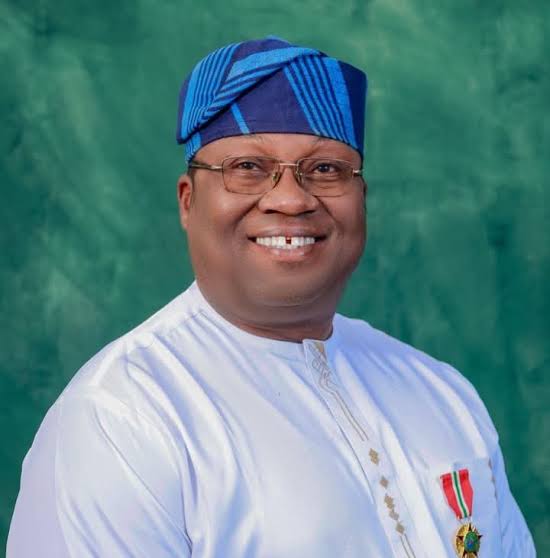
Senator Dayo Faduyile
By Martins Oloja
There comes a time
When we heed a certain call
When the world must come together as one…
We can go on
Pretending day by day
That someone somewhere will soon make a change
We are all a part of God’s great big family
And the truth, you know love is all we need…
There is a choice we are making…
(From ‘We are the world’ song by U.S.A for Africa 1985)
Permit me today to borrow from the brilliance of the 1985 iconic songwriters Lionel Richie & Michael Jackson, the brains behind the song, ‘we are the world’ for suffering Africans in Ethiopia at the time. And here is why I need to use parts of the lyrics to appeal to our people to borrow from the political decisions of Ondo State party leaders who just did something remarkable: organised election of a technocrat, a professor of medicine to spend barely a year at the Senate. I believe that Governor Lucky Aiyedatiwa of Ondo state, I confirmed led the party to support election of that significant technocrat felt we can’t continue “to pretend day by day that someone somewhere will soon make a change”. Yes, “there comes a time”, when leaders “should heed certain calls” that the wards even in our politics of consensus must “come together as one” to elect or select our best to represent us. I believe that sometimes such decisions may not be popular with the traditional bigots. But leaders should note that most significant decisions are unpopular at inception. I think our leaders should always support our best to represent the rest. That is why I would like to recommend to political leaders the Team Aiyedatiwa’s model that led to the election of Professor Dayo Faduyile to the Senate the other day.
Here is what I mean: Senator Dayo Faduyile, Professor of Medicine at LASUTH and former NMA President, embodies the technocrat model Nigeria’s 21st century senate needs. A new kind of senator takes the oath: On Wednesday, June 24, 2026, Senate President Godswill Akpabio administered the Oath of Allegiance and Oath of Office to four new senators following bye-elections. Among them: Senator Dayo Faduyile, APC, Ondo South. He polled 68,474 votes to succeed Jimoh Ibrahim, PhD, now Nigeria’s Permanent Representative to the United Nations.
But Faduyile is not a career politician. He is Adedayo Faduyile, MBBS, MBA, MSc, FWACP, FCP (ECSA), Professor in the Department of Pathology and Forensic Medicine at the Lagos State University College of Medicine and Honorary Consultant at LASUTH. He is a former National President of the Nigerian Medical Association (NMA). He is Chairman of the Governing Council and Pro-Chancellor of the Federal University of Education, Kontagora.
His arrival in the Red Chamber is more than a political win. It is a test case: Can a proven technocrat, with 40+ academic publications and a record of policy advocacy, translate expertise into law? If the 10th and 11th Senate are to be “purpose-driven” for a 21st-century Nigeria, Faduyile’s model matters.
The making of a scholar-clinician
Faduyile’s CV reads like a diagnostic chart of Nigeria’s human capital. MBBS from UNILAG in 1996. Residency in Anatomical and Molecular Pathology at LUTH, 2002–2007, serving as Chief Resident. MSc Cell Biology & Genetics, UNILAG, 2008. Diploma in Forensic Human Identification from the Royal College of Physicians, UK, 2015. Fellow of the College of Pathologists of East, Central and Southern Africa, 2016.
Since 2007 he has taught pathology and forensic medicine at LASU College of Medicine (LASUCOM) while consulting at LASU Teaching Hospital (LASUTH). He has over 40 peer-reviewed publications. That is not résumé padding. It is 27 years of daily exposure to what kills Nigerians: misdiagnosis, poor cancer screening, forensic gaps in criminal justice, and a health system that bleeds doctors.
The unionist-policy maker
As NMA President 2018–2020, Faduyile did not just issue communiqués. He “successfully engaged with the presidency and National Assembly to influence critical health legislation”. He flagged that “over 48 doctors have been kidnapped in two years”. He warned that “unqualified foreign-trained doctors causing havoc in Nigeria”. He pushed back on treating doctors “like civil servants” and argued for a National Health Service Commission.
That is legislative temperament: data, advocacy, and institutional memory. The Senate does not need more lawyers who quote statutes. It needs members who have written the policy briefs others now debate.
The administrator
Faduyile was Special Adviser on Health to the Ondo State Government of Governor Rotimi Akeredolu. He is Pro-Chancellor, Federal University of Education, Kontagora. He understands budgets, subvention, and the politics of appointments. Akpabio told new senators to “familiarise themselves with the provisions of the 1999 Constitution and the Senate Standing Orders 2023”. Faduyile already speaks that language.
Why the 21st century senate needs technocrats
Nigeria’s challenges are technical before they are political. Power, health, education, AI, climate, and forensic security require senators who can read a white paper, not just a party manifesto.
Evidence-based lawmaking
During COVID-19, Faduyile as NMA President explained why asymptomatic patients were a problem for hospitals. He balanced public panic with medical fact: “Asking for appropriate protective equipment as prerequisite… does not constitute professional malpractice”: A Senate with Faduyiles will not pass Infectious Disease Bills without public hearings. It will demand epidemiology, not emotion.
Sector-specific insight
Nigeria “needs between 3,000 to 4,000 medical schools to address the deficit”. That line did not come from a lobbyist. It came from a professor who trains doctors. When the Health Committee debates the Medical and Dental Council Act, Faduyile can explain why foreign-trained doctors fail licensing exams. When Appropriations Committees debate teaching hospital funding, he knows LASUTH’s MRI broke down for 11 months and why.
Credibility with professionals
The NMA Ondo State called his election “a victory for the medical profession and for quality representation”. Technocrats rebuild trust between the National Assembly and professional bodies. ASUU, NBA, ICAN, and NSE will talk to a Senate that has their colleagues inside.
Global competitiveness
Akpabio called the Senate “the most elite club in the world”. Elite is not about ‘agbada’. It is about capacity. The US Senate has physicians, engineers, astronauts. Singapore’s parliament has professors. Nigeria’s Senate needs members who can argue genomics with WHO and fintech with the IMF.
What he brings to the Red Chamber: health security as national security
As NMA President, he linked doctor kidnappings to national stability. In the Senate, he can sponsor a Health Worker Protection and Retention Bill: special insurance, hazard allowance tied to inflation, and a National Health Service Commission to remove doctors from civil service bureaucracy. That is how you keep 300,000 doctors instead of exporting them.
Forensic medicine and justice reform: Faduyile is a forensic pathologist trained in the UK and US. Nigeria’s criminal justice system convicts on confession, not forensics. A Forensic Services Agency Act would standardise autopsies, DNA, and crime scene management. His 2014 training at the Academy of Forensic Medical Sciences, London gives him standing to write it.
Education and research funding: As Pro-Chancellor of Federal University of Education, (FUE) Kontagora, he knows TETFund gaps. He can push for 1% of Consolidated Revenue to Research & Innovation modelled on Brazil. His 40+ publications mean he won’t let “research” become a budget line for SUVs for the federal legislators.
Diaspora brain linkage, not just brain drain: He highlighted “high-level diplomatic experience” from engaging the presidency and NASS. Nigeria’s Senate needs a Diaspora Professional Practice Act: allowing Nigerian doctors abroad to do three-month rotations at home without losing foreign licences. Faduyile has the network to draft it. Fiscal prudence from clinical logic
A pathologist learns triage: do the most good with limited resources. That mindset is missing in appropriation. Faduyile’s MBA from FUTA plus medical training means he can read both a balance sheet and a blood sheet. He will ask: Why is N21bn spent on a Presidential Clinic when LASUTH needs a PET scan?
The risk: Will the system change him or will he change the system?
The Senate can socialise technocrats into politics. Committees can become sinecures.
Oversight too can become oversight-seeing. Faduyile’s test is simple: If he were to be there for four years, would Nigerians point to a _Faduyile Act the way they point to the Mohammed VI Complex in Morocco?
The President of the Senate, Akpabio reminded new senators they “now represent the Federal Republic of Nigeria, not your respective political parties”. For Faduyile, that is literal.
A virus does not ask if you are APC or PDP. A stroke does not check your ward.
The blueprint: five ways the senate can replicate the Faduyile model
1. Professional constituencies: Reserve 10% of Senate seats for election by professional bodies: NMA, NBA, COREN, ICAN. Let engineers vote for engineers.
2. Sabbatical senators: Allow professors to take 4-year leave from universities to serve, with job guarantees. LASUTH will take Faduyile back in 2028. That reduces fear of loss.
3. Technical hearing rule: Any bill on health, tech, or science must have a public hearing chaired by a senator with relevant expertise.
4. Publication disclosure: Like assets, senators should publish Open Researcher and Contributor iD (ORCID ID), a free, unique 16-digit digital identifier that permanently distinguishes you from other reeseachers across the globe. Faduyile has 40+ papers. Let voters see who reads and who doesn’t.
5. Outcome KPIs: Akpabio should assign Faduyile to chair a Senate Delivery Unit tracking three health Sustainable Development Goals (SDGs): maternal mortality, doctor-to-patient ratio, and local vaccine production. Report quarterly.
Anger, expertise, and the purpose-driven senate we need.
Nigeria missed the 2026 World Cup because we normalised failure. We cannot miss the 21st century because we normalised an amateur and mediocre legislature. Senator Dayo Faduyile is not a saviour. He is a signal. The NMA said, “we have no doubt that you will bring the same dedication, professionalism, and passion for excellence that defined your tenure in the NMA to the Senate”. That is the standard.
A purpose-driven Senate is not one that shouts “aye” louder. It is one that can model a health budget, sequence a genome, audit a forensic lab, and still explain it in Ikoya Ward in Okitipupa, Ondo State. Faduyile campaigned on “grassroots connection and high-level diplomatic experience”. That duality is the job. If he succeeds, the Senate of 2027 with more Faduyiles should look like a faculty meeting: physicians, engineers, economists, data scientists, soldiers. If he fails, we will know why: the chamber has a way of turning professors into politicians and doctors into patients of the system.
But for now, his swearing-in is a prescription. Nigeria’s diagnosis is clear: shortage of expertise in power. The treatment: elect more Faduyiles. I hope the political parties are reading this for the purpose of voter education.
The 21st-century Senate will not be built by anger alone. But without the disciplined anger of technocrats who are offended by waste, decay, and death-by-policy, it will not be built at all. Senator Faduyile, Professor of Pathology, has taken the oath. The next oath is ours: to demand that he, and those like him, dissect the laws of Nigeria with the same rigour he uses on tissue samples. Behold, the country is on the table. And the prognosis depends on the surgeon.
Senator Faduyile’s swearing-in is a rare chance to test a thesis: that Nigeria’s biggest deficits aren’t money or manpower, but expertise in the room where laws are made. If he brings to the senate the same rigour that he brought to pathology and the NMA, then the Red Chamber just got a pathologist for the body politic. The real work starts when voters start asking every aspirant: Show me your ORCID, not just your poster.
The Guardian


