By Steve Otaloro
President Bola Ahmed Tinubu did not waste time to declare his vision for Nigeria as a Nation from day one of his administration starting with the solid minerals sector being a strategic sector in our industrialization. For him, the future of a nation’s manufacturing is inextricably linked to how this space develops. This belief has led to courageous reforms and policy pivot that have made the ministry of mines a catalyst for enhancing economic growth and building investor confidence.
Under Tinubu, the criminal gangs and illegal operators that exploit solid minerals for carting away more of the nation’s commonwealth reduced largely to virtually zero government custody or donation of what they took from local communities. The sector had colossal potential but contributed almost next to nothing in national value-addition. Previous initiatives, Dr. Kayode Fayemi’s four years turnaround included, had practically returned nought after the time spent 4years. The ministry continued to be one of the worst funded in the country, over a chronic under-funding.
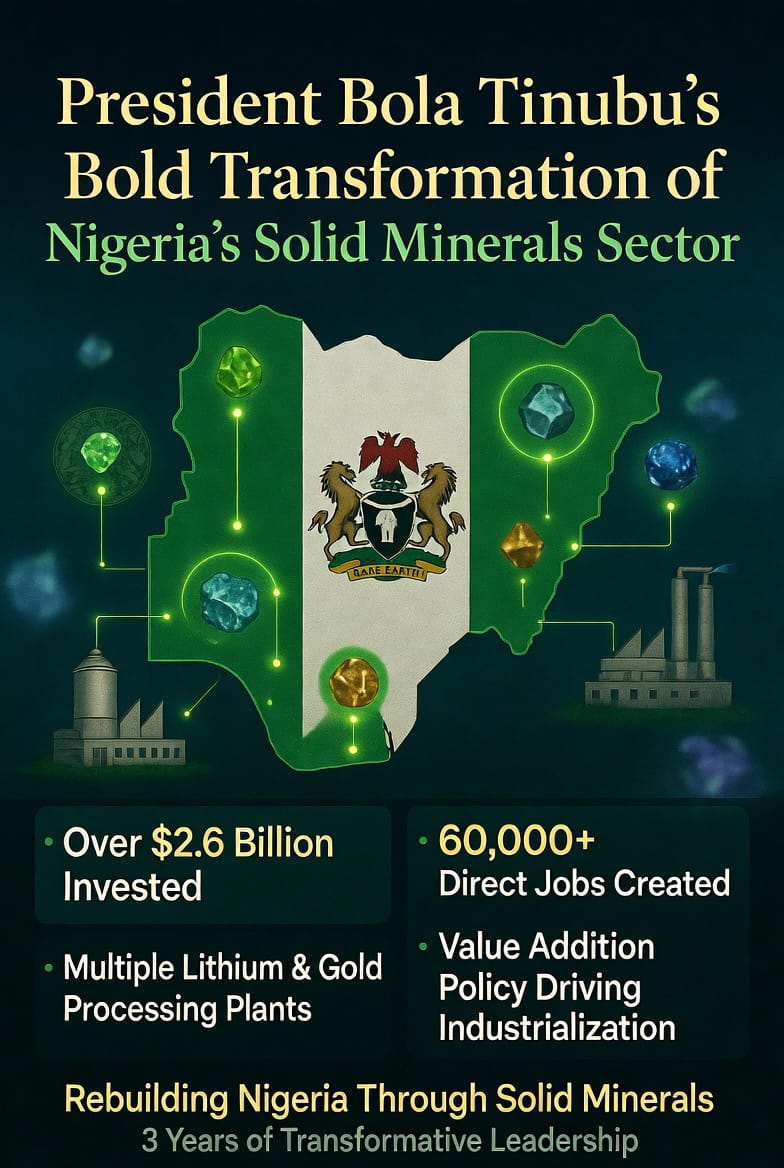
President Tinubu turned the table around with a simple direct actionable policy: No mineral should be able to leave Nigeria without being value added. Which is a strategic vision- process our resources at home, establish industries that need to be established, create jobs, and achieve real industrialization. Just three years into the policy and this humble proposition has unleashed a veritable firestorm of investors
In Nasarawa State, two lithium processing plants worth over $500 million have been completed. These facilities are projected to create over 10,000 direct jobs and thousands more indirect ones. Another $400 million Rare Earth minerals processing plant is rising in the same state. Together, these Nasarawa projects have the potential to generate over $150 million worth of processed minerals annually- evenue that will benefit local governments, the state, the federal government, workers, and the broader Nigerian economy.
The momentum continues across the country. A $200 million lithium processing plant is now operational in Abuja, while a $400 million lithium facility is taking shape along the Kaduna-Niger axis. In Lagos State, a $50 million gold refining plant has been established. These are not isolated projects; they represent a deliberate national strategy.
The Tinubu administration is systematically building mineral processing hubs across Nigeria’s six geo-political zones. Building on initiatives started under the Buhari administration, the government has sustained and accelerated funding for key hubs: the Gold Processing Hub in Kogi, the Pharmaceutical and Industrial Minerals Hub in Bauchi, the Gold Souk and Jewellery Processing Hub in Kano, the Lead and Zinc Processing Hub in Ebonyi, the Barite Processing Hub in Cross River, and the General Mineral Processing Hub in Oyo.
In three short years, over $2.6 billion has been invested in processing plants across the country. More than 60,000 direct jobs have been created, with thousands of indirect jobs following. And the good news is that many more investors are still coming.
President Bola Tinubu is not merely managing resources- he is fundamentally recreating Nigeria’s economic architecture. Through deliberate policy, visionary leadership, and unwavering focus on value addition, he is turning dormant potential into tangible progress. In the solid minerals sector, as in many others, his strides speak for themselves. For those who truly desire an industrialized and self-sufficient Nigeria, there is no replacement for this level of focused leadership.
– Steve Otaloro is a media strategist, political communicator, and public affairs analyst with extensive experience in governance, public policy, and strategic communications. Through his regular commentaries and opinion articles, he examines national issues, economic reforms, governance, and development, with a focus on promoting policies that drive sustainable growth, industrialization, and national progress in Nigeria.