By Ade Oyeyemi
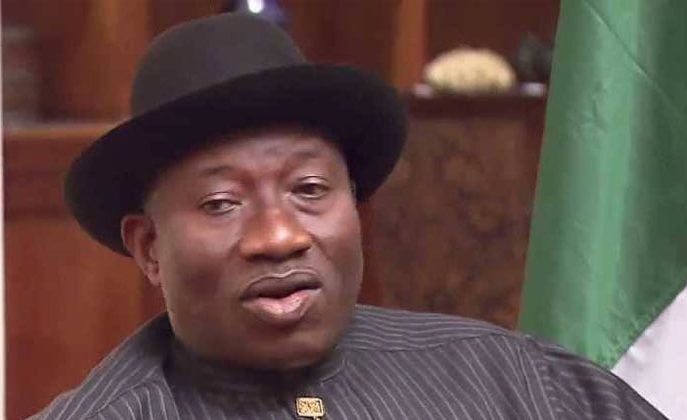
Former President Goodluck Jonathan has called for far-reaching reforms of Nigeria’s democratic system, warning that the country may struggle to achieve meaningful development without fundamental changes to its political and institutional structures.
Jonathan said Nigeria’s current democratic practice was opaque and lacked a clear institutional character, making it difficult to deliver the progress expected by citizens.
He made the remarks on Saturday while speaking as Chairman of the Occasion at the Herbert Macaulay Memorial Colloquium in Lagos.
The former President said Nigeria must restructure its democratic system around popular participation, the rule of law, separation of powers, respect for human rights, judicial independence, accountability and responsible governance.
“We must review our opaque and amorphous democratic system and align it with the fundamental pillars of democracy.
“These include popular participation, the rule of law, separation of powers, respect for human rights, judicial independence, accountability, prudence and democratic governance.
“We must build a democracy supported by vibrant civil society institutions,” he said.
Jonathan argued that the country’s present political arrangement lacked the institutional clarity needed to support sustainable development.
“What we are practising today, as political scientists here may agree, is difficult to define and understand. It is an amorphous democracy that lacks clear institutional character.
“Until we move away from this opaque and amorphous democratic practice, we may find it difficult to make the progress we desire,” he added.
He also identified Nigeria’s political recruitment process as a major obstacle to development, expressing concern that leadership selection was often determined by religious, ethnic and linguistic considerations rather than competence and capacity.
According to him, the problem dates back to the pre-independence era and has continued to undermine the emergence of capable leaders.
“Our political recruitment process has been problematic, even from the pre-independence era.
“We are still suffering from a system in which political leaders are often selected based on religion, language, ethnicity and other considerations rather than competence, character and capacity.
“Sometimes, the challenge goes beyond the distinction between Muslims and Christians,” he said.
The former President cited an example in a southern state where ethnic considerations could prevent qualified individuals from becoming governor, irrespective of their competence.
He urged Nigerians to abandon what he described as a primitive approach to choosing political leaders and prioritise merit in the recruitment of people into public office.
Jonathan also stressed the need to strengthen the country’s educational institutions, saying functional education was essential for technological advancement, innovation and knowledge creation.
He maintained that Nigeria needed a clear vision for its educational sector and deliberate policies to equip schools and universities to prepare citizens for future challenges.
“Education is critical. We cannot make meaningful progress with weak educational institutions.
“I did not have the opportunity of schooling abroad. I obtained all my degrees in Nigeria.
“Therefore, I am not suggesting that Nigerian universities are bad. That is not the issue,” he said.
While acknowledging the presence of excellent universities and competent academics in the country, Jonathan said more needed to be done to improve the quality and effectiveness of educational institutions.
He urged political leaders to begin working towards a clearly defined national development agenda ahead of Nigeria’s 100th independence anniversary in 2060.
The former President said the next 34 years should be used to address the country’s structural challenges rather than allow another generation to inherit unresolved problems.
“By 2060, Nigeria will celebrate 100 years of independence. That is about 34 years from now.
“A child born today will be about 34 years old when Nigeria marks its centenary of independence. These same questions will inevitably arise again.
“The question is: What kind of country will we be celebrating in 2060?” he asked.
He challenged Nigerians to consider whether the country would have overcome its present difficulties by then or would still be struggling with the same failures and unfulfilled aspirations.
Jonathan said the proposed national development agenda should contain clear objectives, measurable targets, timelines and specific responsibilities for political leaders, public institutions, businesses and educational establishments.
“These questions must not remain matters of academic debate. They should become the foundation of a national development agenda with clear objectives, measurable targets, timelines and identifiable responsibilities.
“Our political leaders must provide direction in line with a well-established national vision.
“Our public institutions must deliver efficiently. Our businesses must invest in productive capacity. Our educational institutions must prepare our people for the demands of the future,” he said.
He listed leadership failures, weak institutions, corruption, policy inconsistency, inadequate infrastructure, insecurity and excessive dependence on raw material exports among the major factors slowing Nigeria’s development.
Comparing the country with South Korea, India and Singapore, Jonathan noted that the nations had made significant progress in industrialisation, technology, education, healthcare and human development.
He urged Nigeria to harness its human and natural resources to achieve sustainable development and economic emancipation.
The former President also called for the preservation of Nigeria’s history, warning that a country that neglects its past risks losing its identity and sense of direction.
He described Herbert Macaulay as an intellectual, engineer, surveyor, journalist, political activist and public commentator whose courage and convictions helped shape Nigeria’s nationalist movement.
Jonathan said Macaulay was among the early voices that challenged colonial injustice and demanded greater political participation and self-determination for Nigerians.
He noted that Macaulay and other founding nationalists envisaged an independent country in which citizens would control their affairs and resources and deploy them for national development.
According to him, their vision included a united Nigeria where people of different ethnic, religious and cultural backgrounds would enjoy equal rights, dignity and opportunities.
He said independence was also expected to bring economic freedom, industrialisation, quality education, accessible healthcare, employment, social justice and a country capable of competing with other nations.
Jonathan maintained that the most meaningful way to honour the founding nationalists was to build a country that reflected the ideals for which they fought.
He urged young Nigerians to sustain the struggle for national development through innovation, enterprise, civic participation, responsible citizenship and accountability.
The former President also commended Macaulay’s descendants for organising the colloquium, describing it as an opportunity to reflect on the country’s political history and the responsibilities of nation-building.
Earlier, a former Deputy National Chairman of the Peoples Democratic Party, Chief Olabode George, appealed to President Bola Tinubu to return the property housing the General Post Office in Lagos to the Macaulay family.
George, who is a cousin of the nationalist, said the family wanted to establish a permanent memorial on the property to preserve Macaulay’s legacy and educate younger generations about his contributions to Nigeria.
He explained that the house where Macaulay lived was demolished after his death in 1946, after which the General Post Office was built on the site.
Macaulay was born on November 14, 1864, and died in 1946, 14 years before Nigeria gained independence in 1960.