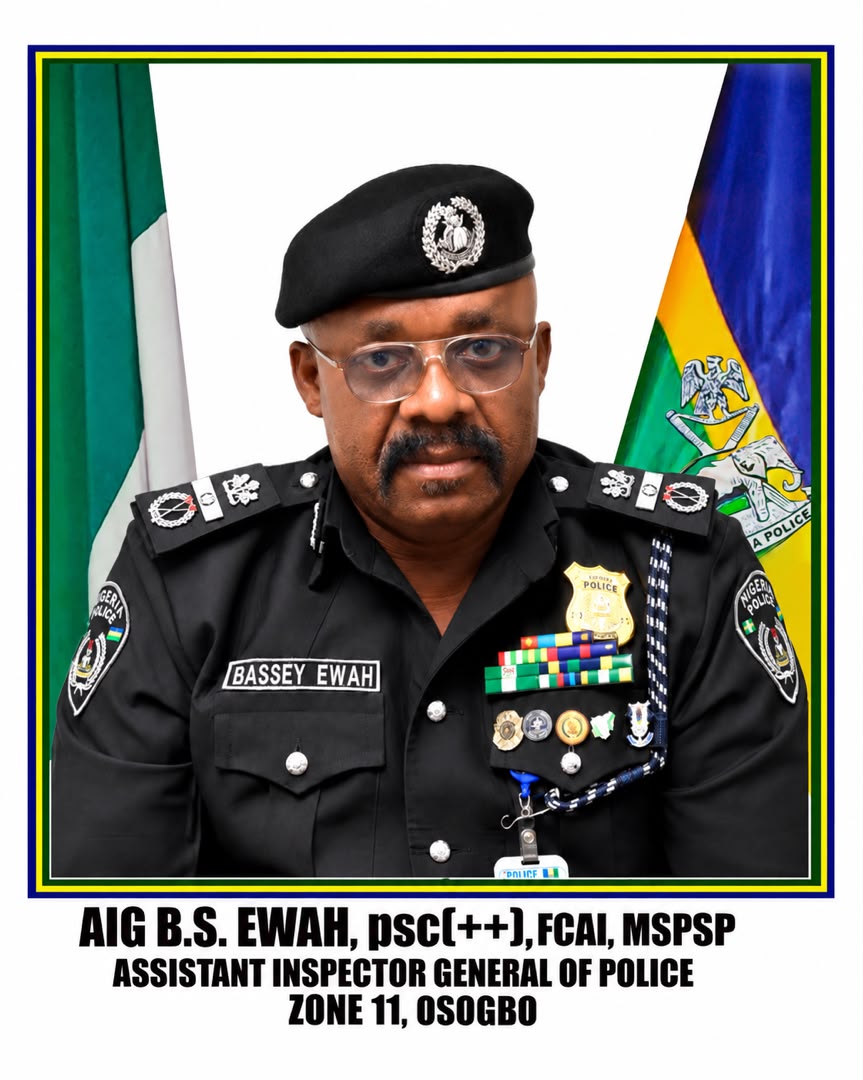
Through engagements with traditional institutions, student leaders and community groups, the Zone 11 police chief is promoting intelligence sharing, public trust and collective responsibility in tackling crime.
By John Dike Osogbo
When a new police chief assumes responsibility for a security formation, the expectations are clear: reduce crime, strengthen intelligence gathering, improve operational efficiency and protect lives and property.
But for the Assistant Inspector-General of Police in charge of Zone 11, Osogbo, AIG Bassey Samuel Ewah, the task of policing Osun and Oyo states goes beyond conventional law enforcement. It also involves building relationships with the people whose cooperation is essential to preventing crime and maintaining peace.
Since assuming office on September 14, 2026, Ewah has embarked on engagements with traditional rulers, community representatives, student leaders and other stakeholders, emphasising that sustainable security depends on effective collaboration between the police and the public.
From the palace of the Ooni of Ife to meetings with the Olowu of Kuta, the Olojudo of Ido-Osun, Hausa community representatives, student leaders and community-based crime prevention advocates, the AIG’s activities reflect an approach that places consultation, intelligence sharing and public confidence at the centre of policing.
For a senior officer responsible for coordinating policing across two states with distinct social and geographical realities, these engagements offer opportunities to understand local concerns, strengthen existing relationships and encourage communities to play constructive roles in preventing crime.
Yet, beyond courtesy visits and stakeholder meetings, the central question remains whether these relationships will translate into practical improvements in public safety, police responsiveness and residents’ confidence in law enforcement.
It is a challenge that goes to the heart of Ewah’s assignment as head of Zone 11.
Born on July 28, 1968, in Etung Local Government Area of Cross River State, Ewah joined the Nigeria Police Force as a Cadet Assistant Superintendent of Police on May 18, 1992.
His career has taken him through operational, administrative, instructional and command responsibilities across different formations of the police institution.
Before his deployment to Zone 11, he served as Assistant Inspector-General of Police in charge of Zone 15, Maiduguri, and Commissioner of Police in Plateau State.
His previous assignments also included service as Deputy Commandant of the Police Academy in Wudil, Kano State; Deputy Commissioner of Police in charge of Administration at Force Headquarters, Abuja; and Deputy Commissioner of Police in charge of Administration and second-in-command of the Lagos State Police Command.
He also served as Area Commander in Port Harcourt, Rivers State, and held operational and intelligence-related positions in Enugu State.
These assignments exposed him to different aspects of policing, ranging from frontline operations and intelligence gathering to personnel administration, institutional training and command management.
Ewah holds a bachelor’s degree in Political Science and has undertaken professional courses in policing, tactical leadership, strategic leadership and other aspects of police administration, including training in Nigeria and abroad, according to information released by Zone 11 police authorities.
His professional background provides context for his current responsibility, which requires operational understanding as well as the ability to coordinate police commands across Osun and Oyo.
However, the effectiveness of police leadership is ultimately determined not simply by the positions an officer has occupied but by the quality of leadership demonstrated, the standards maintained and the results delivered.
For Ewah, Zone 11 presents an opportunity to apply his experience to the security concerns of communities across the two states.
At the heart of community policing is the recognition that the police cannot effectively prevent and investigate every crime without the cooperation of the public.
Residents are often the first to notice unusual movements, suspicious activities, emerging disputes or developments that could threaten peace in their neighbourhoods. They may possess information that can help security agencies prevent criminal activities, identify suspects or respond quickly to incidents.
However, possessing information does not automatically mean residents will share it with the police.
People are more likely to volunteer useful information when they believe their concerns will be taken seriously, their identities will be protected where necessary and their cooperation will not expose them to unnecessary risks.
Public confidence is therefore an important resource in policing.
Engagement with traditional rulers and community representatives provides a channel through which the police can encourage residents to participate in protecting their communities. It also allows security authorities to listen to local concerns and better understand the circumstances surrounding emerging threats.
Community policing, however, does not mean transferring the responsibilities of law enforcement to ordinary citizens. Neither does it justify vigilantism, discrimination or the unlawful profiling of residents.
Rather, it requires a professional partnership in which members of the public provide credible information while the police retain responsibility for investigation, enforcement and the protection of fundamental rights.
The effectiveness of this partnership depends on trust, accountability and sustained communication.
One of Ewah’s significant engagements during his early days in Zone 11 was his visit to the palace of the Ooni of Ife, Oba Adeyeye Enitan Ogunwusi, in Ile-Ife.
During the meeting, the AIG sought the monarch’s support and cooperation in strengthening security across Osun and Oyo states.
The Ooni, who serves as Permanent Chairman of the Southern Nigerian Traditional Rulers Council, pledged to mobilise traditional rulers to work with the police in promoting security and peaceful coexistence.
The engagement underscored the potential contribution of traditional institutions to community-based security initiatives.
Across many communities in Yorubaland, traditional rulers maintain close relationships with residents and possess local knowledge that can help facilitate communication between communities and public institutions.
They are often familiar with longstanding disagreements, local disputes and other developments that may require attention before they escalate into more serious conflicts.
Their involvement can help security agencies understand community concerns, encourage residents to report criminal activities and promote lawful approaches to resolving disputes.
Beyond information gathering, traditional institutions can also contribute to peaceful coexistence by discouraging reprisal attacks, encouraging dialogue and promoting respect for the law.
The Ooni’s pledge to mobilise traditional rulers therefore provides an important foundation for closer cooperation between the police and traditional institutions.
The challenge is to sustain the relationship and ensure that commitments made during palace visits translate into practical collaboration at the community level.
The importance of public trust also featured prominently during Ewah’s visit to the palace of the Olowu of Kuta Kingdom, Oba Hammed Oyelude Makama, Tegbosun III.
The monarch urged the AIG to strengthen intelligence gathering, rebuild public confidence in the police and deepen security collaboration across Osun and Oyo states.
Oba Makama described Ewah’s deployment as an opportunity to strengthen relationships between the police and the communities they serve, stressing that public trust remained critical to effective crime prevention.
He urged the police chief to maintain professionalism and integrity, noting that decisions and operational standards established at the zonal level could influence policing across the state commands under his supervision.
The monarch maintained that security agencies could not successfully tackle crime without cooperation among residents, traditional rulers, government institutions and other stakeholders.
Using a proverbial expression, he said, “The bush does not shake without a cause,” urging residents to speak up whenever they noticed suspicious activities or developments that could threaten peace.
He also called for stronger working relationships between the police and the Osun State Government, stressing that sustainable security required a coordinated approach involving government, security agencies, traditional institutions and citizens.
Oba Makama expressed confidence that Ewah would provide the leadership needed to strengthen security coordination and sustain peace, particularly as political activities and preparations for future elections continued.
Responding to the concerns raised about public confidence, Ewah assured residents of Osun and Oyo that his administration would maintain an open-door policy and welcome constructive criticism.
“Our doors are open. There is no protocol to see us. We are ready to receive criticism, but constructively. It will help us to bring out the best in us,” he said.
The AIG urged the Commissioners of Police in both states to maintain open channels of communication with the public, assuring residents that information supplied to the police would be treated seriously and informants’ identities protected.
He stressed that effective policing required strong cooperation between officers and the communities they serve.
“I look for a very strong synergy between the police and members of the public. That relationship is underpinned by my abiding respect for traditional institutions. Without them, we cannot police well,” he said.
Ewah also pledged to work with traditional rulers, political actors and other stakeholders to promote peace, while urging political leaders to embrace politics without bitterness.
He said political differences should not be allowed to destroy relationships, threaten public safety or undermine peaceful coexistence.
Ewah’s visit to the palace of the Olojudo of Ido-Osun, Oba Ishola Olayinka Oyetunde Jokotola II, offered another dimension to his stakeholder engagement.
The visit on September 28, 2026, was particularly significant because the monarch and the AIG shared a professional history within the Nigeria Police Force.
According to reports of the meeting, the monarch recalled that Ewah had served as his course officer at the Police Staff College in Jos during his training before he left the police to ascend the traditional throne of Ido-Osun.
The monarch described Ewah as a father to many and expressed delight at receiving him in his new capacity as head of Zone 11.
He also pledged his support and cooperation towards ensuring a successful tenure for the AIG.
Beyond the personal significance of their reunion, the meeting illustrated how relationships established within public institutions can provide opportunities for cooperation when individuals assume different responsibilities.
In this instance, a former police training relationship had evolved into a connection between a senior police officer and a traditional ruler.
Such relationships can facilitate dialogue, provided that official responsibilities remain guided by professionalism, impartiality and the law.
For the people of Ido-Osun, the important consideration is whether the engagement will strengthen communication between the palace and the police, particularly when community concerns require timely attention.
A security strategy built on public cooperation must recognise that communities are not homogeneous.
Different groups may have different concerns, communication channels and relationships with formal security institutions. Engaging only traditional rulers or established community leaders may therefore leave gaps in the information available to security authorities.
Ewah’s engagement with representatives of traditional rulers and Hausa community leaders from Ifewara, Ibodi and Iwoye-Ijesa reflected the importance of reaching different groups within the wider community.
At a security meeting reported on October 21, the AIG urged the representatives to remain vigilant and report suspicious activities that could threaten public safety.
The meeting focused on improving police-community relations, strengthening intelligence sharing and preventing criminal elements from exploiting gaps in community awareness and cooperation.
Such engagements can help security agencies obtain information about developments that may not be immediately visible to officers operating outside particular neighbourhoods.
However, effective cooperation must be based on credible information rather than rumours, prejudice or assumptions about a person’s background.
Security agencies have a responsibility to assess information professionally and take lawful action based on evidence. Community leaders, in turn, must discourage discrimination, avoid spreading unverified allegations and encourage residents to report genuine concerns through appropriate channels.
When properly managed, engagement with diverse communities can improve communication, promote mutual understanding and strengthen relationships between law enforcement authorities and residents.
The task for Zone 11 is to ensure that such engagement becomes a sustained process rather than an occasional activity.
Another important stakeholder group in Ewah’s engagement strategy is the student community.
On October 22, executives of the National Association of Nigerian Students, South-West Zone, visited the Zone 11 headquarters in Osogbo to strengthen relations with the police.
The delegation, led by Comrade Josiah Adeyemo, expressed its willingness to collaborate with the police in promoting peace and security across Osun and Oyo.
The engagement highlighted the importance of including young people in discussions about public safety and responsible citizenship.
Students constitute an important segment of the population in both states, and their campuses and surrounding communities depend on a peaceful environment for academic activities and social development.
Effective communication between student leaders and security authorities can help address concerns before they develop into serious confrontations. It can also create opportunities for public education on lawful protest, conflict resolution, crime prevention and citizens’ rights and responsibilities.
During the meeting, Ewah recalled his own experience as a student unionist at the University of Calabar and urged student leaders to demonstrate discipline, maturity and responsibility.
He also assured the delegation of the police’s commitment to protecting the fundamental rights of students and other citizens.
Maintaining security in educational environments requires a balance between public order and respect for lawful student activities.
Student leaders can contribute by encouraging peaceful conduct, discouraging violence and promoting dialogue when disagreements arise. They can also help circulate credible security information among students and encourage cooperation with relevant authorities when genuine threats emerge.
By engaging student representatives, Ewah is extending the community policing conversation beyond traditional institutions and established community structures.
It recognises that a safer society requires the participation of different generations and social groups.
Ewah has also received representatives of the Complaint Response Unit Advocacy Agents, a section of the Eagle Crime Awareness and Prevention Initiative.
The delegation, led by its State Commander, Clement Igwe, visited the AIG to welcome him to Zone 11 and strengthen collaboration on community-based crime prevention.
During the engagement, Ewah assured the group of his support and encouraged its members to sustain their partnership with the police.
Community-based organisations can contribute to public safety by raising awareness, encouraging lawful reporting and helping residents understand how to engage with security institutions.
Their activities must, however, remain consistent with the law and avoid interference with investigations, endangerment of informants or attempts by private individuals to take enforcement into their own hands.
The police remain responsible for investigating allegations, determining appropriate legal responses and ensuring that suspects are treated in accordance with established procedures.
When community organisations understand these boundaries and work within them, their activities can complement formal policing and help develop a stronger culture of crime prevention.
For Zone 11, sustained cooperation with such groups could create additional channels through which security information and public awareness reach grassroots communities.
While stakeholder engagements provide a foundation for security cooperation, the real test of leadership lies in what follows.
Meetings with traditional rulers, student representatives and community leaders can identify concerns, establish communication channels and build goodwill. Residents, however, ultimately judge policing by its practical impact on their lives.
They want complaints to be taken seriously, security concerns addressed promptly and investigations conducted professionally. They also expect officers to respect the law, protect fundamental rights and remain accountable for their conduct.
These expectations make it necessary for stakeholder engagement to be supported by effective operational planning, adequate resources, professional training and reliable follow-up mechanisms.
When community leaders report security concerns, there should be appropriate channels for communicating the information to relevant authorities. Allegations of misconduct should receive attention through established procedures, while security problems requiring cooperation between agencies should be handled through clear communication and coordination.
Such measures can help transform the goodwill generated by meetings into meaningful institutional cooperation.
For Ewah, this is one of the major challenges of his assignment. His experience across operational and administrative positions provides a background in police management, but his leadership will ultimately be assessed by the effectiveness of the commands under his supervision and the quality of their relationships with the public.
The success of his approach will depend on whether residents experience improvements in the responsiveness, professionalism and effectiveness of policing.
Zone 11’s responsibility for Osun and Oyo gives Ewah’s assignment a regional dimension.
The two states are connected through economic activities, transportation routes, social relationships and communities whose interactions extend beyond administrative boundaries.
These connections make communication between security formations important, particularly when incidents require coordination across state lines.
Information sharing can support investigations, assist the tracking of suspects and help authorities identify patterns that might otherwise be difficult to detect.
Cooperation is also important when disputes involve communities near state boundaries, where careful investigation and clear communication are needed to establish the facts and prevent unnecessary escalation.
Traditional rulers and community leaders can contribute by promoting dialogue and discouraging actions that may aggravate tensions. However, criminal allegations must remain within the jurisdiction of the appropriate law enforcement and judicial institutions.
A coordinated approach involving the police, other relevant security agencies and community stakeholders can help ensure that security concerns are addressed professionally.
For Ewah, the zonal structure offers an opportunity to encourage consistent communication, supervision and operational cooperation across the two states.
The broader objective is to ensure that security responses reflect the realities of interconnected communities rather than treating every incident as an isolated matter.
No security strategy can achieve its full potential without public confidence.
When citizens believe that officers will act fairly, investigate allegations professionally and respect their rights, they are more likely to cooperate with the police.
When confidence weakens, residents may become reluctant to report crimes or provide information, making it more difficult for authorities to prevent and investigate criminal activities.
This is why accountability and professionalism are inseparable from effective policing.
Police leadership must ensure that officers understand their responsibilities, respect the law and treat members of the public with dignity. It must also ensure that complaints receive appropriate attention and allegations of misconduct are handled through established procedures.
These responsibilities are particularly important in community policing, where the relationship between officers and residents can directly influence public willingness to cooperate.
For Ewah, building partnerships must therefore go hand in hand with maintaining professional standards within the police institution.
Community engagement should provide opportunities for listening and communication, while operational decisions must remain guided by evidence, the law and the public interest.
The objective is not merely to make the police more visible but to make their presence more effective, accessible and trusted.
Ewah’s professional journey has exposed him to operational policing, administrative leadership and police training. His service at the Police Academy in Wudil and his experience in police administration demonstrate exposure to institutional development and personnel preparation, while his command assignments involved supervision and responses to different security environments.
Such experience can provide useful perspective in a zonal command, where effective leadership requires coordination across multiple formations.
Nevertheless, the public significance of a police officer’s career rests on how experience is translated into responsible leadership and practical outcomes.
His early engagements in Zone 11 indicate an emphasis on stakeholder cooperation, but the longer-term assessment will depend on the results of the policies and relationships developed under his leadership.
For residents of Osun and Oyo, the expectations are straightforward: safer communities, prompt responses to security concerns, credible investigations and police officers who perform their duties professionally.
Traditional rulers want their engagement with the police to contribute to practical responses to security challenges. Student leaders need a safe environment in which academic activities can continue without unnecessary disruption. Community representatives want reliable channels through which credible information can reach the appropriate authorities.
Meeting these expectations requires continued communication, appropriate follow-up and a commitment to assessing whether security interventions are producing the intended results.
Citizens can contribute by providing credible information, complying with the law and avoiding the spread of rumours that may undermine investigations or create unnecessary fear. Community leaders can encourage cooperation and peaceful coexistence, while security agencies must ensure that information is assessed and acted upon professionally.
Together, these efforts can support a more effective approach to public safety.
As Ewah continues his assignment as Assistant Inspector-General of Police in charge of Zone 11, his priority remains strengthening the capacity of the police to protect lives and property while building relationships that support effective law enforcement.
His engagements with the Ooni of Ife, the Olowu of Kuta, the Olojudo of Ido-Osun, community representatives, student leaders and community-based crime-prevention advocates illustrate the range of stakeholders whose cooperation can contribute to this objective.
Each engagement offers an opportunity to improve communication, understand local concerns and encourage a collective response to security challenges.
But the ultimate value of these relationships will depend on their continuity and their contribution to practical improvements in policing.
The coming months will provide opportunities to assess how stakeholder engagement, operational coordination and professional oversight translate into outcomes for residents across Osun and Oyo.
For Ewah, the assignment requires balancing the operational demands of law enforcement with the need to earn public trust. For communities, it presents an opportunity to participate constructively in preventing crime and promoting peaceful coexistence.
Ultimately, the AIG’s leadership will be measured not by the number of meetings held or visits undertaken, but by the extent to which his administration helps create safer communities, strengthens public confidence and improves the effectiveness of policing across Zone 11.
For Osun and Oyo, the hope is that the partnerships being cultivated will develop into sustained cooperation that protects lives, supports peaceful coexistence and reinforces a fundamental principle of democratic policing: security is most effective when professional law enforcement works hand in hand with public trust.