

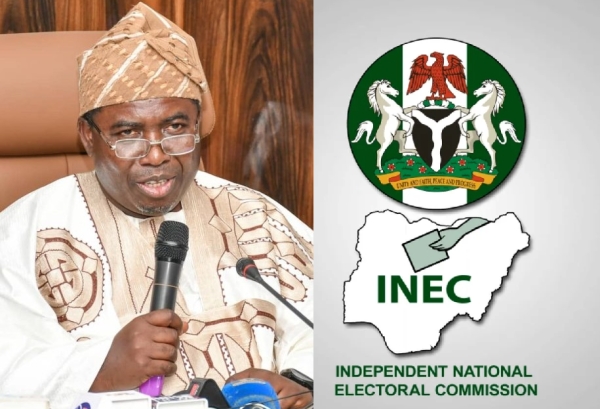
Chairman of the Independent National Electoral Commission, Prof Joash Amupitan.
Nigeria’s democracy is on edge, gripped by internal contradictions and avoidable tensions. There must be a conscious effort to rescue it from sliding into extinction.
Months to the next general elections, when critical stakeholders should be tidying up any loose ends in electioneering efforts to deliver credible polls, the political landscape is engulfed in credibility issues around the leadership of INEC, the electoral body, amid calls for the removal of its chairman.
Indeed, Nigeria’s electoral challenges are hydra-headed and multi-layered, reflecting a fundamentally and foundationally defective polity.
Putting the country’s elections, beginning with the 2027 polls, on the path of credibility requires a wholesale, coordinated, sincere and sustainable resolution of all the critical problems that have undermined the country’s democracy.
Therefore, the calls for the removal of Joash Amupitan by some prominent political parties and other Nigerians over alleged integrity and partiality are just a part of the turbulence rocking the electoral system.
The main accusations against the chief electoral umpire are INEC’s handling of the African Democratic Congress leadership tussle and his social media footprints. Amupitan came under fire for delisting the David Mark-led ADC faction. He was also accused of partisanship in posts on his X (formerly Twitter) account.
On Monday, INEC again debunked social media footprints of Amupitan, saying a forensic examination has cleared him.
But basing Nigeria’s legendary electoral heists on Amupitan’s incumbency misses the point; it is short-sighted.
Indeed, there are far more critical issues than the removal call. The calls are a symptom. If pushed through, the same system might deliver something worse.
The major loophole, it seems, is the legal underpinnings, especially the 1999 Constitution.
So, without amending the Constitution to pave the way for transparent and credible appointments in the top echelons of INEC is chasing after the wind.
For now, the mode of appointment, the removal of the INEC chair and the top officers of the commission are fundamentally flawed and have been at the root of the electoral charades since 1999.
Hurriedly handed down by a military junta at its exit in 1999, the Constitution vests the President with omnibus powers to appoint and remove the chairman of INEC. In a society where power corrupts, this is dangerous and illogical.
The power granted to the Council of State in the Third Schedule, Part 1, Section B(i) and Section F in respect of INEC is merely advisory. Its advice is not binding on the President. It is another way of elevating the President to the status of an emperor.
Section 154 (1) of the 1999 Constitution empowers the President to appoint the INEC chair, while Section 157 grants him the power to remove them, supported by two-thirds of the Senate, respectively.
This is overly naïve in the Nigerian context. All INEC chairmen since 1999 have had serious question marks over their tenure and the conduct of elections.
All the presidential elections – except in 2015 when the incumbent Goodluck Jonathan conceded to Muhammadu Buhari – have been decided by the Supreme Court. This is an abnegation of democracy: the voters must always decide the election winner, not the court.
So, the fundamental issues must be clinically addressed to lend credibility to elections and strengthen the country’s democracy. To all intents and purposes, an INEC chair with the highest integrity profile cannot perform in the bitter, combative and poisonous election climate infested by desperado politicians.
The election charade is demoralising and is a setback for the advancement of democratic ethos. Voter turnout since 2007 bears an ugly witness, declining from 57.54 per cent in 2007 to 26.7 per cent in 2023.
Thus, Nigeria cannot afford a repeat next year. Yet, all the signs point to that.
Additionally, the funding of INEC is dependent on the executive and legislative arms of government. In mitigation, the two have ensured that the commission received its votes on time.
As a way forward, the President, the legislature and stakeholders should dust off the Mohammed Uwais panel report.
The panel, established by the late President Umaru Yar’Adua in 2007 after he deemed his own election flawed, recommends the appointment of the INEC Chair by a neutral body, and the funding of elections from the first line charge, among other landmark recommendations.
This is the direction to go to guarantee the credible elections Nigerians desire.
In the US, voters elect the chief election official in 33 states, while the governor or the State Board of Elections in some other states. For a politically volatile Nigeria, it could adopt some of these policies.
The judiciary has its own black marks. It employed technicalities to overturn the governorship election cases in Osun, Imo and Nasarawa states in the past. The courts interfere in internal party affairs. This is embarrassing.
Tinubu must deliver credible elections to Nigerians.
The Punch


