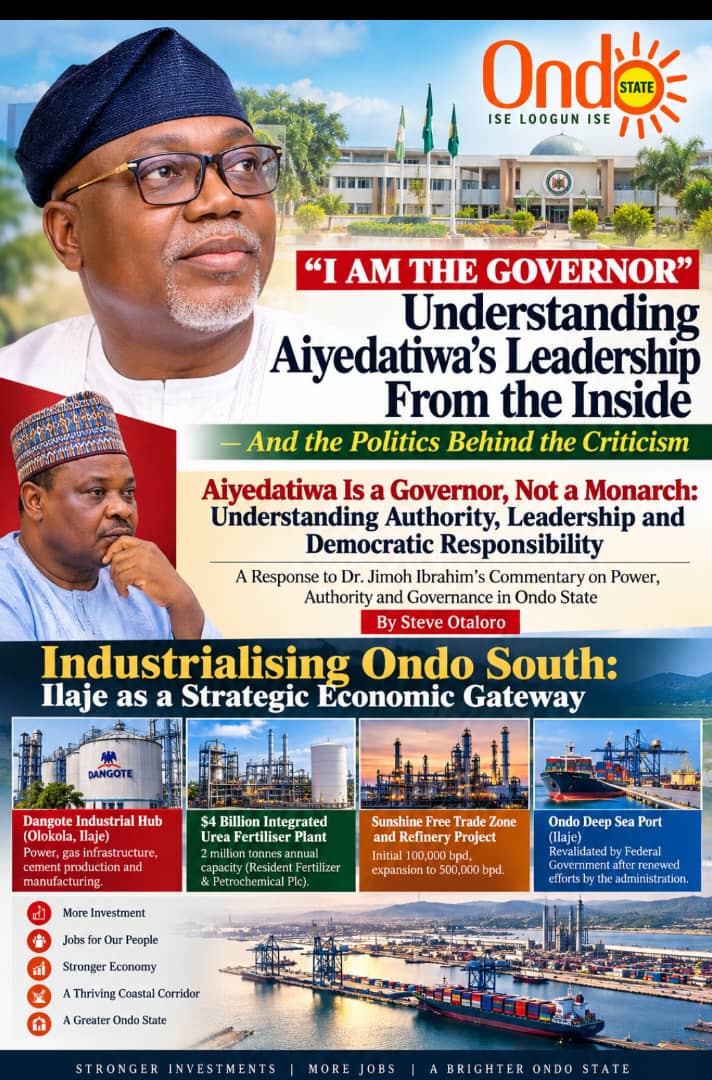
- A Response to Dr. Jimoh Ibrahim’s Commentary on Power, Authority and Governance in Ondo State
By Steve Otaloro
In his article titled “I Am the Governor – Aiyedatiwa: Navigating Classic Hegemonic Praxis and Power-Currency Dynamics,” Dr. Jimoh Ibrahim, Ambassador Extraordinary and Plenipotentiary to the United Nations, attempts to interpret Governor Lucky Orimisan Aiyedatiwa’s assertion of executive authority through the historical experiences of European monarchs, including Henry VIII of England and Louis XIII of France.
While Dr. Ibrahim raises important questions about power, leadership, collaboration and the distribution of public resources, I believe that understanding Governor Aiyedatiwa’s leadership requires a closer appreciation of the realities of governance, the responsibilities of his office and the demands placed on an elected executive.
I write not merely as an observer of political developments in Ondo State, but as someone serving within Governor Aiyedatiwa’s administration as Senior Special Assistant on Public Engagement. This responsibility places me in a position to appreciate the importance of communication between government and citizens, the need for stakeholder engagement, and the delicate balance between consultation and executive decision-making.
From this vantage point, I consider it necessary to distinguish between a governor asserting the authority of his office and a ruler seeking to impose personal supremacy. These are not the same thing.
However, before accepting the historical and theoretical framing of Dr. Ibrahim’s argument, it is equally important to examine the political context in which such commentary emerges. Political analysis does not take place in a vacuum, particularly in an environment where the contest for public office is often accompanied by competing ambitions, interests and calculations.
The Political Undertones Behind the Commentary
Beyond the historical analogies and theoretical discussions of power, Dr. Jimoh Ibrahim’s intervention cannot be completely divorced from the political realities of Ondo State and the ambitions associated with its most coveted political office.
Dr. Ibrahim is no stranger to gubernatorial politics. His previous attempts to secure the governorship, alongside the perception that he may continue to harbour such ambitions, makes it reasonable to examine whether his latest commentary is entirely an academic exercise or whether it also carries political undertones.
This is not to suggest that an aspiring politician forfeits the right to criticise a sitting governor. Far from it. Every citizen has the right to question government, challenge political decisions and offer alternative perspectives. However, when someone who has previously sought the same office occupied by the person under scrutiny chooses to frame that officeholder’s assertion of authority through the imagery of historical monarchs associated with executions and absolute power, the political implications deserve careful consideration.
The question is not whether Dr. Jimoh Ibrahim has the right to criticise Governor Aiyedatiwa; he certainly does. The question is whether the criticism is sufficiently grounded in evidence and public interest or whether political ambition may be influencing the way the argument is presented.
It would be unfair to claim certainty about another person’s motives without direct evidence. Nevertheless, it would be equally naive to pretend that political ambition and rivalry have no bearing on public commentary in a political environment such as ours.
If Dr. Ibrahim continues to aspire to govern Ondo State, that ambition is legitimate. However, it is incumbent upon him to demonstrate the seriousness, discipline and sense of responsibility expected of someone who wishes to lead the state. Rather than becoming preoccupied with interpreting every assertion of executive authority through the language of hegemonic power, he would do well to remain focused on the responsibilities of his present public assignment and the substantial demands of national and international affairs.
Nigeria is navigating complex diplomatic, economic and political challenges. The responsibilities attached to his current role as an ambassador to the United Nations demand focus, diligence and constructive engagement. Those responsibilities should not be overshadowed by domestic political manoeuvring or the continuing struggle for influence that characterises our politics.
Political ambition should inspire a prospective leader to develop ideas, demonstrate public value and offer credible solutions to the challenges confronting the people. It should not become an overriding lens through which the legitimate actions of an incumbent are routinely interpreted as threats to political freedom or signs of authoritarianism.
The people of Ondo State deserve serious discussions about development, infrastructure, employment, education, healthcare, investment and the equitable distribution of public resources. They deserve criticism that identifies specific shortcomings, examines evidence and proposes workable alternatives. They also deserve a political culture in which disagreement does not automatically become a contest of personalities or ambitions.
The historical comparison with Henry VIII and Louis XIII is particularly striking because the political institutions of their time were fundamentally different from those of contemporary Nigeria. Their histories of royal executions and absolutist authority offer little basis for concluding that a governor’s insistence on his constitutional position is, in itself, evidence of authoritarianism.
When a governor says, “I am the Governor,” the context matters. The statement may be an assertion of responsibility, a clarification of institutional authority or a reminder that the ultimate responsibility for executive decisions rests with the occupant of the office.
A governor cannot be expected to preside over an administration in which the boundaries of authority are constantly blurred or in which every political interest assumes the right to determine the direction of government. Leadership requires consultation, but it also requires clarity about who is constitutionally responsible for making decisions and answering for their consequences.
This is a distinction that deserves greater attention in the interpretation of Governor Aiyedatiwa’s leadership.
Dr. Ibrahim’s references to Henry VIII and Louis XIII may add historical drama to his article, but they risk creating an impression that has not been established merely by the assertion of executive authority. There is a fundamental difference between the abuse of power and the lawful exercise of constitutional responsibility.
Modern democratic governance operates within a framework of constitutional provisions, legislative oversight, judicial review and public accountability. A governor is neither above the law nor deprived of the authority conferred by the office. The existence of limits on executive power does not mean that the executive must continually justify the legitimacy of exercising that power.
My role in public engagement has reinforced my understanding that governance is not simply about issuing directives or exercising authority. It is also about listening to citizens, communicating government policies, engaging stakeholders and ensuring that public concerns find appropriate channels of attention.
These responsibilities demand openness, accessibility and a willingness to consider different perspectives. They also require a functioning structure of authority through which decisions can be made, implemented and evaluated.
The realities of public administration require a careful balance between consultation and decision-making. A governor must be accessible to the people and receptive to legitimate concerns, but accessibility should not be mistaken for an absence of executive authority. Consultation should enrich decision-making, not render leadership ineffective.
It would therefore be misleading to interpret the expression “I am the Governor” in isolation and make it the defining feature of an entire administration. A more meaningful assessment must consider the circumstances in which the statement was made, the decisions that followed and the administration’s broader approach to governance.
As someone entrusted with the responsibility of facilitating public engagement, I consider it important that discussions about the Governor’s leadership should be informed by a fair understanding of the demands of his office rather than by assumptions drawn from historical analogies.
Dr. Ibrahim acknowledges that collaboration and cooperation are necessary for the development of Ondo State. On this point, there is common ground. No governor can develop a state without the contributions of public institutions, political stakeholders, traditional rulers, civil society, the private sector and ordinary citizens.
Governor Aiyedatiwa’s approach to governance should be assessed within this broader context of cooperation, institutional responsibility and development. His administration’s commitment to engaging stakeholders and advancing the state’s development agenda deserves to be considered alongside legitimate questions about the exercise of executive authority.
However, collaboration is not synonymous with the surrender of executive responsibility.
An administration needs a clear chain of responsibility. Stakeholders must have opportunities to contribute, raise concerns and influence policy through legitimate channels, but executive decisions must ultimately be taken by the authorities constitutionally empowered to make them.
A governor who insists on the responsibilities attached to his office is not necessarily rejecting collaboration. The real test is whether his administration provides meaningful opportunities for engagement while ensuring that government remains coordinated and accountable.
This is particularly relevant in a politically active state such as Ondo, where diverse interests and competing expectations must be reconciled in the pursuit of development.
From the perspective of public engagement, the objective should be to strengthen communication between the government and the people, not to create an artificial conflict between consultation and authority.
Industrialising Ondo South: Ilaje as a Strategic Economic Gateway
Dr. Jimoh Ibrahim’s discussion of resource allocation and the place of the Ilaje people in Ondo State’s development priorities provides an opportunity to examine Governor Lucky Orimisan Aiyedatiwa’s drive to industrialise the southern senatorial district, particularly Ilaje, his home local government area.
The administration has pursued an industrial development agenda encompassing major proposed investments in maritime infrastructure, manufacturing, energy and petrochemicals. Among these is the proposed Dangote industrial hub at Olokola, which the Dangote Group reaffirmed plans to develop in June 2026, with proposed facilities covering power generation, gas infrastructure, cement production and manufacturing.
Another significant initiative is the proposed $4 billion integrated urea fertiliser plant by Resident Fertilizer and Petrochemical Plc, facilitated by the Ondo State Government through ONDIPA. The proposed facility is designed to produce two million tonnes of fertiliser annually, subject to successful implementation.
The administration has also facilitated the proposed Sunshine Free Trade Zone and refinery project promoted by Backbone Infrastructure Nigeria Limited and its partners. Announced plans envisage an initial refining capacity of 100,000 barrels per day, with a proposed expansion to 500,000 barrels per day.
Equally significant is the Ondo Deep Sea Port project in Ilaje. Following an earlier approval setback, the Federal Government revalidated the port licence in December 2025 after renewed efforts by the Aiyedatiwa administration to revive the project. The proposed port could provide a strategic maritime gateway for industrial production, international trade and exports, while strengthening the investment potential of the surrounding coastal corridor.
Taken together, these four initiatives, the Dangote industrial hub, the integrated fertiliser plant, the refinery and free trade zone proposal, and the Ondo Deep Sea Port-represent substantial industrial development opportunities for Ilaje and the wider southern senatorial district. If implemented, they could stimulate investment, expand employment, strengthen logistics and manufacturing, and create opportunities for local businesses and young people.
As Governor Aiyedatiwa’s home local government area, Ilaje occupies an important place in discussions about his administration’s development priorities. However, the ultimate measure of success will be the actual delivery of these projects, the infrastructure they provide, the jobs they create and the benefits they bring to host communities. Transparent land arrangements, environmental safeguards and meaningful community engagement must remain integral to the process.
The broader point is that industrialisation in Ilaje should not be viewed as a favour to one community at the expense of others. Properly executed, these investments could strengthen the economic base of Ondo State, improve its competitiveness and contribute to balanced development across its senatorial districts. The proposals must now translate into verifiable implementation and measurable benefits for the people.
Dr. Jimoh Ibrahim’s attempt to classify Governor Aiyedatiwa as a classical realist, neorealist or liberalist introduces an interesting theoretical debate. Yet the practical demands of governing a state cannot always be neatly captured by a single political label.
An executive may embrace consultation, encourage cooperation and accommodate different interests while remaining firm on matters of institutional responsibility. Likewise, the exercise of executive authority does not automatically establish a preference for coercion or personal dominance.
The more important consideration is how authority is exercised: whether decisions are lawful, whether public institutions are respected, whether legitimate dissent is accommodated and whether the administration remains accountable to the citizens it serves.
These are practical questions that can be examined through policies, decisions and outcomes. They are more useful to the people of Ondo State than a debate that places a contemporary elected governor alongside European monarchs whose systems of power were built on entirely different foundations.
My position within this administration makes me particularly conscious of the need to bridge the gap between government and the public. Public engagement is not about shielding the Governor from criticism or asking citizens to accept every government decision without question. It is about promoting accurate information, encouraging constructive dialogue and ensuring that public concerns are communicated through appropriate channels.
A responsible public engagement framework must allow citizens to ask difficult questions. It must also provide the government with an opportunity to explain its decisions, clarify misconceptions and demonstrate how its policies serve the public interest.
For this reason, I believe discussions about Governor Aiyedatiwa should be anchored in evidence and a balanced understanding of the responsibilities of his office. Neither uncritical praise nor exaggerated allegations of authoritarianism contribute meaningfully to public understanding.
The Governor’s record should remain open to scrutiny. His administration must be judged by the quality of its policies, the transparency of its decisions, the fairness of its approach to development and its responsiveness to the people of Ondo State.
At the same time, criticism should distinguish between legitimate questions about the exercise of power and the assumption that every assertion of executive authority represents an attempt to dominate others.
There is nothing wrong with aspiring to become Governor of Ondo State. Such an ambition, however, comes with the responsibility to demonstrate a credible understanding of governance, the Constitution and the distinction between political rivalry and public service.
Those who seek the highest office in the state should be prepared to explain what they would do differently, how they would address the challenges confronting the people and what practical alternatives they offer. They should be able to engage the incumbent’s policies on their merits, using verifiable facts rather than relying principally on interpretations that may heighten political tensions.
If Dr. Ibrahim believes that Governor Aiyedatiwa’s administration has fallen short in any area, he should identify the specific decisions, policies or outcomes that justify his criticism. If he believes that the state requires a different approach to resource allocation, he should explain the principles and practical measures he would adopt. Such contributions would enrich the democratic conversation.
However, reducing the question of executive authority to comparisons with historical monarchs does little to advance that conversation. It risks shifting attention away from the substantive policy questions that matter to citizens and towards a contest of political interpretations.
The people of Ondo State have a right to expect that anyone aspiring to lead them will place the public interest at the centre of political engagement. Political ambition is legitimate, but it should be accompanied by discipline, intellectual honesty and a willingness to contribute constructively to the development of the state.
Ultimately, the expression “I am the Governor” should be understood within the constitutional and institutional context of the office. It does not place the Governor above the law, nor does it relieve him of the obligation to listen to the people. Rather, it identifies an office whose occupant bears significant responsibility for the direction and administration of the state.
That authority is subject to constitutional limitations, legislative oversight, judicial review and public accountability. These safeguards are essential to democratic governance, and they distinguish an elected executive from an absolute monarch.
Governor Lucky Orimisan Aiyedatiwa does not need to be measured against Henry VIII or Louis XIII to establish the meaning of his leadership. His administration should be evaluated within the realities of Ondo State, the provisions of Nigeria’s Constitution and the expectations of the citizens whose interests he is constitutionally obligated to serve.
Having approached governance through the responsibilities of public engagement, I recognise the importance of a conversation that acknowledges both the authority of the Governor and the legitimate expectations of the people. The challenge is not to choose between executive authority and collaboration, but to ensure that both operate within the law and in the service of development.
Governor Aiyedatiwa’s leadership should ultimately be judged by the decisions he makes, the policies his administration implements, the institutions it strengthens and the tangible benefits delivered to the people. These are the standards that should guide both supporters and critics.
Governor Aiyedatiwa is the Governor of Ondo State, and his office carries both authority and accountability. The recognition of one does not diminish the importance of the other.
The task before the administration is to sustain effective governance, deepen public engagement, promote equitable development and translate policy into measurable benefits for the people. The task before commentators and stakeholders is to interrogate that process with evidence, fairness and intellectual honesty.
For anyone who continues to harbour gubernatorial ambitions, the more productive path is to demonstrate preparedness for leadership through ideas, solutions and responsible public service, rather than allow political rivalry to overshadow the demands of the offices they presently occupy.
Ondo State needs constitutional leadership, constructive engagement and demonstrable results, not exaggerated historical comparisons or political narratives that risk turning the exercise of legitimate executive authority into an accusation of kingship.
The statement “I am the Governor” should therefore be examined in its proper context: not as a declaration of absolute power, but as an assertion of the responsibilities attached to an elected office, exercised within the law and ultimately accountable to the people of Ondo State.