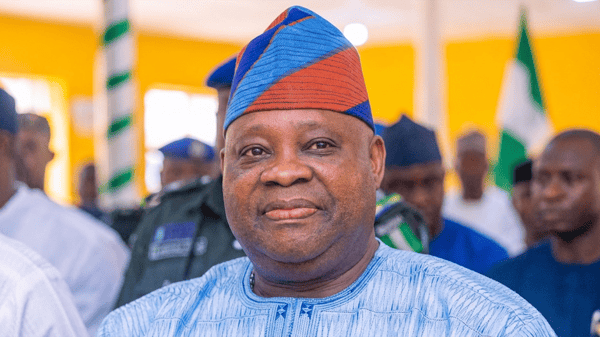
Governor Ademola Adeleke
By John Dike, Osogbo
Osun State Government has challenged the position of the Committee of Pro-Chancellors of State-Owned Universities (COPSUN) on the tenure extension of the Vice-Chancellor of Osun State University (UNIOSUN), describing the committee’s characterisation of the development as illegal, premature and requiring further legal clarification.
The government, while acknowledging COPSUN’s role in promoting sound governance and institutional stability in state-owned universities, said the committee’s position appeared to be based on what it described as an incomplete understanding of the constitutional and legislative framework governing UNIOSUN.
In a statement signed by the Commissioner for Information and Public Enlightenment, Oluomo Kolapo Alimi, the government said UNIOSUN was established by the Osun State House of Assembly under the Osun State University Establishment Law, 2006.
It argued that the 1999 Constitution places university education on the Concurrent Legislative List and recognises the authority of State Houses of Assembly to establish institutions for university, technological and professional education.
The government, however, acknowledged that state legislative authority does not exclude legitimate federal regulation of university standards, accreditation and professional requirements.
It cautioned, however, against conflating such regulatory responsibilities with the statutory governance of a state-owned university.
According to the statement, the central legal question arising from COPSUN’s reliance on the Universities (Miscellaneous Provisions) Amendment Act, 2012, is whether the relevant provisions of the federal legislation apply to UNIOSUN in a manner capable of overriding provisions contained in the university’s enabling law.
The government acknowledged the constitutional principle that a valid federal law prevails over an inconsistent state law to the extent of the inconsistency.
It nevertheless maintained that the constitutional competence, scope and applicability of the federal enactment must first be established before it could be concluded that the state’s governing law had been overridden.
The government also drew attention to the Osun State House of Assembly’s consideration and passage of the Osun State University Establishment Amendment Bill, 2026.
It said the legislative development made it inaccurate to portray the tenure arrangement as a unilateral alteration of the university’s governing law by the executive.
The government stressed that while the Visitor could not amend legislation through an executive declaration, neither could a professional body or staff union legislate through a public statement.
It said the pertinent issue was whether the legislative process undertaken by the State House of Assembly and the subsequent statutory arrangements were constitutionally and legally valid.
Clarifying the tenure timeline, the government said the incumbent Vice-Chancellor’s existing tenure runs until January 2027, while the proposed additional tenure is scheduled to commence on January 4, 2027.
It stressed that the arrangement therefore does not retrospectively alter an already completed tenure.
The government further noted that Governor Ademola Adeleke had publicly explained during the university’s 16th Convocation that the tenure extension followed consultations and legislative action concerning the institution’s enabling law.
While acknowledging COPSUN’s concerns regarding university autonomy, the state government maintained that institutional autonomy should not be interpreted as immunity from lawful legislative action.
It called for the respective responsibilities of the Visitor, Governing Council, Senate, university management, staff unions, National Universities Commission (NUC) and professional regulatory bodies to remain clearly defined.
The government warned that regulatory responsibilities should not become indistinguishable from the statutory governance powers of a state-owned university.
It consequently urged COPSUN to consider the complete legislative record and the final legal status of the amendment before reaching a definitive conclusion on the legality of the tenure extension.
The state government also called for the dispute to be resolved through the Constitution, applicable statutes and official legislative records rather than through competing public statements.
It expressed concern that the controversy should not undermine the academic stability and development of UNIOSUN, noting that the university continues to serve thousands of students and staff across its campuses and has recorded developments in infrastructure, research and academic activities.
The government therefore called for constructive engagement among COPSUN, the NUC, professional regulatory bodies, the university’s Governing Council, staff unions, the Visitor and the state government.
It stressed that all stakeholders in the university system must operate within their respective lawful mandates.
The state government reaffirmed its commitment to the rule of law, institutional stability, academic excellence and constructive engagement with stakeholders in the Nigerian university system.