- reject foreign aid bill
- call for recovery of lands seized by bandits, free 2027 elections, national prayer
By John Dike, Osogbo
The Catholic Bishops’ Conference of Nigeria (CBCN) has called on the Federal and state governments to intensify efforts to tackle insecurity, poverty, poor infrastructure and other challenges threatening the dignity and wellbeing of Nigerians.
It also urged the government to recover vast portions of land seized by bandits and ensure their productive use, while calling for stronger security measures to curb kidnapping, banditry, illegal mining and other criminal activities.
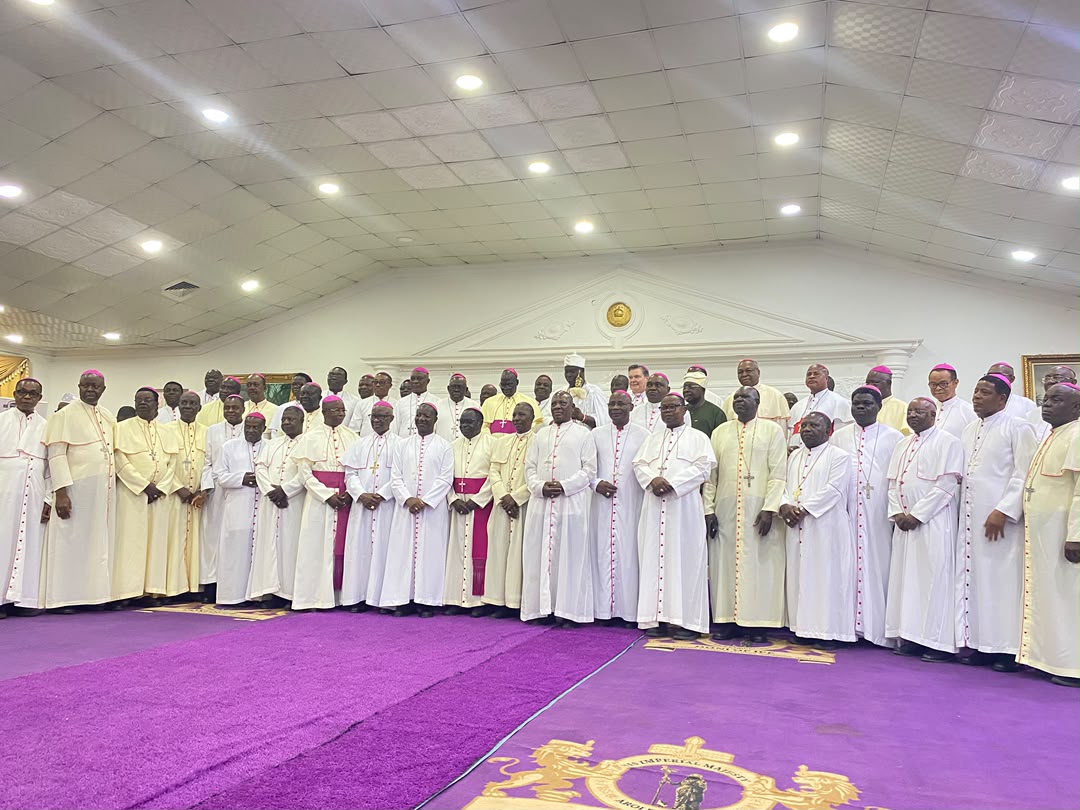
The demands were contained in a communiqué issued at the end of the Second Plenary Meeting of the CBCN held from September 10 to 18, 2026, at Our Lady and St. Kizito Pastoral Centre, Oke-Gada, Ede, in the Catholic Diocese of Osogbo, Osun State.
The communiqué, titled “Working Together for Upholding Human Dignity in Our Nation,” was signed by the President of the CBCN, Archbishop Matthew Man-Oso Ndagoso, and the Secretary, Bishop Peter Olukayode Odetoyinbo.
The bishops said the dignity of every human person was an inalienable, unconditional and inviolable gift rooted in humanity’s creation in the image and likeness of God.
They maintained that recognition of human dignity and the right to life formed the foundation of Catholic Social Teaching and were prerequisites for the pursuit of the common good and social justice.
According to them, sexual and other forms of violence constituted abuses of human dignity, stressing that the Church opposed every form of violence and abuse.
They noted that men and women were created equally in dignity and called to relationships marked by love, fidelity and mutual respect.
The CBCN acknowledged that the credibility of the Church’s pastoral witness was strongly affected by the manner in which it responded to cases of abuse, defended vulnerable people and listened to victims.
It therefore urged members of the Church and the wider society to reject all forms of abuse and violence and respect the dignity of every human person.
Technology, AI
The bishops also called for responsible and ethical use of technology and Artificial Intelligence (AI), particularly as Nigeria approaches the 2027 general elections.
They said technology was a profoundly human reality and should be deployed for purposes that promote human development rather than undermine society.
The CBCN urged politicians and other stakeholders to exercise responsibility and ethics in deploying technology and AI, warning against their misuse.
It also encouraged the use of digital platforms, social media and online catechesis in evangelisation and Christian formation.
Neo-paganism
The bishops expressed concern over what they described as the continued challenge of neo-paganism in Nigeria, particularly the return of some believers and young people to idol worship.
They attributed the trend, among other factors, to economic hardship, cultural revival and shallow Christian formation.
The conference observed that modern neo-paganism was spreading rapidly through internet culture, media engagement and books.
It therefore called on pastoral agents to make greater use of digital spaces, social media and online catechesis to teach the Christian faith.
The bishops also recommended what they described as healthy inculturation that respects positive aspects of Nigeria’s cultural heritage while upholding foundational Christian teachings.
Education
On education, the CBCN described quality education as a necessary tool for human development and peaceful integration of Nigeria’s diverse peoples and cultures.
It said Catholic education had contributed significantly to national development and reaffirmed the Church’s readiness to collaborate with government in providing quality education.
The bishops urged governments to embrace their constitutional responsibility to fund education, stressing that children have a right to education, particularly at the primary and secondary levels.
They also called for policies that would enhance the development of the human person and the nation.
Insecurity
On the state of the nation, the bishops thanked God for Nigeria’s human and natural resources and appreciated the efforts of governments and citizens to keep the country united.
They, however, expressed regret that insecurity, poverty, poor infrastructure, bad governance and assaults on human dignity continued to affect Nigerians.
On security, the bishops acknowledged moves by government to decentralise the police system but cautioned that any reorganisation must serve the common good rather than personal, ethnic, political or religious interests.
They said widespread violence, kidnapping, banditry, illegal mining and the theft of natural resources continued to deprive citizens of peace and threaten national unity.
The conference demanded that government do everything necessary to stop banditry, recover lands occupied by criminals and ensure that the recovered lands were put to productive and beneficial use.
The bishops also expressed concern over the invasion of schools and places of worship, as well as the abduction and killing of students and worshippers.
They noted that the massive displacement of communities in some parts of the country had adversely affected the social, economic and political lives of millions of Nigerians.
The CBCN called on government to intensify efforts and take impactful measures to enable displaced persons return safely to their ancestral homes.
It further urged government at all levels to ensure that migrants, refugees and internally displaced persons were treated with respect for their human dignity, basic rights and needs.
The bishops called for stronger security forces, better intelligence gathering and accountability for perpetrators of violence.
They also urged citizens to report suspicious activities, cooperate with security agencies and reject ethnic and religious divisions.
Poverty
The bishops expressed “grave concern” over the use of poverty as what they described as an instrument of control in the country.
They said economic hardship and lack of basic necessities had left many families struggling to survive despite Nigeria’s enormous resources.
The CBCN demanded that governments create more jobs, provide an enabling environment for businesses, support local enterprises and formulate economic policies capable of reducing the financial burden on poor Nigerians.
It called for concerted efforts by the Federal and state governments to drastically reduce poverty, pain and suffering.
The conference also encouraged citizens to embrace honest labour, support local businesses and reject criminality and corruption.
Poor infrastructure
The bishops also expressed concern over bad roads, erratic electricity supply and failing public utilities, saying these were slowing economic growth and affecting daily life.
They charged government to transparently invest more resources in public amenities, repair vital roads and ensure steady electricity and access to clean water.
The CBCN particularly called for the provision of railway transport facilities across the country to enhance socio-economic development.
It also urged citizens to protect public property from vandalism and report corrupt practices relating to infrastructure projects.
Foreign Aid Bill
The bishops rejected the Foreign Aids (Regulation, Transparency and Disclosure) Bill 2026, which they said had passed through first and second readings in the National Assembly.
According to the CBCN, although some provisions requiring registration and supervision of foreign aid resources might appear reasonable, the proposed legislation had the potential to adversely affect churches, mosques, schools and humanitarian organisations providing assistance to vulnerable and conflict-affected communities.
The bishops expressed concern about provisions that could allow authorities to deny registration or refuse renewal where an organisation’s activities were considered not to be in the “national interest.”
They argued that such provisions could give government officials broad discretionary powers and create unnecessary bureaucracy.
The conference maintained that non-profit organisations, incorporated trustees, churches, mosques and humanitarian bodies were already regulated by the Corporate Affairs Commission under the Companies and Allied Matters Act and other existing laws.
The CBCN therefore called on the National Assembly and Federal Government not to proceed with the process of making the bill law, citing concerns over freedom of association, religion, thought and conscience.
2027 elections
As Nigeria prepares for the 2027 general elections, the bishops called on all stakeholders to work towards free, fair and credible elections.
They urged eligible voters to participate actively and vote for qualified candidates according to their consciences.
The conference also called on Nigerians to study its pastoral letter on the forthcoming elections and follow its guidance.
The bishops directed dioceses and parishes across the country to organise civic education and mobilisation, as well as end-of-month fasting and prayer with Rosary processions from October to December 2026.
They announced December 8, 2026, as a special national day of prayer and fasting for the success of the 2027 general elections.
Church events
The CBCN, while marking the special Jubilee commemorating the eighth centenary of the death of St. Francis of Assisi, called on Nigerians to pay greater attention to environmental protection.
The bishops said the celebration of the Mass for the Care of Creation should serve as a wake-up call to strengthen efforts towards environmental protection.
They also expressed appreciation for the success of their Ad Limina Apostolorum visit to Rome from March 1 to 16, 2026, saying the visit reinforced communion with the Holy Father and expressing hope that it would bear fruit in the local churches and Nigeria.
The bishops congratulated the Vice President of the CBCN, Archbishop Alfred Adewale Martins of Lagos Archdiocese, on his appointment to the Dicastery for Evangelization, Section for First Evangelization and New Particular Churches.
They also commiserated with the Catholic Diocese of Abakaliki over the death of its Local Ordinary, Bishop Peter Nworie Chukwu, and the Archdiocese of Benin City over the death of Archbishop Augustine Obiora Akubeze.
The bishops congratulated Most Rev. Ernest Obodo and Most Rev. Donatus Ogun on their appointments as Apostolic Administrators of Abakaliki Diocese and Benin City Archdiocese respectively.
“All hope is not lost”
In conclusion, the CBCN declared that although Nigeria faced serious challenges in achieving national integration, “all hope is not lost.”
The bishops stressed that every positive change at home, workplace and community contributes to making society better.
They renewed their call for politics anchored on moral principles, protection of human life and dignity and pursuit of the common good.
The conference also pledged continued prayers for political leaders and all Nigerians, expressing hope for a productive, peaceful and dignified life for the people.
The communiqué was signed by Archbishop Matthew Man-Oso Ndagoso, President of the CBCN, and Bishop Peter Olukayode Odetoyinbo, Secretary of the Conference.