- congratulate Adeleke on reelection
By John Dike, Osogbo
The Catholic Bishops’ Conference of Nigeria (CBCN) has warned political leaders against manipulating the 2027 general elections, calling for free, fair and credible polls capable of restoring Nigerians’ confidence in the democratic process.
The Bishops also urged eligible voters to reject vote-buying and selling, resist political cronyism and refuse to allow themselves to be used as political thugs by desperate politicians during the forthcoming elections.
The President of the CBCN and Archbishop of Kaduna, Most Rev. Matthew Man-Oso Ndagoso, gave the warning on Thursday at the opening session of the Second Plenary Meeting of the Catholic Bishops’ Conference of Nigeria at Our Lady and St. Kizito’s Pastoral Centre, Oke-Gada, Ede, Osun State.
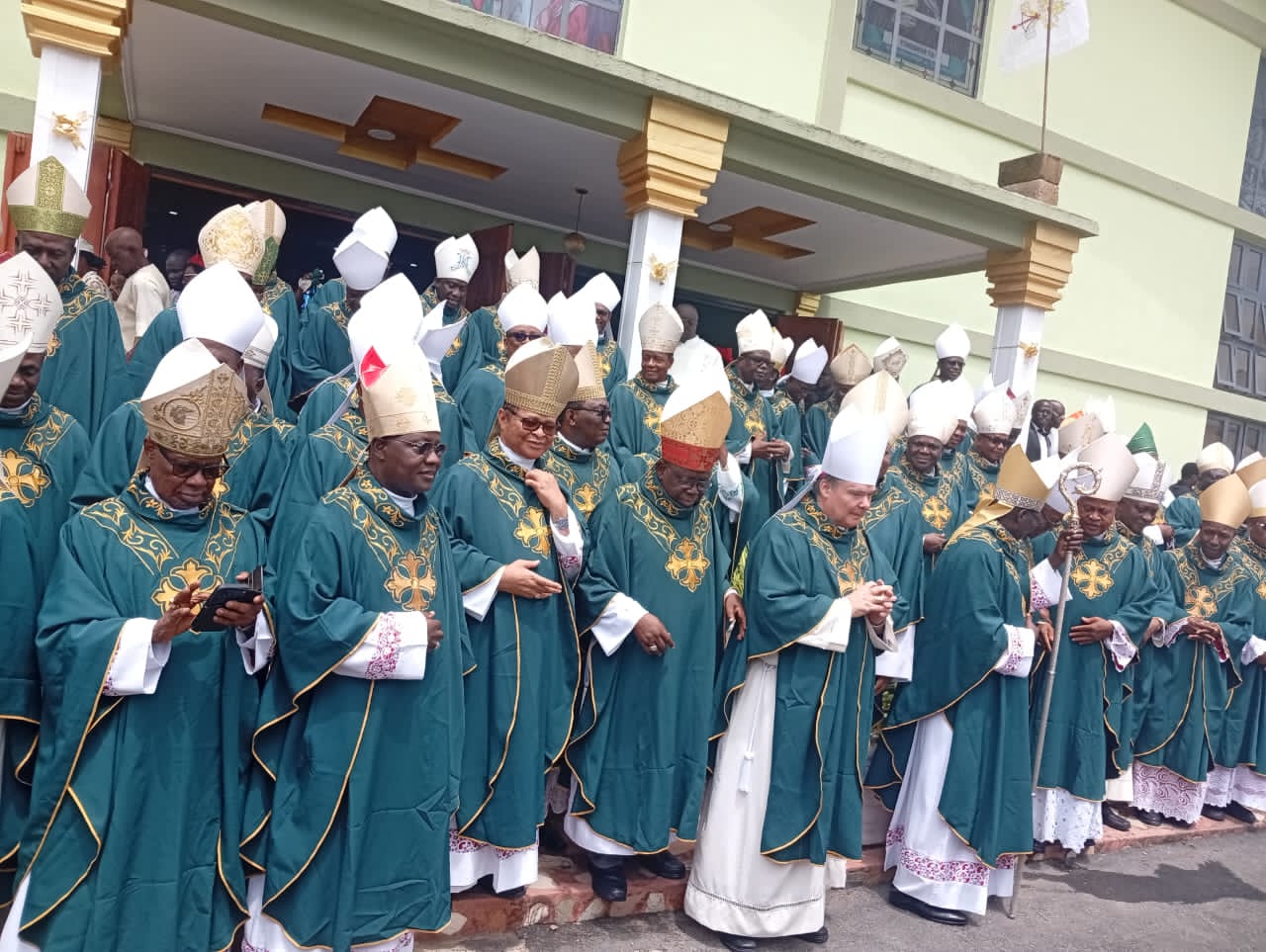
The plenary, which runs from September 10 to 18, 2026, brought together Catholic bishops, the Apostolic Nuncio to Nigeria, clergy, consecrated men and women, lay faithful and other Church leaders to deliberate on issues affecting the Church and the Nigerian society.
Archbishop Ndagoso, while addressing the gathering, said the 2027 general elections presented another opportunity for Nigeria to strengthen its democracy and restore public confidence in the electoral process.
He described politics as a noble profession when practised in the service of the common good, urging elected and appointed public officials to ensure that the electoral environment remained fair and inclusive.
He said political office holders, including the President, governors, National Assembly members, ministers and local government chairmen, had a responsibility to ensure that the rules of the democratic process were respected by all.
According to him, conducting credible elections was within the capacity of Nigerians and should not be treated as an impossible task.
He said: “Politics is a noble profession at the service of the common good and should be treated as such.”
The CBCN President said Nigerians were only a few months away from the 2027 general elections, noting that political campaigns had already commenced across the country.
He observed that political activities would soon take over stadia, event centres, school fields, hotels and other public spaces as politicians intensified their efforts to secure votes.
Despite the shortcomings of the democratic system, Ndagoso said Nigerians had continued to demonstrate faith in democracy by refusing to demand a return to military rule.
He said this was significant because Nigerians had, in the past, often called for military intervention whenever they became frustrated with elected governments.
According to him, the continued commitment of Nigerians to democracy should serve as a message to the political class that citizens still believed in the social contract between leaders and the people.
He therefore urged political leaders to reciprocate the confidence of Nigerians by improving security, tackling hunger and poverty and restoring public trust.
The Archbishop said Nigeria had the resources required to provide a better life for its citizens, but lamented that the major challenge remained the political will to deploy those resources for the common good.
Ndagoso expressed concern over what he described as increasing disenchantment among Nigerians arising from fears that electoral processes could be manipulated.
He said the fear that votes might not count could discourage citizens from participating in elections and weaken democratic institutions.
The CBCN President therefore called on the Independent National Electoral Commission (INEC) to ensure that the 2027 elections were free, fair, transparent and credible.
He urged the electoral commission to make voters’ cards easily available to all eligible Nigerians and remove unnecessary obstacles that could prevent citizens from exercising their constitutional right to vote.
He warned that anything short of a credible election in 2027 would constitute a serious disservice to Nigeria.
Ndagoso also called on the political class to conduct their activities in line with the national interest and urged eligible voters to come out in large numbers to vote for candidates of their choice.
He said Nigerians must not surrender their democratic power to political manipulators.
Bishops commend Osun election
The Catholic Bishops also commended INEC for the conduct of the recent Osun State governorship election, describing the poll as a positive development capable of restoring confidence in the electoral system.
Ndagoso said the Osun election had been adjudged free and fair by most election observers and analysts, describing the outcome as a glimmer of hope for Nigerians.
He expressed optimism that the experience in Osun could provide a model for improved electoral conduct ahead of the 2027 general elections.
He specifically commended the people of Osun State for participating in the election and guarding their votes.
According to him, the Osun experience demonstrated that credible elections were possible when voters were determined to participate actively in the democratic process.
He urged Nigerians in other parts of the country to emulate what he described as the positive example provided by Osun voters.
The Archbishop said the lesson from Osun was that Nigerians could protect the integrity of their votes when they collectively refused to be intimidated or discouraged.
He therefore called on Catholic lay faithful and other Nigerians to enter the political space with well-formed consciences and make informed decisions at the polls.
‘Reject vote buying’
Ndagoso called on Nigerians to reject vote-buying and vote-selling, warning that the practice undermined democracy and denied citizens the opportunity to choose leaders based on competence, integrity and capacity.
He also urged citizens to resist political cronyism and cynicism.
He said the Church, through its Justice, Development and Peace Commission (JDPC), would continue to educate its members and other people of goodwill on responsible political participation.
The CBCN President disclosed that the Church was preparing a pastoral letter on the 2027 general elections.
He further revealed that the Catholic Church was working towards establishing a situation room that would enable it to monitor the 2027 elections across the country.
He said the initiative was part of the Church’s effort to encourage responsible citizenship and contribute to the credibility of Nigeria’s electoral process.
Ndagoso said the Church would rely on its Social Teachings to educate the faithful on how to assess political candidates and make informed choices.
Bishops warn Nigerian youths against political thuggery
The CBCN President also issued a strong warning to Nigerian youths against allowing themselves to be recruited as political thugs.
He urged young Nigerians not to risk their lives or futures for politicians pursuing personal political ambitions.
According to him, young people who engage in political violence on behalf of politicians often end up abandoned after elections, while the politicians they fought for eventually reconcile among themselves.
He urged youths to understand that political opponents who encourage violence against one another during campaigns could become friends after the elections.
Ndagoso therefore appealed to Nigerian youths to refuse to be used as instruments of violence.
Bishops demand action on insecurity
The CBCN President expressed deep concern over the persistence of insecurity across several parts of Nigeria.
He said continued attacks on communities and institutions remained a serious concern to the Catholic Church and the wider Nigerian population.
According to him, many rural communities continued to feel abandoned and left to their fate as criminal attacks, killings and displacement persisted.
While appreciating the efforts of the Federal Government and security agencies, he said more needed to be done to protect vulnerable communities.
He expressed particular concern over attacks on places of worship and the killing and abduction of worshippers.
Ndagoso described such attacks as a wake-up call to religious leaders and the government.
He called for stronger security measures capable of protecting communities and religious institutions.
Illegal mining worsens insecurity
The Archbishop also identified illegal mining as an emerging area of serious concern, particularly in several northern parts of the country.
He said illegal mining had contributed to violence and instability in communities and called on the Federal Government to take stronger action to regulate the sector.
According to him, the country’s mineral resources should be developed legally and responsibly for the benefit of Nigerians rather than becoming sources of conflict and criminality.
He appealed to government to create effective regulations and ensure that mining becomes a legitimate economic activity that contributes to national development.
Ndagoso stressed that Nigeria’s natural resources must be deployed for the common good rather than exploited in ways that endanger communities.
Bishops demand rehabilitation of displaced Nigerians
The CBCN President also drew attention to the plight of millions of Nigerians displaced by insecurity over the past two decades.
He said the displacement of communities had caused serious social, economic and political consequences for affected Nigerians.
Ndagoso urged the government to develop a comprehensive rehabilitation programme for internally displaced persons and other victims of violence.
He said returning displaced citizens to their ancestral homes should be a priority of government before other development programmes were implemented in affected areas.
He called for a fully integrated master plan that would facilitate the safe return, rehabilitation and reintegration of displaced communities.
According to him, Nigerians who had lost their homes, livelihoods and communities to violence deserved more than temporary accommodation in IDP camps.
Call for humane treatment of migrants, refugees
The Archbishop also condemned hostility towards migrants and refugees in some host communities.
He urged Nigerians to treat migrants and refugees with dignity, stressing that displaced persons should not be regarded as threats merely because they came from other parts of the country or neighbouring countries.
He called on governments at all levels to ensure that the basic human rights and needs of migrants and refugees were respected.
Ndagoso commended Catholic dioceses, non-governmental organisations, corporate bodies and individuals working to alleviate the suffering of displaced persons and refugees.
He urged dioceses and parishes to strengthen collaboration with migration initiatives of the Catholic Secretariat of Nigeria.
Bishops urge religious leaders to avoid inflammatory statements
The CBCN President also expressed concern over tensions between Christian and Muslim communities arising from insecurity and violence.
He said the bonds between Christians and Muslims had been tested by years of violence and insecurity but urged Nigerians to preserve peaceful coexistence.
He reaffirmed the Catholic Church’s commitment to ecumenical and interreligious dialogue through the Christian Association of Nigeria (CAN) and the Nigeria Inter-Religious Council (NIREC).
Ndagoso, however, expressed concern over inflammatory statements allegedly made by some religious leaders.
He called on the government and law enforcement agencies to ensure that anyone whose statements threatened community harmony was held accountable under the law.
He stressed that nobody should be considered above the law regardless of religious, political or social status.
The Archbishop also encouraged Catholic jurisdictions across Nigeria to participate actively in CAN and support efforts aimed at strengthening relationships among Christian denominations.
He said stronger cooperation among Christians would improve engagement with Muslims and other religious groups for the benefit of the country.
Catholic Church renews partnership with government
Earlier in his address, Ndagoso highlighted the historic contribution of the Catholic Church to Nigeria’s development, particularly in education and healthcare.
He said the Church had been involved in building modern Nigeria through thousands of primary and secondary schools across the country.
He cited Catholic institutions in Lagos, Oyo, Ogun, Ondo and Ekiti states, including St. Gregory’s College, Holy Child College, St. Finbarr’s College, St. Louis Grammar School, St. Mary’s College, Loyola College, St. Peter’s College Abeokuta, St. Augustine’s College, Our Lady of Apostles College, St. Thomas Aquinas College and St. Michael’s College.
According to him, Catholic institutions had also established numerous universities, polytechnics and colleges of education.
He said the Church’s contribution extended beyond education to the medical sector, where it had established hundreds of hospitals, clinics and colleges of nursing sciences.
Ndagoso said the Church was therefore not asking government for charity whenever it sought partnership.
He explained that the Catholic Church was seeking collaboration with government because both institutions had a common responsibility to alleviate the suffering of Nigerians.
He said the moral decline in the education system required a collaborative response, stressing that government could not solve the problem alone.
The CBCN President disclosed that the Catholic Secretariat of Nigeria had developed Catholic Social Teaching textbooks for nursery, primary and secondary schools.
He said the textbooks were designed to introduce children to issues including human dignity, justice, solidarity, peace, responsible citizenship, care for creation and the common good.
He urged Catholic dioceses to ensure that the textbooks were adopted and effectively used in Catholic schools.
Ndagoso said Catholic schools should not only provide academic knowledge but should also form the consciences of young people and prepare them to become responsible citizens.
He said the Church wanted to raise a generation of young Nigerians whose faith would influence their understanding of society and motivate them to contribute positively to national development.
Archbishop warns on technology and artificial intelligence
Ndagoso also drew attention to the emerging challenges associated with technology and artificial intelligence.
He referenced Pope Leo XIV’s encyclical, Magnifica Humanitas: On Safeguarding the Human Person in the Time of Artificial Intelligence, saying technology had the capacity to heal, educate, connect and protect humanity but could also create new forms of injustice.
He warned that technology could become dangerous when developed or deployed irresponsibly.
According to him, technology itself was not inherently good or evil, but its impact depended largely on the people who developed, financed, regulated and used it.
He said the warning was particularly relevant to Nigeria as a developing country seeking to harness technological advancement for national development.
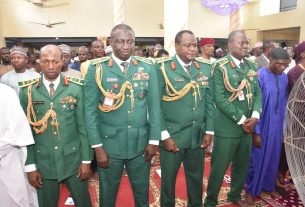
At the opening of the plenary, Archbishop Ndagoso welcomed Governor Ademola Adeleke and other government officials to the gathering.
He congratulated Adeleke on his re-election as Osun State Governor and commended the other contestants in the governorship election.
The CBCN President urged all political actors in the state to unite after the election and focus on delivering the dividends of democracy to the people.
He also thanked the Bishop of Osogbo Diocese, Most Rev. John Akinwumi Oyejola, and the faithful of the diocese for the reception accorded the bishops.
Ndagoso described Osogbo as an appropriate location for the conference, noting the city’s cultural significance, its UNESCO-recognised Sacred Grove, artistic heritage and importance to Yoruba music and dance.
He said the Catholic Church would continue to extend its hands of collaboration and partnership to government in line with its history of contributing to Nigeria’s development.
Church events and appointments
The CBCN President also informed the gathering about recent developments within the Catholic Church.
He recalled the Conference’s Ad Limina Apostolorum visit to Rome earlier in the year, describing it as a successful engagement.
He expressed appreciation to the Apostolic Nuncio to Nigeria, Archbishop Michael Francis Crotty, and the Secretary General of the Catholic Secretariat of Nigeria, Rev. Fr. Michael Banjo, for facilitating the visit.
He also congratulated His Eminence Anthony Cardinal Olubunmi Okogie and Archbishop Felix Adeosin Alaba Job on their birthdays and anniversaries of priestly and episcopal ordinations.
Ndagoso prayed for continued good health, peace and blessings for the two senior Church leaders.
He further recalled the celebration of 50 years of diplomatic relations between Nigeria and the Holy See.
He said the occasion provided an opportunity for Nigeria to strengthen its relationship with the Holy See, noting that Archbishop Paul Richard Gallagher, Secretary for Relations with States and International Organisations, visited Nigeria as part of the anniversary activities.
He said Gallagher was received by President Bola Ahmed Tinubu and the Minister of Foreign Affairs.
The CBCN President also announced developments following the death of two bishops.
He recalled the death of Most Rev. Peter Nworie Chukwu of Abakaliki Diocese, who also served as Assistant Secretary of the CBCN, and Most Rev. Augustine Obiora Akubeze of Benin City Archdiocese, a former President of the Conference.
He asked the gathering to pray for the repose of their souls and those of all the faithful departed.
Following the death of Bishop Chukwu, Most Rev. Ernest Obodo, Auxiliary Bishop of Enugu, was appointed Apostolic Administrator of the Diocese of Abakaliki.
Most Rev. Moses Chikwe, Auxiliary Bishop of Owerri, was also appointed Assistant Secretary of the CBCN.
Following the death of Archbishop Akubeze, Most Rev. Donatus Ogun, OSA, Bishop of Uromi, was appointed Apostolic Administrator of the Archdiocese of Benin City.
The Archbishop also announced the appointment of Most Rev. Alfred Adewale Martins, Archbishop of Lagos and Vice President of the CBCN, as a member of the Dicastery for Evangelization, Section for First Evangelization and New Particular Churches.
He congratulated the newly appointed Church leaders and prayed for God’s guidance in their respective responsibilities.
The Second Plenary Meeting of the CBCN continues in Osun State, with the bishops expected to deliberate further on matters affecting the Catholic Church, governance, peace, security, the economy, national development and the moral responsibilities of Nigerians ahead of the 2027 general elections.