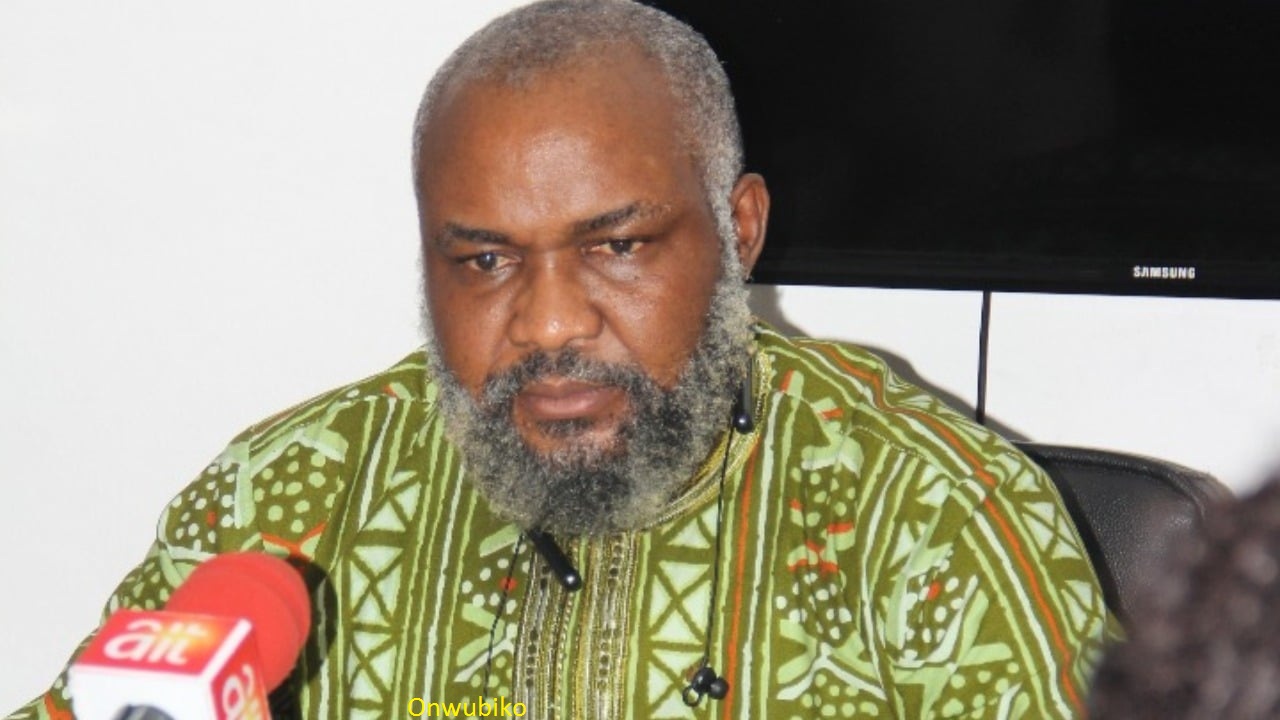
HURIWA’s National Coordinator, Emmanuel Onwubiko
The Human Rights Writers Association of Nigeria (HURIWA) has rejected the interim report of the Independent Corrupt Practices and Other Related Offences Commission (ICPC) on the controversial Presidential Foreign Intervention Promotion Council (PFIPC), saying the findings raised more questions than they answered.
HURIWA, in a statement signed on Friday by its National Coordinator, Comrade Emmanuel Onwubiko, argued that the report appeared to focus largely on alleged offences committed by one individual while failing to establish how a purportedly non-existent government agency operated within official circles for an extended period.
The organisation said it was not opposed to the prosecution of Prince Adeniyi Adeyemi, whom the ICPC reportedly accused of forging documents, falsely presenting himself as Director-General of the PFIPC, creating additional agencies, opening bank accounts with forged instruments and exploiting weaknesses in government institutions.
However, it insisted that the alleged activities of Adeyemi could not, on their own, explain how the PFIPC acquired the appearance of an official government institution.
According to HURIWA, the central issue was not merely who allegedly forged documents, but how such documents were accepted and acted upon by government institutions.
It asked how a non-existent agency could acquire official legitimacy, who admitted its operators into government circles, who authorised meetings and engagements with public institutions and why elementary verification procedures failed to detect the alleged fraud.
The group also questioned how the PFIPC found its way into the 2026 Appropriation Act with a budgetary allocation running into billions of naira if it did not legally exist.
HURIWA said, “The questions confronting Nigeria are neither difficult nor complicated,” listing the need to establish who processed documents linked to the agency, who ignored red flags and who enabled it to operate without challenge.
The organisation expressed concern that the ICPC’s interim findings could give the impression that the scandal was essentially the work of a lone individual.
It argued that such a conclusion would be difficult to reconcile with the scale and duration of the alleged activities, particularly given the involvement of multiple Ministries, Departments and Agencies (MDAs).
“HURIWA refuses to accept the proposition that one private citizen, acting entirely alone, successfully penetrated multiple Ministries, Departments and Agencies, operated for an extended period, secured official interactions and allegedly built an elaborate structure involving forged instruments without significant failures or possible complicity within the public service,” Onwubiko stated.
The association noted that the ICPC itself had identified weaknesses in inter-agency coordination, verification mechanisms and internal controls, arguing that such weaknesses required further investigation.
It said Nigerians deserved to know whether the failures were merely administrative lapses or whether some officials deliberately facilitated the activities of the alleged fake agency.
HURIWA was particularly critical of any recommendation for administrative sanctions against public officers whose negligence may have enabled the operation.
It argued that where evidence established criminal wrongdoing, administrative sanctions should not substitute for prosecution.
The group consequently urged the ICPC to pursue every credible lead and investigate all individuals and institutions connected to the PFIPC controversy, regardless of their status or political influence.
It also called on the National Assembly to deepen its independent investigation into the affair and establish the chain of events that allowed the alleged fake agency to operate within the government system.
HURIWA said the legislature should determine not only who allegedly forged documents but also how government systems failed and whether public officials should be held accountable for their actions or omissions.
The organisation maintained that the credibility of the government’s anti-corruption campaign would ultimately depend on whether the investigation was comprehensive and impartial.
“The credibility of Nigeria’s anti-corruption campaign will not be measured by the prosecution of one suspect alone. It will be measured by whether the investigation is comprehensive, impartial and fearless enough to identify every person whose actions or omissions contributed to the scandal,” it said.
HURIWA further urged President Bola Ahmed Tinubu to ensure that the investigation was taken to its logical conclusion, with every person against whom credible evidence emerged subjected to the same standard of justice.
It said the PFIPC controversy remained a major test of transparency, accountability and institutional integrity, stressing that Nigerians deserved a complete explanation of how an organisation later described as non-existent was able to present itself as a government institution for so long.
The Guardian
Fake agency probe: ICPC report clears Presidency, indicts embattled DG