

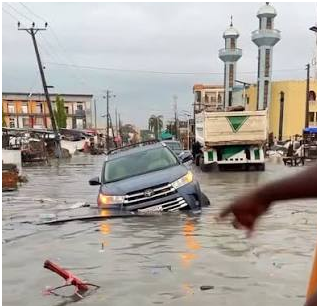
The Federal Government and Lagos State have blamed blocked drainage channels indiscriminate waste disposal, and climate change for the recent flooding in some parts of the state.
They dismissed claims that the Lagos-Calabar Coastal Highway is responsible for the disaster pledging closer collaboration to address environmental challenges along the corridor.
Works Minister, David Umahi, declared this on Tuesday during an inspection tour of the Lagos section of the highway with members of the National Assembly Committees on Works and Environment.
He later met with Governor Babajide Sanwo-Olu at the Lagos House, Marina.
According to Umahi, the inspection was at the directive of President Bola Tinubu due to complaints by residents and reports alleging that the project had contributed to flooding in nearby communities.
He said, “We are here on the directives of Mr President, with our supervisors from the National Assembly, following complaints by residents that the coastal highway is causing flooding within the corridor.”
Umahi rejected the claims, arguing that many affected communities had long been vulnerable due to their geographical location, poor drainage systems and the effects of climate change.
He said Lagos’ coastal communities have a high water table and experience frequent Atlantic Ocean surges, while increased rainfall has worsened flooding.
The minister blamed blocked drainage channels, indiscriminate waste disposal and poor urban planning for aggravating the situation.
His words, “If the coastal highway had not been constructed, Oceanbay Estate would have been completely wiped out.”
Umahi noted that flood-control measures were incorporated into the project, particularly around the Kuramo and Bluewater axis, adding that the government was ready to construct internal roads and drainage systems in low-lying communities.
“We are willing to provide internal roads and also put drainage at that level because our coastal highway is higher than the buildings.
“We have culverts, but some people dump refuse into manholes, thereby blocking them. They should stop complaining,” he said.
He urged residents to stop dumping refuse into drainage channels, warning that the practice obstructs water flow and worsens flooding.
Also, he disclosed that the ministry was considering a partnership with the Lagos State Government to construct service lanes along sections of the highway as part of efforts to improve access and address environmental concerns.
In his speech, Governor Babajide Sanwo-Olu, commended President Tinubu, Umahi and the National Assembly for supporting the project, describing the coastal highway as a transformative infrastructure initiative that would boost economic growth.
He said the project, which was once viewed as a political promise, had become a reality, with sections of the road already in use.
“Two years ago, it felt like it was just a political conversation, but today people are already using the road,” he said.
Sanwo-Olu explained that Lagos, being a coastal city with a significant portion of its land covered by water, would naturally experience seasonal flooding.
He said flooding was a common challenge in coastal cities globally but noted that indiscriminate waste disposal and blocked drainage channels had worsened the situation.
The governor added that Lagos would continue enforcing environmental regulations and strengthening measures to protect drainage infrastructure.
He disclosed that the state had signed an agreement with a mechanised street-cleaning company to deploy specialised sweeping machines to maintain the Lagos-Calabar Coastal Highway daily.
Both Umahi and Sanwo-Olu stressed the need for sustained stakeholders’ engagement involving residents, environmental experts and government agencies to develop lasting solutions.
Umahi added that recommendations from environmental impact assessments would guide future interventions, including possible demolition of structures obstructing proposed service lanes, with affected property owners to be compensated in line with government policy.
He also announced plans for additional drainage channels, surveillance cameras, wind stations, parking facilities, tourism infrastructure and other modern amenities along the corridor.


