Mega City
By Babatope Okeowo
The Olokola Free Trade Zone (OKFTZ) is a joint initiative of the Federal, Ondo, and Ogun state governments, conceived in 2005. However, the baby was then abandoned for over 20 years by successive administrations. Now there is hope of its coming alive as the efforts of the richest man in Africa, Alhaji Aliko Dangote, to revive the project is yielding fruits.
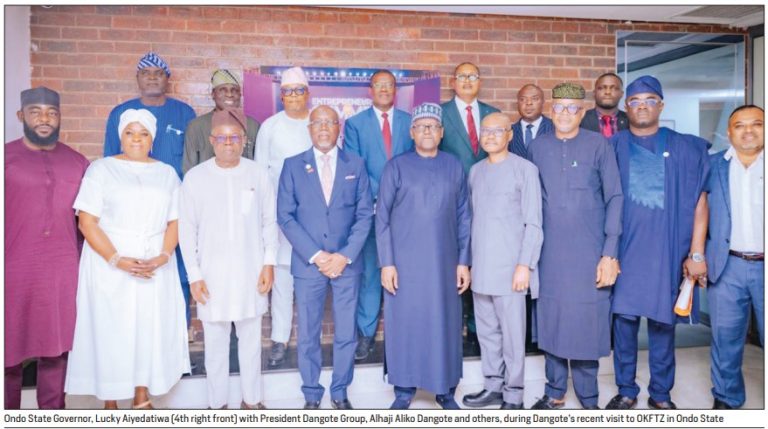
On June 15, 2026, Dangote, and his team walked into the Governor’s Office in Akure, the Ondo State capital, to discuss with Governor Lucky Aiyedatiwa and members of his cabinet on the future of the project, which will turn around the economic fortunes of the state. An elated Aiyedatiwa said Ondo State is set for an “industrial revolution” with the take-off of OKFTZ. Aiyedatiwa said OKFTZ is an economic strategy to change the state from predominantly civil service-driven to an economic hub.
The Project was conceived in 2005 as a joint Ondo-Ogun venture. Olokola was designed to be Nigeria’s answer to Singapore in Asia – a deep seaport, gas corridor, refinery, fertiliser plant, and manufacturing belt along the Atlantic, less than 100 kilometres east of Lagos. It was meant to be a $6 billion project when it was conceived in 2005. Dangote Group of Companies was a partner in the multi-billion-dollar project.
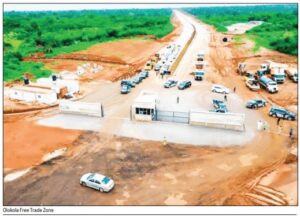
The OKFTZ was located in a 10,000-hectare coastal enclave along the Atlantic, straddling the Ogun Waterside Local Government Area of Ogun State and the Ilaje Local Government Area of Ondo State. It was to serve as a maritime, industrial, and logistics hub with a deep seaport, power, gas, and manufacturing zones. The zone was meant to be a South-West economic gateway But the project became stalled, forcing the Dangote Group to concentrate investments in Lagos instead.
The major reason for abandoning the project was the policy gaps of the participating governments. When the project was conceived, Dr Olusegun Agagu was the Governor in Ondo State, while Otunba Gbenga Daniel was the Governor in the neighbouring Ogun State.
The President was Chief Olusegun Obasanjo. The trio were pushing for the take-off of the project until they left office in 2007, 2009, and 2011, respectively.
The exit of governments that were interested in the project led to coordination issues and delays. Dangote said the group previously attempted Olokola investments but faced operational challenges, forcing concentration in Lagos. Without reliable power and with slow regulatory movement, investors looked elsewhere.
Preparatory to the revival of the Free Trade Zone, Aiyedatiwa inaugurated the Technical Committee on the OKFTZ, the move that set in motion fresh efforts to revive the longabandoned industrial project.
The committee is chaired by Chief Bode Sunmonu, who was the Commissioner for Commerce and Industry when the project was conceived. Other members of the committee included: Mr Yinka Orokoto, Mr Sola Adebisi, Mr Idowu Ojo, and Engineer Femi Akarakiri. Mr Emmanuel Omomowo served as secretary.
Speaking at the inauguration, Aiyedatiwa described the event as a historic step towards the reactivation and optimisation of the Olokola corridor, saying his administration is determined to transform the project from a long-standing concept into a thriving economic reality.
The Governor recalled that the Olokola Free Trade Zone was conceived in 2005 as a joint initiative of the Ondo and Ogun state governments. Situated along the coastlines of both states with direct access to the Atlantic Ocean, the zone was designed as a strategic economic gateway for the South-West and Nigeria.
According to him, the project has the potential to become one of Africa’s leading maritime, industrial, and logistics hubs due to its strategic location and abundant natural resources. Lamenting that the vision had remained dormant for nearly two decades, he said the people of Ondo State had long looked to the coastline as a source of thousands of jobs, major investments, and accelerated industrialisation, but policy gaps, coordination challenges, and implementation delays had hindered its realisation.
He assured investors and development partners of the state’s readiness to support investment initiatives, disclosing that during a recent visit to the state, President of the Dangote Group, Dangote, expressed the company’s resolve to return to Olokola and develop the largest industrial and free trade hub in Nigeria there.
The proposed development, according to the governor, will include independent power generation, gas infrastructure, cement production facilities, and a plug-and-play environment for investors. Aiyedatiwa said members of the committee were selected based on competence, integrity, experience, and proven records in infrastructure, finance, law, trade, and project management.
He said the committee would undertake a comprehensive review of all legal instruments governing the project, including joint venture and shareholders’ agreements, powers of attorney, and documents relating to IPEM’s divestment of equity to the Dangote Group. The committee will also serve as the interface between the Ondo State Government and key stakeholders, including the Dangote Group, IPEM, OKFTZC, OKFTZE, the Nigeria Export Processing Zones Authority (NEPZA), the Deep-Sea Port Authority, the Ogun State Government, and relevant federal agencies.
Other responsibilities include verification of land ownership and status within the zone, identification of encroachments and alienation issues, resolution of outstanding community matters, including compensation for economic trees and crops, and engagement with host communities and groups to sustain support for the project.
The governor further charged members to discharge their responsibilities with urgency, transparency, and patriotism, noting that they had been entrusted with the historic task of restoring the Olokola project to its intended position. He disclosed that the committee had been given six weeks to submit its report, a timeline informed by the Dangote Group’s planned mobilisation to the site.
The Chairman of the Technical Committee assured the governor that members would deliver on their mandate within the stipulated period, revealing that work had commenced even before the formal inauguration. He commended the governor for his leadership and commitment to reviving the project, noting that the conducive investment environment created by the administration contributed to the return of the Dangote Group
. Describing the development as a major boost for industrialisation, job creation, and economic prosperity, Sunmonu noted that the benefits of investments in the zone would be shared by Ondo and Ogun states, irrespective of location, and pledged that all technical requirements would be handled transparently and in line with global best practices.
Dangote’s revival plan
When Dangote and his team walked into the Governor’s Office, they were received by the governor and his economic team, who were ready to accommodate the multi-billion-dollar investments that would shape the economic landscape of the state.
The President of Dangote Group, in his speech, reaffirmed plans to develop a large-scale industrial and free trade zone at Olokola in Ondo State, describing it as a power-driven investment hub designed to attract manufacturers and reduce infrastructure constraints for investors. He outlined a renewed investment framework covering power generation, cement production, gas infrastructure, and industrial manufacturing.
He said the proposed Olokola project would go beyond a conventional free trade zone, stressing that it would be fully equipped with power, water, and logistics infrastructure to enable investors to operate without delays associated with basic utilities.
According to him: “We want to create the biggest free trade zone where investors can just come and plug in. We will generate power, provide infrastructure, and remove the bottlenecks around doing business.”
Dangote said the initiative was designed to address Nigeria’s long-standing power deficit, which he described as the country’s biggest industrial constraint for over 30 years, noting that most manufacturers currently rely on self-generated electricity. He explained that the absence of reliable power had slowed industrial expansion across the country, adding that the new model would integrate a dedicated energy supply into the industrial zone.
He also disclosed plans to integrate gas infrastructure through an east-west gas corridor to support energy intensive industries within the zone. Dangote said the Group had previously attempted to develop investments in Olokola but was constrained by operational challenges at the time, leading to the concentration of projects in Lagos.
He, however, said the renewed engagement reflects improved conditions and stronger collaboration prospects with the state government. According to him, contractors are expected to mobilise to the site within three to four months, with full construction scheduled to commence in the last quarter of the year. He also indicated that the project structure would include government participation, requesting the nomination of a state representative to the board of the industrial zone to facilitate coordination and execution.
Dangote said the initiative would stimulate large-scale job creation and industrial expansion across Ondo State and surrounding regions, noting that similar projects in Lagos had delivered significant employment and export revenues. Aiyedatiwa welcomed Dangote’s renewed investment drive, describing it as a major milestone in Ondo State’s industrialisation agenda.
He said the project aligns with his administration’s efforts to position the state as a leading industrial destination in the South-West, noting its strategic location along the Lagos-Calabar Coastal Highway corridor. The governor also highlighted the state’s deep-seaport licence, describing it as a key logistics advantage capable of handling large vessels without transhipment. He disclosed that limestone deposits in the state had been tested and found suitable for industrial use, signalling potential for cement production expansion.
He said a technical committee had been established to engage with Dangote Group on legal, land, community, and operational frameworks, while confirming readiness to nominate a state representative to the project board. He assured full government backing for the initiative, stressing that Ondo State would work closely with investors and host communities to ensure smooth implementation and long-term sustainability.
Aiyedatiwa woos investors In his desire for economic growth of the state, Aiyedatiwa called for urgent action to revive a long-dormant oil asset in the state, warning that delays in investment decisions and infrastructure gaps must be addressed if Nigeria is to meet its crude oil production targets.
Speaking during a courtesy visit by Sahara Energy Group executives to the Governor’s Office in Akure, where discussions centred on reactivating an oil field that has remained inactive since 1998, Aiyedatiwa said Ondo State must take a stronger position in national oil production, stressing that its oil assets, if properly developed, could significantly boost output. Recalling a past fire incident linked to the field, he said the episode exposed inconsistencies in operational information management.
His words: “I remember when there was a fire outbreak in that very well, and then I was in NDDC as the representative of the state. They claimed then that there was no operation in that place, that there was no oil…and I was like, how can a place with no oil be on fire? Is it water that is bringing out the fire? The governor said Ondo’s ranking among oil-producing states – at number five – could improve with renewed activity and stronger operational systems.
He stressed that production growth would depend on addressing structural and operational constraints, including leakages and out-dated systems. Aiyedatiwa, who said modernisation and fresh investment inflows are key to efficiency and higher output, assured investors of a secure and supportive environment, describing Ondo State as peaceful and open to oil operations.
He disclosed that the state had awarded dredging contracts to improve waterways and ease logistics to production sites, with further interventions planned for affected communities. He reiterated his administration’s commitment to boosting investor confidence, expanding production capacity, and ensuring oil-producing areas benefit from development
EndnoteIf contractors are on site by year end and construction begins fourth quarter 2026 as promised by Dangote, Olokola could finally move from master plan to cranes on the shoreline. Until then, communities that have waited 20 years may just see the Atlantic unveil its hidden wealth for the benefits of the people.
New Telegraph