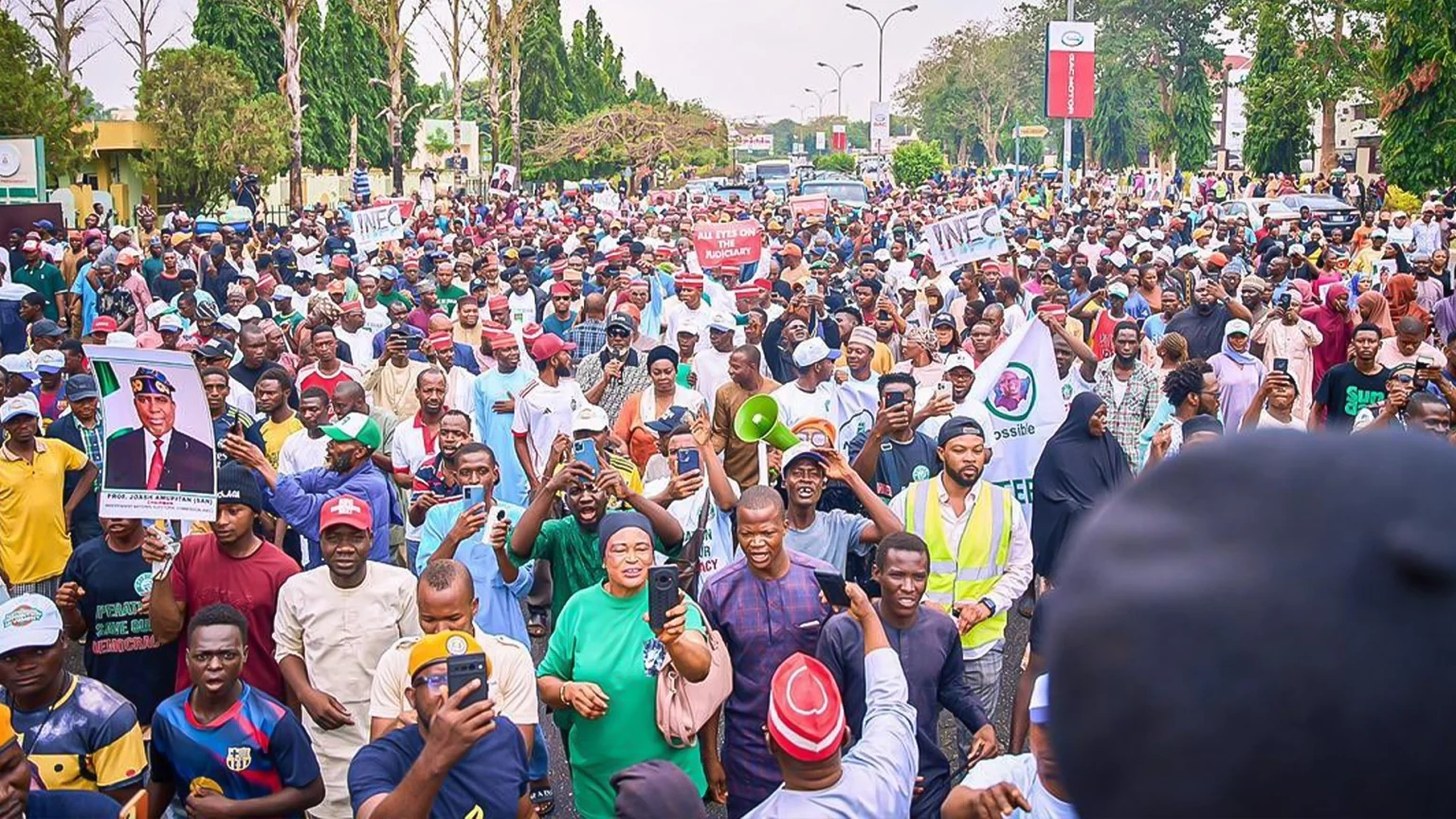
Supporters of the African Democratic Congress (ADC) on a peaceful protest tagged ‘Occupy INEC’ in Abuja, on Wednesday. PHOTO: LUCY LADIDI ATEKO
- Opposition must survive, Mark insists
- Dare: No design to have only APC on ballot
One week after the derecognition of the African Democratic Congress (ADC) leadership by the Independent National Electoral Commission (INEC), the party’s national leaders, yesterday, intensified the standoff with the electoral umpire with a protest at the Federal Capital Territory (FCT), while calling on Nigerians to defend democracy.
Leading the demonstration were the party’s National Chairman, David Mark; National Secretary, Rauf Aregbesola; former Vice-President Atiku Abubakar; Peter Obi; Rotimi Amaechi; and Rabiu Musa Kwankwaso. In a symbolic gesture, protesters opened the rally by singing Nigeria’s former national anthem, “Arise, O Compatriots,” before marching to INEC headquarters, where they submitted a formal petition.
In a letter dated April 8, 2026, the ADC called for the immediate resignation or removal of the INEC chairman, Joseph Amupitan, accusing him of misconduct and abuse of office.
“The credibility of the Commission is now at stake,” the party stated, framing its demand as necessary to protect institutional integrity. The party alleged that INEC, under Amupitan’s leadership, had abandoned neutrality.
On the same day, a Washington-based lobbying firm, Von Batten-Montague-York, L.C., has said it will urge United States authorities, including President Donald Trump and members of Congress, to impose sanctions on Nigerian officials over INEC’s derecognition of the ADC leadership. In a statement, the firm raised concerns about INEC’s role in Nigeria’s electoral process, citing past and emerging challenges.
It said, “Nigeria’s Independent National Electoral Commission, though supported by the United States and the European Union, has the capacity to credibly manage federal elections. Yet, INEC has demonstrated serious weaknesses in safeguarding free, fair, and credible elections when confronted with deliberate efforts by Nigerian political actors to manipulate and undermine the voting process.”
It added that “this was evident during the 2023 Nigerian elections, and current developments suggest the same pattern may be emerging again.” The firm disclosed that it is already engaging U.S. policymakers, noting that “the U.S. House and Senate are currently on Easter recess, but we are actively echoing the State Department’s assessment to key members of Congress and intend to brief congressional leadership and senior members of the U.S. National Security Council early next week.”
Recall that INEC, citing an order of the Court of Appeal that the status quo ante bellum should be maintained, removed all the names of the David Mark-led National Working Committee (NWC) of the party from its portal, thereby rendering the party comatose.
But stakeholders have continued to point to the action of the electoral commission as evidence of a covert ploy to remove the feature of multiparty competition in next year’s general election, even as the INEC chairman is being accused of partisanship.
According to Haruna Mohammed, who explained the rationale for the commission’s action, the delisting of the names of Mark and Aregbesola as the national chairman and national secretary of the ADC was a sequel to ‘Court Order” flowing from Suit No. FHC/ABJ/CS/1819/2025, filed by Nafiu Bala Gombe.
INEC explained that while Gombe was still serving as the ADC Vice-National Chairman, other members of the NWC, led by Ralph Okey Nwosu, resigned from their offices to pave the way for the emergence of Mark and others.
The Commission added that contrary to the suggestion by the Nwosu-led NWC that all the members of the NWC resigned en masse, “Gombe, who was the Vice-National Chairman, denied he ever resigned from the party and claimed that he, automatically, ought to take over as the chairman of the party.”
RILED by INEC’s interpretation of the Court Order for status quo to be maintained, stakeholders regretted the creepy attempts to kill virile opposition, which constitutes the life wire of multi-party democracy.
For instance, writing for the Athena Election Observatory, former Aviation Minister, Osita Chidoka, lamented that Nigeria’s political competition was weakening, noting: “Strengthening the institutional foundations of political competition is not a partisan objective. It is a constitutional and democratic imperative.”
While examining the roles of INEC and the judiciary in the unfolding onslaught against democratic plurality, the report called on the electoral commission and Nigeria’s judiciary to operate with greater clarity, consistency, and restraint in politically sensitive disputes.
The report, therefore, documented intra-party crises across the ADC, Peoples Democratic Party (PDP), and Labour Party (LP), arguing that “these are not isolated events, but symptoms of a deeper structural problem.”
The report also observed obvious shortcomings in the political party management and cohesion in the country, stressing that “political coordination in Nigeria consistently outpaces the institutional frameworks required to sustain it.
“Alliances are formed, actors reposition, and coalitions emerge, but the rules governing internal party democracy, leadership legitimacy, and dispute resolution remain contested or underdeveloped.”
In a similar vein, accusing the ruling party of actively fertilising insurrection within the opposition parties, one Ifeanyi Diokpa, noted that the planned litigation against the National Democratic Congress (NDC), the newest party registered by INEC, shows that the ruling All Progressives Congress (APC) was guilty of troubling the opposition.
In a post on his X (formerly Twitter) handle, Diokpa declared: “NDC is a newly registered party. They didn’t kill anyone, they didn’t take anything from anyone, yet some people have already been sponsored to file court cases against them. If what we are dealing with isn’t clear to you by now, then your blindness is a special case.”
Also, taking to his X handle, Prof Ekiyor K. Wellson, opined that “the coalition may have been planning to use NDC as ‘Plan B’ and someone leaked it to President Tinubu. It’s possible that people within the top echelon of the coalition are working with Tinubu to sabotage the coalition; that is a possibility.”
But dissociating the Yoruba ethnic nationality from the political stratagem of President Tinubu, a public affairs commentator, Olawale Oluwade, said that politics has replaced governance in the scheme of things.
Comparing former President Goodluck Jonathan’s era with the current dispensation, Oluwade noted that by voluntarily relinquishing power, “Jonathan earned his seat in the pantheon of decent and honourable leaders of the world.”
“For three years now, no concrete effort at solving the following existential crisis bedevilling this country: out-of-school children, maternal and infant mortalities, chronic hunger and misery, electricity failure, rampant poverty, unemployment and insecurity. Nothing has been done on any of these beyond showboating.”
Also, the founding national chairman of All Progressives Grand Alliance (APGA), Dr Chekwas Okorie, called on politicians to reflect on history and learn to give fairness a chance for national survival and progress.
Okorie recalled how, during the military transition to democracy in 1998, the authorities wanted additional political parties after the Peoples Democratic Party (PDP) and All Peoples Party (APP) were registered, to cater for plurality and inclusion and avoid railroading voters into two odd choices.
“We applied to be registered as the Peoples Democratic Congress, but INEC rejected our proposal and registered Alliance for Democracy (AD). We were more qualified, but the military wanted to ensure that the South-West was well accommodated for national unity and stability.
“If the military understands the nuances of nation-building and democracy, I expect that politicians should be more circumspect in their quest for absolute power. It is obvious that most of the state governors who left their party for the ruling party are afraid of their shadows.”
Okorie, who is the convener of Igbo Agenda Dialogue, expressed the belief that Nigeria’s democracy would survive the politics of impunity, remarking that corruption festers when there are no opposing views.
MEANWHILE, the embattled National Chairman of ADC, Senator David Mark, yesterday, assured Nigerians that there was no cause for alarm, stressing that the current distress in the polity poses no threat to the opposition party.
Speaking at a church Thanksgiving earlier, to mark his 78th birthday anniversary, the former Senate President said challenges are a normal part of any growing institution, maintaining that the ADC will ultimately triumph.
“We remain united, determined, and focused on strengthening the party and upholding democratic values. Let me reiterate that we are fully committed to the survival of democracy and the development of our dear nation, Nigeria. We will continue to work tirelessly, guided by discipline, integrity, and patriotism, to ensure that our democratic institutions are preserved and that the dividends of democracy reach all our people.”
He noted, however, that INEC’s decision to subdue the party has effectively created a leadership vacuum in the ADC in a few weeks before the deadline for submission of electronic membership registers for party primaries for the 2027 general election.
Amid the ongoing crises of legitimacy bedevilling the major opposition parties, The Guardian gathered that the main opposition parties, ADC and PDP, are exploring the possibility of an imminent coalition to join forces against the creeping totalitarian rule in the country.
Leaders of the opposition on Wednesday night converged on the Abuja residence of David Mark, in what observers describe as a decisive step towards forging a broad-based political coalition ahead of future electoral contests.
The high-level meeting, held behind closed doors, brought together key figures from the PDP and the ADC, in what insiders say could culminate in a strategic alliance between the two parties.
Among those in attendance were Atiku Abubakar, Oyo State Governor, Seyi Makinde, and prominent PDP stakeholders under the leadership of Tanimu Turaki. Also present at the crucial meeting were former Minister of Justice, Abubakar Malami; former governors Rotimi Amaechi, Rabiu Musa Kwankwaso, Aminu Tambuwal, Peter Obi, and Babangida Aliyu.
Others included former Minister of Information, Prof. Jerry Gana; PDP National Secretary, Taofeeq Arapaja; ADC National Publicity Secretary, Bolaji Abdullahi; and PDP National Publicity Secretary, Ini Ememobong.
From the PDP bloc were the Chairman of the defunct PDP faction, Kabiru Tanimu Turaki, and the factional Board of Trustees (BoT) Chairman, Adolphus Wabara, alongside other party chieftains.
Although details of deliberations were not immediately available as of press time, sources familiar with the development hinted that discussions centred on the possibility of forming a united opposition front capable of challenging the ruling party and reshaping the country’s political landscape.
Observers note that the choice of Mark’s residence as a venue underscores his continuing role as a rallying figure within opposition politics, particularly at a time when realignments and strategic partnerships are gaining momentum.
The visit, according to a statement signed by the factional PDP National Publicity Secretary, Ini Ememobong, followed “recent political attacks targeted at Nigeria’s opposition parties.”
The party said the development reflects a pattern affecting multiple opposition groups. “The PDP acknowledged the growing and shared threat confronting opposition political parties in the country, noting that similar pressures have been experienced by the PDP in recent times,” the statement added. It also stressed the need for caution to protect democratic values.
The meeting is expected to produce a communiqué outlining key resolutions, which may offer clearer insight into the direction of the emerging political collaboration.
As the nation inches closer to another electoral cycle, the outcome of the Abuja talks is likely to shape the trajectory of opposition politics and redefine alliances within Nigeria’s evolving democratic space.
However, the Special Adviser to President Tinubu on Media and Public Communication, Sunday Dare, has denied allegations by opposition parties that the ruling APC is working to ensure it will be the only viable party on the ballot in the 2027 general election. Speaking on Channels Television’s Politics Today on Wednesday, Dare said there is no plan, covert or overt, to restrict the ballot to the APC.
“There is no design, whether covertly or overtly, to have just the APC on the ballot. We have 21 parties registered to compete on the ballot; every party has the right to field a candidate. Now the APC will not roll out the carpet and close shop because other parties are struggling,” Dare said.
The rebuttal by Dare comes a day after the spokesperson of ADC, Bolaji Abdullahi, accused the APC of instigating crises within opposition parties to avoid being challenged in the 2027 elections. Abdullahi claimed that President Tinubu and the APC were seeking to make Nigeria a one-party state and vowed that the ADC would resist such a development. According to him, President Tinubu is aware of his unpopularity, and the ruling party’s internal polls have allegedly pushed it into panic mode.
However, Dare dismissed claims that the APC is shrinking democratic space. He noted that the ADC’s ability to approach INEC with a protest freely is evidence of political freedom in the country. The presidential aide stressed that the APC and President Tinubu are not afraid of the opposition, noting that the president has focused on national governance while the party manages political matters.
Dare insisted that the ruling party has no role in the challenges facing opposition parties, describing the situation within the ADC as self-inflicted.
The Guardian