By; Steve Otaloro
Lagos is not merely a city; it is an economic force of nature. Perched on the Atlantic coast, restless, crowded, chaotic, and endlessly creative, Lagos has evolved into the beating commercial heart of Nigeria and one of the most consequential urban economies in the Global South. Today, with an estimated GDP of about US$259 billion (PPP), Lagos stands as Africa’s second-largest city economy, trailing only Cairo. It accounts for a disproportionate share of Nigeria’s output, tax revenue, innovation, trade, and cultural exports.
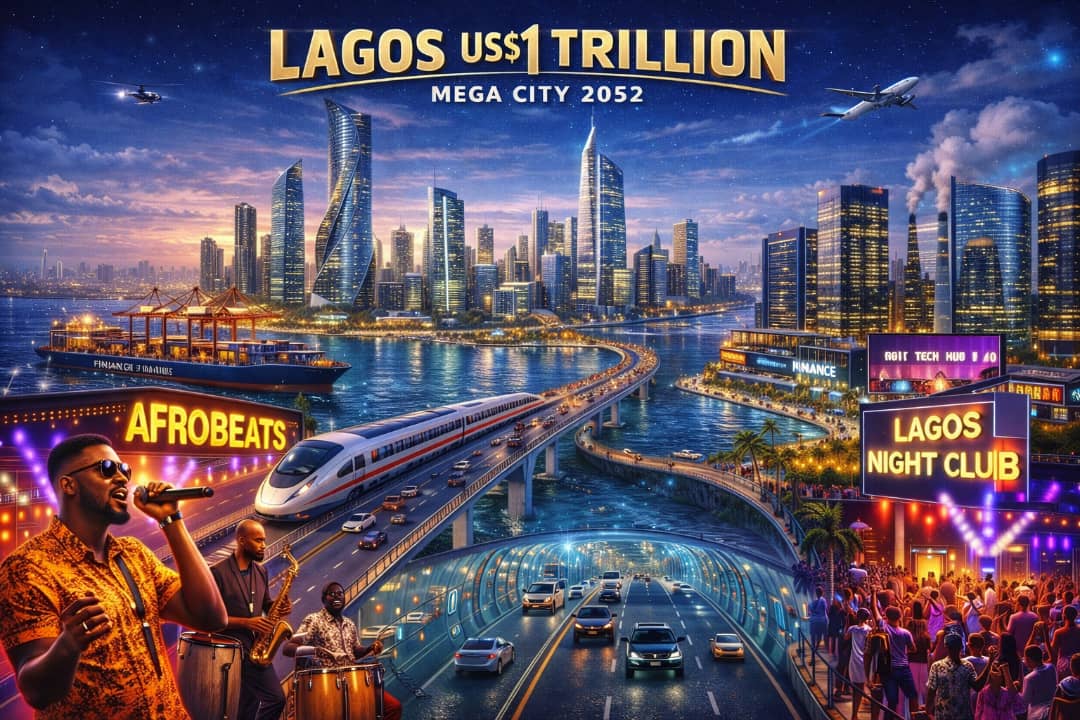
Yet Lagos is no longer content with continental relevance. In October 2022, Governor Babajide Sanwo-Olu unveiled an audacious 30-year Lagos Development Plan, anchored on a single, electrifying ambition: to transform Lagos into a one-trillion-dollar economy by 2052. If achieved, Lagos would not only become Africa’s first trillion-dollar city economy; it would rival-and surpass-the economic size of several European countries.
This is one of the boldest urban economic bets in modern history.
A City Built on Motion, Scale, and Demography. Lagos grows at a pace few cities on earth can match. Over 2,000 people migrate into Lagos every single day, drawn by opportunity, proximity to capital, and the promise of social mobility. Its population today exceeds 20 million, and long-term projections suggest that by the end of the century Lagos could house nearly 88 million people- more than the current population of Germany.
This demographic surge is not merely a social statistic; it is an economic multiplier. Large populations, when productively engaged, translate into labor supply, consumer demand, entrepreneurship, and tax base expansion. History is clear: the world’s largest economies- from New York to Tokyo to Shanghai- are powered by scale. Lagos has scale in abundance.
From Chaos to Capital: Lagos’ Economic Starting Point; Despite its dynamism, Lagos remains one of the least livable megacities globally. Chronic power shortages, traffic congestion, housing deficits, infrastructure gaps, brain drain, and a volatile currency environment have long constrained productivity.
Yet, in a striking paradox, Lagos continues to grow faster than many better-planned cities. Trains are finally running. A $20 billion refinery has come online. Africa’s deepest seaport is operational. Entire financial districts are rising from reclaimed land in the Atlantic Ocean.The Lagos story is no longer about potential alone. It is increasingly about execution.
The Infrastructure Spine of a Trillion-Dollar Economy;
The Lagos–Calabar Coastal Highway; The proposed 700-kilometre Lagos–Calabar Coastal Road will stretch along the Atlantic seaboard, linking nine Nigerian states into a single economic corridor. With Lagos as the anchor and hub, this corridor will unlock logistics, tourism, manufacturing, and trade on a scale Nigeria has never witnessed. It effectively positions Lagos as the gateway between southern Nigeria and global maritime commerce.
Rail Revolution: Moving a Megacity; Urban productivity depends on mobility. Lagos has finally turned the corner;
• The Blue Line Rail (Marina–Mile 2) opened in September 2023.
• The Red Line (Agbado–Oyinbo) followed in October 2024.
• Construction has begun on the 68-kilometre Green Line, linking the city directly to the Lekki Free Trade Zone.
Together, these lines will radically reduce travel time, cut economic losses from congestion, and integrate labor markets across the metropolis- a non-negotiable condition for trillion-dollar cities.
Industrial Power: Dangote Refinery and the Manufacturing Leap; No single project illustrates Lagos’ economic leap more vividly than the Dangote Refinery- a $20 billion private investment, the largest in Nigeria’s history. Currently operating at about 750,000 barrels per day, with plans to scale up toward 1.4 million barrels per day, it is poised to become the largest refinery on the planet.
Its impact on Lagos’ economy is staggering:
• Over $15 billion added annually to Lagos’ GDP
• 570,000 direct and indirect jobs created
• $12 billion saved yearly in foreign exchange
This single asset fundamentally reshapes Nigeria’s trade balance and positions Lagos as a continental energy and industrial hub.
Eko Atlantic: Manufacturing a New Financial District; Rising from land reclaimed from the Atlantic Ocean, Eko Atlantic City represents Lagos’ financial future. Its economic value is already evident: the United States government chose Eko Atlantic for its largest diplomatic facility anywhere in the world, investing over $537 million in a single complex.
Eko Atlantic is designed to host global banks, multinational headquarters, luxury real estate, and capital markets infrastructure- the type of ecosystem that defines trillion-dollar cities.
Trade, Ports, and Global Connectivity;
Lekki Free Trade Zone. The Lekki Free Trade Zone is rapidly emerging as Nigeria’s most significant industrial cluster, attracting manufacturers, logistics firms, energy companies, and exporters. Special regulatory regimes, proximity to ports, and infrastructure integration make it a magnet for foreign direct investment.
Lekki Deep Sea Port;
Now operational, the Lekki Deep Sea Port is Africa’s deepest port, capable of handling the largest container vessels in the world. It reduces shipping costs, eliminates trans-shipment dependence, and cements Lagos as West Africa’s primary trade gateway.
Lagos: The Fastest-Growing Tech Ecosystem on Earth;
By multiple indicators, Lagos is now the fastest-growing tech ecosystem globally, with growth rates exceeding 1,100% – outpacing Silicon Valley, London, and Beijing. Fintech, health-tech, logistics platforms, and digital services are scaling at extraordinary speed, attracting venture capital and exporting innovation across Africa. Technology is Lagos’ silent accelerator- high-value, low-weight, and globally scalable.
Culture as Capital: Soft Power with Hard Returns
Lagos is Africa’s undisputed cultural capital.
• Afrobeats dominates global music charts.
• Nollywood, headquartered in Lagos, is one of the world’s largest film industries.
• Lagos Fashion Week now sits on the global fashion calendar.
• “Detty December” has become a global tourism phenomenon, drawing thousands of foreigners and diaspora Nigerians annually, injecting massive seasonal revenue into hospitality, retail, and transport sectors. Few cities monetize culture as effectively as Lagos- and culture compounds over time.
The Next Frontier: Future-Defining Projects;
Looking ahead, Lagos’ trillion-dollar ambition is reinforced by visionary infrastructure:
• A proposed underwater tunnel beneath the Lagos Lagoon, linking Victoria Island to Snake Island and extending toward Badagry
• The Lagos–Sokoto Superhighway, integrating national markets
• Proposed bullet train systems, redefining inter-city mobility
These projects are not luxuries; they are productivity multipliers
Stability, Continuity, and the Politics of Growth;
Perhaps Lagos’ most underrated advantage is political stability. Since 1999, the same political tendency has governed Lagos State, ensuring policy continuity, institutional memory, and infrastructure sequencing- rare assets in emerging markets.
The Lagos Development Plan explicitly assumes long-term stability, the full maturation of President Bola Tinubu’s economic reforms, currency stabilization, and the compounding effect of sustained investment through 2052. Continuity of party leadership at both state and federal levels remains a critical variable in beating rival cities such as Cairo and Johannesburg to the trillion-dollar finish line.
The Verdict: Destiny, Discipline, and a Race Against Time;
Is Lagos building the future of Africa’s economy- or gambling with it?
The evidence increasingly points to strategy, not speculation. Demographics, infrastructure, industry, culture, technology, and political continuity are aligning in rare fashion. The risks are real, but so is the momentum.
If Lagos stays the course, 2052 will not merely mark a numeric milestone. It will confirm Lagos as Africa’s largest city economy, a megacity whose GDP rivals nations, and a case study in how chaos, when disciplined by vision, can become capital.
The trillion-dollar countdown has already begun.