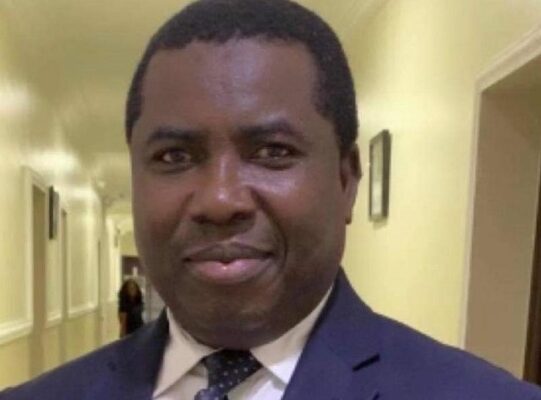
INEC chairman, Prof Joash Amupitan
By John Dike, Osogbo
Chairman of the Independent National Electoral Commission (INEC), Prof. Joash Amupitan, SAN, has appealed to Nigerians to actively participate in the upcoming Claims and Objections period of the Continuous Voter Registration (CVR) across the county.
He warned that an unclean national voters’ register poses a fundamental threat to election credibility.
At the Nigeria Civil Society Situation Room’s Stakeholders’ Forum on Elections in Abuja, he said the Claims and Objections phase opening December 15, remains the most crucial opportunity for citizens to help cleanse the register of ineligible, duplicated, or erroneous entries.
Amupitan, who is barely two months in office, stressed that democracy cannot flourish if the national register continues to carry the names of deceased individuals and others who are no longer eligible.
He recalled a disturbing discovery during preparations for the recent Anambra governorship election, where a well-known community leader who died during the 2020 lockdown still appeared on the register. “Such lapses erode public trust and damage the credibility of our elections,” he said.
He urged civil society organisations, community leaders, the media, and the general public to mobilize citizens to scrutinize the provisional register once it is displayed.
His words, “INEC cannot do it alone. If we cannot clean up our register, we cannot claim credibility.”
The Chairman announced that Phase 1 of the CVR exercise, which ended on December 10, recorded 2,685,725 new registrations. Of this number,
1,576,137 completed their registration online, and 1,109,588 completed physical capture.
He hailed the rising political consciousness across the country, noting impressive turnout in states such as Osun, Kano, Sokoto, Imo, Borno, and Lagos.
To increase accessibility, INEC will relocate many registration centres closer to communities when Phase 2 begins on January 5, 2026. This move, he explained, follows field assessments showing that long distances and inaccessible terrain discouraged prospective voters in several locations
Amupitan highlighted ongoing preparations for the FCT Area Council elections scheduled for February 21, 2026, describing them as one of INEC’s most sensitive assignments since the Commission conducts local government–level elections in the FCT.
He reaffirmed that the deployment of technology, particularly the Bimodal Voter Accreditation System (BVAS) and the INEC Result Viewing Portal (IReV), has transformed electoral transparency, closing the door to over-voting and manual manipulation.
However, he warned that technology is not a cure-all. Poor network connectivity across many of Nigeria’s 176,000 polling units continues to hinder real-time uploads. He recounted cases during the Anambra mock accreditation where presiding officers struggled to transmit results due to technical limitations.
INEC, he said, is working closely with telecom operators and the NCC to address these challenges while exploring alternative technologies that could give the Commission greater control over its own network environment.
The INEC Chairman expressed deep worry over chronic voter apathy, noting that participation in some elections has dipped below 22 percent, with the 2023 general election recording only 27 percent voter turnout.
Citing Anambra’s recent experience, he said strategic interventions, such as the five-day extension of PVC collection, including weekends, boosted collection rates to 98.8 percent and doubled voter turnout.
On vote buying, he described the practice as “one of the most corrosive threats” to Nigeria’s democracy, disclosing that some political actors openly admitted to engaging in vote trading during pre-election engagements in Anambra. INEC has written to the Police and EFCC demanding updates on the cases, but noted that the Commission can prosecute, not arrest.
Amupitan urged Nigerians to stop referring to the country’s democracy as “nascent,” arguing that after more than two decades of uninterrupted civilian rule, the nation must begin to lead by example.
Quoting Kofi Annan and Jim Kator, he said democracy is neither inherited nor imported, but learned and nurtured through deliberate participation
Wrapping up, the INEC Chairman returned to his core message: the upcoming Claims and Objections exercise offers citizens a decisive opportunity to strengthen the integrity of future elections.
“With Phase 2 of the CVR starting on January 5 and the FCT elections approaching, the time to take responsibility is now,” he said. “INEC is doing its part, but democracy cannot thrive if the people themselves do not protect and purify the process.”