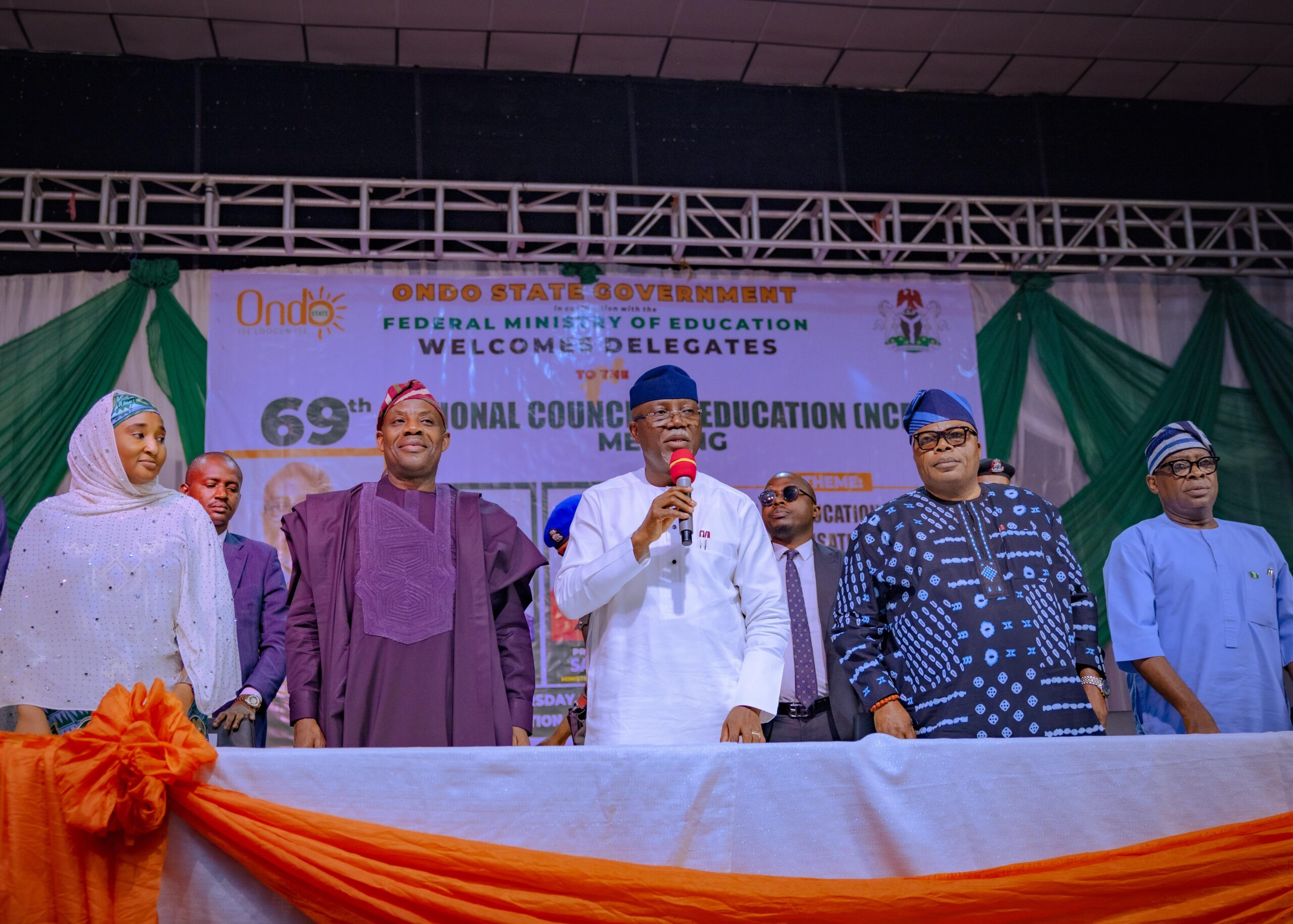
- Aiyedatiwa pledges improved teachers welfare
The Federal Government has announced its plan to reposition the nation’s education system through digital innovation, data management and professional teacher development.
It announced the plan through the Education minister, Dr. Olatunji Alausa, at the 69th National Council on Education (NCE) meeting on Wednesday in Akure the Ondo State capital.
Addressing the meeting, the minister, announced the approval of the National Education Repository and Databank (NERD) system, a digital platform for collecting and preserving academic records.
The National Credential Verification System, he said, would eliminate certificate fraud and enhance global recognition of Nigerian credentials.
He disclosed that 21 states had uploaded data into the Digital Nigerian Education Management Information System (DNEMIS), which integrates with the National Identity Management Commission to track learners.
Alausa added that commissioners and SUBEB chairmen would receive smart interactive boards for real-time monitoring.
He noted that the Teachers Registration Council of Nigeria had been fully digitised to ease teacher registration and licence renewal, while UBEC had been directed to pay licence fees for primary and junior secondary school teachers. Over 60,000 digital tablets have also been distributed to teachers nationwide.
Altogether, 4,900 classrooms had been built, 3,000 renovated, and 34 model schools established, reaching over 2.3 million learners, according to the minister.
Also nationwide, over one million out-of-school children had been digitally mapped, with over 15,000 learners enrolled under the Accelerated Basic Education Programme (ABEP), while 577,000 girls benefitted from scholarships under the AGILE initiative.
In her speech, the Minister of State for Education, Prof Suwaiba Sa’idu Ahmad, commended Ondo State Governor Lucky Aiyedatiwa for hosting the event and praised Ebonyi and Delta States for meeting their hosting obligations.
She stressed the importance of credible data and teacher professionalism, announcing that TRCN had launched a digital portal to streamline teacher licensing.
In his speech at the event, Aiyedatiwa described education as the most powerful tool for social mobility, national unity and sustainable development.
He said Ondo State’s long-standing legacy in education had continued from the free education era of the old Western Region to modern investments in digital learning, teacher welfare and school infrastructure.
He noted that the state’s policy direction remained anchored on quality and inclusivity, saying: “Our goal is to make education not just accessible, but meaningful and transformative. Every child in Ondo State deserves a fair chance at learning and success.”
Commending President Bola Tinubu for initiating reforms like the Nigerian Education Loan Fund, which has supported over 624,000 students, the Governor said the move had bridged the gap between children of the rich and the poor.
He also hailed the Education minister, and Minister of State for Education for championing innovation and accountability in the sector.
Aiyedatiwa described the meeting’s theme, Quality Education Data and Professionalisation of Teaching: Tools for Enhanced National Development, as timely, noting that it addresses major challenges facing Nigeria’s education system.
He stressed that quality education data remains the foundation for effective policy decisions, resource allocation, and performance tracking.
The Governor lamented the decline in the value of the teaching profession, calling for improved welfare, merit-based recognition, and continuous professional growth.
“We must restore dignity to the teaching profession. Teachers are the bedrock of national progress and when they are empowered, the nation prospers”, he added.
He said his administration is committed to free, functional, and affordable primary and secondary education, while expanding access through investments in digital infrastructure and inclusive learning.
According to him, under the OUR EASE education policy, over 2,100 teachers had been recruited and trained, annual examination fees paid for students, more than 75,000 textbooks distributed and classrooms and laboratories built or rehabilitated across senatorial districts. He also revealed that Ondo had paid all counterpart funds up to 2024 to access UBEC/SUBEB grants.
He further highlighted interventions such as bursaries, scholarships, digital skills centres, free school shuttle buses and boats, and regular payment of teachers’ salaries, pensions, and gratuities.
“We are building a future where no child will be left behind, where technology drives learning and where our schools become centres of excellence,” Governor Aiyedatiwa said.
While appreciating the NCE for granting Ondo the hosting right, the Governor expressed confidence that deliberations from the meeting would lead to transformative outcomes capable of reshaping Nigeria’s education system.
In his welcome address, Ondo State Commissioner for Education, Prof Igbekele Ajibefun, called for stronger collaboration among stakeholders to improve learning outcomes across the country.
He noted that under the Aiyedatiwa administration, all school data had been migrated to digital platforms to enhance transparency, planning and governance.