

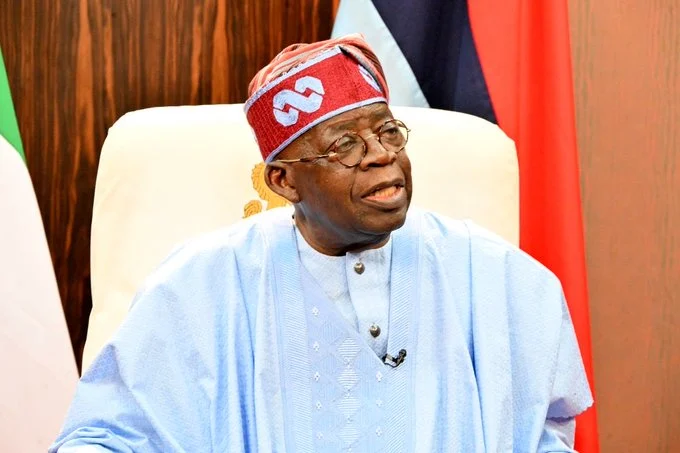
President Bola Tinubu has promised to recruit 28,000 additional military personnel and 50,000 police officers as part of efforts to strengthen Nigeria’s security architecture and tackle terrorism, banditry and kidnapping.
According to the 109-page APC 2027 Presidential Election Manifesto, titled From Reform to Prosperity Agenda 2027–2031, Tinubu plans to achieve six per cent annual economic growth, facilitate the construction of 200,000 affordable homes and sustain a downward trend in inflation and food prices by 2031.
The APC leadership will unveil the 2027–2031 presidential manifesto on Tuesday, November 10, 2026, at the Shehu Musa Yar’Adua Centre in Abuja.
The event is scheduled to begin at 11 am.
Under the healthcare component of the manifesto, Tinubu promises to increase the number of functional primary healthcare centres to 90 per cent nationwide and expand active health insurance coverage to 40 per cent of Nigerians.
The manifesto further outlines plans to make communities safer, recruit and train 20,000 additional teachers and scale available electricity generation towards 10,000 megawatts to improve access to power for households and businesses.
The President said his second term would focus on translating the economic reforms and foundations laid during his first tenure into tangible improvements in the lives of Nigerians, with prosperity extending to homes, markets, farms and workplaces across the country.
On what Nigerians should expect by 2031, the manifesto stated, “Safer lives and communities: Stronger protection against terrorism, banditry and kidnapping; a police service that responds when needed; and better protection of our borders.
“Lower living costs and food security: Inflation set on a sustained downward trajectory, domestic food production, storage, and processing expanded, and post-harvest losses halved, and goods moving more quickly and cheaply between states.
“Reliable power for homes, businesses and communities:
Available power generation scaled towards 10,000MW, metering extended towards full coverage, transmission and distribution networks reinforced, and clean energy access extended to underserved communities.
“Expanded jobs and higher real incomes: Annual economic growth accelerated to 6 per cent, youth unemployment halved, and equitable credit reached half of all economically active Nigerians.
“Quality education and accessible healthcare: Out-of-school children halved, more children completing their education, 20,000 additional teachers deployed, health insurance expanded from more than 23 million enrollees to 40 per cent of Nigerians, and primary health centres functioning in at least 90 per cent of facilities, up from 53 per cent today.”
Tinubu pledged to facilitate the construction of 200,000 affordable homes for Nigerian workers by 2031 through the Tinubu Mass Social Housing Scheme, mortgage financing and partnerships with licensed private developers.
He said the initiative would provide more working households with access to decent housing while strengthening regulations to protect property buyers.
The President also promised to strengthen accountability in governance by extending digital case management systems to magistrate courts, tracking public service delivery and ensuring local governments receive their constitutional allocations under clear performance standards.
On security, Tinubu pledged to guarantee Nigerians greater safety in their homes, workplaces, schools, farms and commercial centres, assuring that his administration would strengthen measures to protect lives, secure national borders and enable citizens to live, work and travel without fear.
The APC presidential candidate promised to strengthen the Armed Forces and other security agencies, improve intelligence gathering and deploy modern technology to tackle insecurity across the country if re-elected in 2027.
The President, in his 2027–2031 manifesto, also pledged to intensify efforts against terrorism, banditry, kidnapping and organised crime through improved recruitment, specialised training, modern equipment and better welfare for security personnel.
He said the proposed security reforms would prioritise the protection of farmers, schoolchildren, traders and other Nigerians, while strengthening border surveillance, community policing and emergency response systems to ensure safer communities and commercial activities.
It read in part, “2027–2031: Complete the establishment and equipping of the four new Army divisions in Makurdi, Ilorin, Jalingo and Benin City, recruit and train the 28,000 additional personnel approved, and report publicly on their deployment.
“Sustain intelligence-led kinetic operations against insurgent and kidnapping networks to degrade and dismantle their operating bases, backed by independent verification of reported operational outcomes to build public trust.
“Strengthen surrender and rehabilitation frameworks through standardised, verifiable reporting on all screened, reintegrated, and prosecuted ex-combatants. Establish specialised zonal counter-terrorism capabilities while fortifying physical security across schools, commercial markets, places of worship, and vital transport corridors.
“Expand peace-building, trauma support, and deradicalisation programmes to enable long-term social recovery, rebuild civic trust, and safely resettle internally displaced families in their homes. We will restore peace in every community.
“Train and deploy the 50,000 newly recruited officers and expand recruitment and tactical training towards a 1:400 police-to-citizen ratio, maximising visible patrols across residential neighbourhoods, commercial centres, schools, and transit corridors.”
Tinubu also plans to implement a nationwide police reform programme featuring digital record systems, officers’ body cameras, geographic mapping tools, emergency response channels and modern forensic facilities to improve policing and crime prevention.
The manifesto further proposes recruiting 30,150 personnel of the Nigeria Security and Civil Defence Corps to take over static security duties from the police, while working with federal and state lawmakers and governors to establish a legal framework for accountable state and community policing.
It added, “Complete e-surveillance coverage of all mapped borders (31 of 190 mapped areas remain), extend e-Gates, passenger-data (APIS) and MIDAS border systems to more entry points, and strengthen patrol, screening and intelligence-sharing.
“Complete nationwide Mining Marshals coverage across all identified mining sites (over 530 identified, 420 already protected) and resolve outstanding governance and funding questions so the unit is accountable and credible.
“Deploy trained Forest Guards, Agro-Rangers, and Mining Marshals to safeguard agricultural belts, farming communities, grazing routes, national forest reserves, and mineral deposits.
“Launch full implementation of the National Protection Policy and Strategy for Critical National Assets, with real-time surveillance across energy pipelines, electrical power grids, railways, schools, and health facilities.
“Expand domestic military production of ammunition, personal protective gear, armoured vehicles, and tactical drones, generating high-skilled Nigerian jobs while securing defence supply chains.”
Tinubu also pledged to establish integrated security command systems to improve intelligence gathering, detect threats early and strengthen coordination among security agencies, while boosting local defence production through technology partnerships.
He promised to implement approved salary increases for security personnel, improve their welfare and housing, and fast-track insurance and pension payments to families of fallen officers.
The manifesto also outlines plans to rehabilitate police barracks, improve working conditions and expand tactical training, while introducing vocational programmes and non-custodial measures to reduce congestion in correctional facilities.
Tinubu further promised to modernise fire stations, strengthen maritime surveillance and cybersecurity, deploy drones for emergency response and enrol 95 per cent of Nigerians in the National Identity Database.
It added, “Building on the 80,284 teachers already certified and licensed, recruit and train 20,000 additional teachers, prioritising female educators and underserved rural communities nationwide.
“Enforce safe-school standards, expand school water and sanitation facilities, and publish an annual education dashboard tracking enrolment, dropout, and completion rates.
“Prioritise foundational learning, science, technology, engineering, mathematics, and digital capabilities across all educational levels. Strengthen partnerships with industry to provide practical, work-linked training and move students into the workforce, aligning courses with labour-market needs.
“Scale NELFUND, expand the National Smart Learning Initiative, sustain industrial peace in public universities, and extend the Student Venture Capital Grant and Diaspora BRIDGE to additional tertiary institutions. Expand technical, vocational, and digital training programmes, building on the TVET initiative (117,152 verified trainees, monthly stipend raised from N22,500 to N30,000) and the Digital Technical Academy, measuring systemic success by graduate employment, enterprise survival, and workplace productivity.”
Tinubu also pledged to expand the Mandatory School Sports Programme and the National Sports and Education Excellence Programme nationwide, building on the ongoing pilot involving 61 schools, 3,500 teachers and 15 trained students to strengthen grassroots sports development.
The manifesto read in part, “Expand static and mobile primary care, upgrade secondary facilities across all local government areas, and strengthen referral networks to tertiary hospitals, raising the share of functional primary health centres from 53 per cent today towards 90 per cent by 2031 and extending direct quarterly financing under the Basic Health Care Provision Fund from about 8,300 to all 17,600 primary health centres.
“Sustain maternal, newborn, immunisation, cancer-screening, and early detection programmes, prioritising families with the greatest financial need and tracking the proportion of births attended by a skilled health provider as a
“Expand active health insurance coverage from more than 23 million enrollees to 40 per cent of Nigerians by 2031, subsidising poor and vulnerable Nigerians through the Vulnerable Group Fund, and cut out-of-pocket spending from 71 per cent to below 50 per cent of health expenditure.
“Complete the revitalisation of the remaining primary health centres (about 1,000 still under way), bring steady power to 30 per cent of health facilities by the end of 2027 through Power for Health solar installations, and scale MAMII free emergency obstetric care from 172 local government areas to all 774.
“Complete the National Health Information Exchange to ensure portable electronic records by 2031, while achieving complete Emergency Operations Centre coverage across all states.”
Tinubu also pledged to improve the recruitment, training and welfare of healthcare workers, boost local production of essential medicines to 50 per cent by 2031 through BioVaccines Nigeria, and complete cancer treatment centres across the six geopolitical zones.
Abdulrahman Zakariyau
Abdulrahman is a journalist at Punch Newspapers with nearly a decade of professional experience covering political parties, elections, religion, civil society organizations, and the Nigeria Governors Forum. He is also a development and strategic communication expert, skilled at analyzing complex issues and delivering impactful narratives. Abdulrahman’s reporting reflects extensive newsroom experience, editorial judgment, and a strong commitment to informative and insightful journalism.
The Punch


