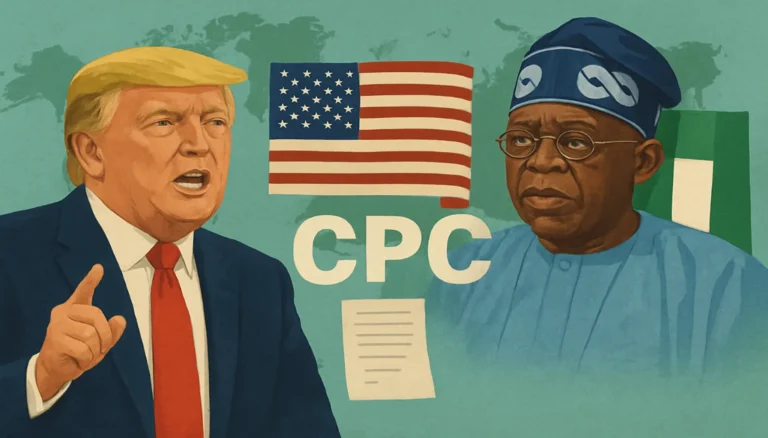
On 3 November 2025, news broke that U.S. President Donald Trump designated Nigeria a Country of Particular Concern (CPC). Citing alleged large-scale attacks on Christians, President Trump ordered U.S. agencies to prepare responses — including the possibility of sanctions. In rhetoric that escalated the issue, he threatened military action if the alleged abuses continued.
The President’s action was swiftly endorsed by the U.S. Commission on International Religious Freedom (USCIRF). The group, alongside Republican lawmakers and faith-based advocacy groups had urged this step for months.
What is a CPC?
A CPC is a formal U.S. designation reserved for governments accused of tolerating “systematic, ongoing, and egregious violations of religious freedom.” It is derived from a law – the International Religious Freedom Act (IRFA) of 1998. This act mandates the Secretary of State — and ultimately the President — to identify such countries. Once a country is so named, it may be subjected to a range of punitive diplomatic and economic measures. The punishments range from public naming and shaming to targeted sanctions and suspension of non-humanitarian aid. The law also requires the U.S. to try consultations with the named government and to report to Congress on targeted actions.
Designating a country as a CPC is in itself not a punishment. It merely raises the profile of alleged abuses and gives the U.S. legal cover to impose penalties if it chooses.
Nigeria’s response
The Nigerian government strongly rejected the characterization. Officials — including the Information Minister and military leadership — claimed that the security crisis in Nigeria is caused by violent extremist groups (Boko Haram, IS-affiliates, bandits) that target people across faiths. They characterized the U.S. claim as misleading or based on faulty data. The government highlighted its counter-terrorism actions and rescue/arrest figures. It also emphasized Nigeria’s sovereignty and religious diversity. President Bola Tinubu and his ministers said they remain open to cooperation with partners but rejected threats of force.
Important Background
Violence in Nigeria, often described as “religion-based,” reflects a complex mix of extremist Islamist insurgents. The groups include Boko Haram and Islamic State – West Africa Province/ISWAP). There are also heavily-armed and security-protected Fulani herders and bandits wreaking violence in the so-called communal-land, water and ethnic conflicts. Between 2019 and 2023 alone, one study found nearly 56,000 people killed in ethnic or religious violence in Nigeria. The figures include at least 16,769 Christians and 6,235 Muslims.
The crisis deepened under Buhari’s tenure, going beyond purely “religious” motives to faith-based targeting. The violence extended to churches – a watchdog estimated about 1,200 churches destroyed each year since 2009. That would mean roughly 19,100 churches attacked between 2009 and 2025. Enugu Metro could not independently verify the figures.
The administration of former President Muhammadu Buhari (2015-2023) is often accused as the driver of this violence. Buhari campaigned to defeat Boko Haram and strengthen the economy. After his election, he announced in 2015 that insurgency was “technically” defeated. His government made the claim while bandits and herder violence were spreading and vulnerable communities were being ravaged.
Diplomatic Responses
President Trump and members of Congress, backed by USCIRF pushed for Nigeria’s designation as CPC. The U.S. framed the move as defending religious freedom. In public rhetoric from the White House, it was also positioned as a prelude to possible sanctions or other actions if the situation doesn’t improve.
Canadian public officials and some lawmakers voiced concern about violence in Nigeria and signaled increased attention. In a travel advisory for Nigeria, Canada’s warned its citizens against non-essential travel to many regions because of terrorism and kidnapping risks. In addition, some Canadian MPs and interest groups echoed calls for action on behalf of victims.) Travel.gc.ca+1
Meanwhile, China publicly backed Nigeria’s government and warned against external interference. The Chinese said human-rights frames should not be used to infringe sovereignty and urged respect for Nigeria’s internal affairs. According to President Tinubu’s privately-owned TV station, the Chinese authorities publicly expressed support for the Nigerian President. That response signals geopolitical pushback against any punitive Western measures.
What Nigeria is saying
Reactions inside Nigeria are mixed and politically charged:
The Federal government and security leaders reject the CPC label and argue the country is fighting terrorism that affects Muslims and Christians alike; they call for fact-based engagement.
Religious leaders, church bodies and diaspora advocacy groups either supported the designation or described the violence against Christians as grossly under-addressed. It was those voices that pressed U.S. officials for action.
Others clergy and civic leaders sounded notes of caution. Bishop Matthew Kukah warned that such re-designation could inflame divisions or harm diplomatic cooperation.
Ethno-political activists – including the proscribed IPOB and other advocacy groups welcomed the designation as validation of long-standing claims of targeted violence.
Others, including analysts, civil society and some governors, urged calm. They cautioned that simplistic religious framing could obscure local drivers which they identified as land, poverty, political competition, and criminality.
Wider implications of re-designation
The CPC move is not merely symbolic; its ripple effects can be significant:
Diplomatic fallout and alignment choices. The redesignation and attendant incendiary rhetoric around it is already straining U.S.–Nigeria ties. Nigeria’s turning to partners such as China for political support is significant. It heightens the potential to accelerate geopolitical realignment on security cooperation, intelligence-sharing and arms procurement at a time that the US and Nigeria need cooperation on multinational counter-terrorism.
Effects on counter-terrorism cooperation. If the U.S. imposes sanctions or cuts assistance (or if Abuja perceives Washington as an adversary), intelligence sharing, training, logistics support and joint programmes could be reduced or halted. That would complicate efforts against Boko Haram/IS-affiliates and the rising bandit/terror networks in the Middle Belt and northwest, potentially creating security vacuums. As one analyst put it, this could conversely pressure Abuja to improve accountability and protection for vulnerable communities.
Humanitarian and human-rights consequences. Aid that is non-humanitarian could be restricted; however, humanitarian flows typically continue. The label can increase international attention and donor pressure for protection programs for victims — yet it can also polarize domestic politics and stoke reprisals or identity politics if poorly managed.
International law & precedent. The CPC is a U.S. domestic statutory tool, not a UN or international court finding. That means it is powerful in U.S. policy terms but contested diplomatically. It is unlikely that other states and multilateral organizations may follow suit. It also risks shifting focus from criminal counter-terrorism responses to geopolitically charged religious narratives.
What to expect, going forward
Escalation: If the U.S. moves to sanctions or other punitive steps (or rhetoric leads to deeper military signaling), the results could be catastrophic. Bilateral cooperation could fray, regional stability may be undermined, and geopolitical rivals (notably China) could deepen ties with Nigeria. All of this will complicate multilateral counter-terrorism action.
Constructive pressure and engagement: The US State Department counsels Nigeria to use the CPC to trigger serious, evidence-based consultations and actions. Suggested actions include targeted accountability for perpetrators (not whole-of-state penalties), and stepped-up multilateral support for policing, justice and community protection programmes. The overarching goal is to spur overdue reforms and better protection of civilians.
Enugu Metro