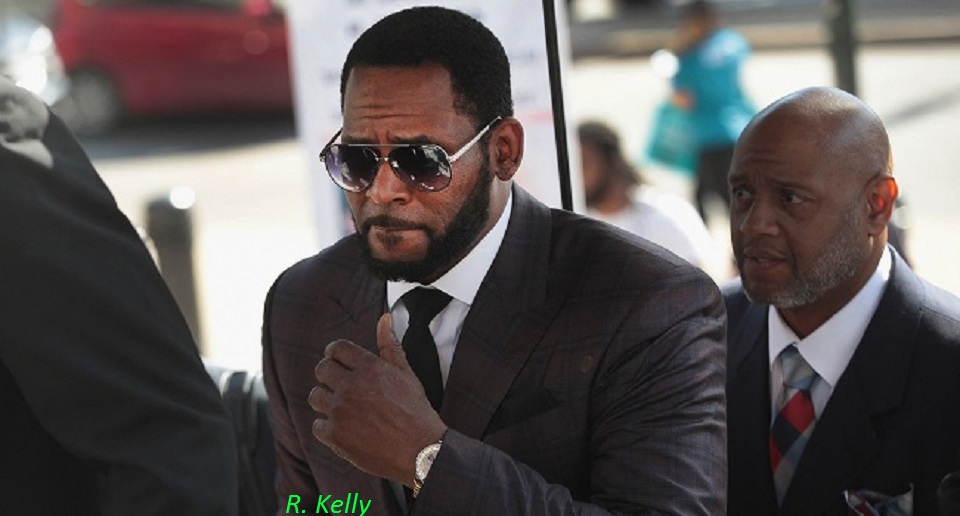
In this file photo taken on June 26, 2019 R&B singer R. Kelly (C) arrives at the Leighton Criminal Courts Building for a hearing in Chicago, Illinois; Photo by Scott Olson / Getty Images North America / AFP
US singer R. Kelly has been sentenced to 30 years in prison for using his celebrity status to sexually abuse children and women.
The R&B artist, 55, was convicted last September in New York of racketeering and sex trafficking crimes.
According to BBC News: He had faced years of allegations and the judge on Wednesday said he had an “indifference to human suffering.”
Lawyers for the singer, whose real name is Robert Sylvester Kelly, say he will appeal.
Ahead of his sentencing, a handful of women took the stand to confront Kelly.
A woman identified only as Angela called the singer a Pied Piper who “grew in wickedness” with every new victim, while others who were not named testified he had broken their spirits.
“I literally wished I would die because of how you made me feel,” said one.
Dressed in prison khakis and dark glasses, Kelly declined to make a statement of his own and did not react as the verdict was handed down.
US District Judge Ann Donnelly said the celebrity had used sex as a weapon, forcing his victims to do unspeakable things and saddling them with incurable diseases.
“You taught them that love is enslavement and violence,” she said.
The court heard how Kelly – known for hit songs like I Believe I Can Fly and Ignition – used his influence to lure women and children into sexual abuse over two decades.
Jurors at his six-week trial in Brooklyn heard how he trafficked women between different US states, assisted by managers, security guards and other members of his entourage.
The court also heard how Kelly had illegally obtained paperwork to marry singer Aaliyah when she was 15 in 1994, seven years before the singer died in a plane crash.
The certificate, leaked at the time, listed Aaliyah’s age as 18. The marriage was annulled months later.
Federal prosecutors had recommended that Kelly be sentenced to more than 25 years in prison, given the seriousness of his crimes and “the need to protect the public from further crimes.”
But his lawyers called for a sentence of 10 years – the mandatory minimum for his conviction – or less.
They portrayed Kelly as growing up poor in a household rife with domestic violence and suffering sexual abuse from a young age.
They said he was “devastated” by the sentence and planned to appeal.
Kelly has been in custody since he was indicted by federal prosecutors in New York and Chicago in July 2019.
His three years behind bars have been eventful, including a beating from a fellow inmate in 2020 and a bout with Covid-19 earlier this year.
The singer faces further legal action in August, when he goes on trial again, this time in Chicago on child sex images and obstruction charges.
He is also due to face sex abuse charges in courts in Illinois and Minnesota.
Also, AFP reports that: He was sentenced to 30 years in prison Wednesday for leading a decades-long effort to recruit and trap teenagers and women for sex.
Judge Ann Donnelly handed down the term in the Brooklyn federal court nearly a year after the 55-year-old Kelly was convicted by a New York jury.
“The verdict is in: R. Kelly has been sentenced to 30 years,” the US attorney’s office for the Eastern District of New York said in a tweet.
The prosecutors had urged the court to put the “I Believe I Can Fly” artist behind bars for at least 25 years, saying he still “poses a serious danger to the public.”
In September, the fallen superstar was found guilty on all nine charges he faced, including the most serious of racketeering.
“His actions were brazen, manipulative, controlling and coercive. He has shown no remorse or respect for the law,” prosecutors wrote in their sentencing memo.
Kelly’s lawyers called for a lighter sentence with a maximum of approximately 17 years.
The sentence comes just over a month before jury selection is due to start in Kelly’s separate, long-delayed federal trial in Chicago on August 15.
In that case, Kelly and two of his former associates are alleged to have rigged the singer’s 2008 pornography trial and hid years of sexual abuse of minors.
The musician who once dominated R&B also faces prosecution in two other state jurisdictions.
Kelly’s conviction in New York was widely seen as a milestone for the #MeToo movement: It was the first major sex abuse trial where the majority of accusers were Black women.
It was also the first time Kelly faced criminal consequences for the abuse he for decades was rumored to have inflicted on women and children.
Prosecutors were tasked with proving Kelly guilty of racketeering, a federal charge commonly associated with organized crime syndicates that depicted Kelly as the boss of an enterprise of associates who facilitated his abuse.
Calling 45 witnesses including 11 alleged victims to the stand, they painstakingly presented a pattern of crimes they say the artist born Robert Sylvester Kelly carried out for years with impunity, capitalizing on his fame to prey on the less powerful.
To convict Kelly of racketeering, jurors had to find him guilty of at least two of 14 “predicate acts” — the crimes elemental to the wider pattern of illegal wrongdoing.
Lurid testimony intended to prove those acts included accusations of rape, druggings, imprisonment and child pornography.
His accusers described events that often mirrored one another: Many of the alleged victims said they had met the singer at concerts or mall performances and were then handed slips of paper with Kelly’s contact details by members of his entourage.
Several said they were told he could bolster their music industry aspirations.
But prosecutors argued all were instead “indoctrinated” into Kelly’s world — groomed for sex at his whim and kept in line by “coercive means of control,” including isolation and cruel disciplinary measures, recordings of which were played for the jury.
Core to the state’s case was Kelly’s relationship with the late singer Aaliyah.
Kelly wrote and produced her first album — “Age Ain’t Nothin’ But A Number” — before illegally marrying her when she was just 15 because he feared he had impregnated her.
His former manager admitted in court to bribing a worker to obtain fake identification allowing the union, which was later annulled.
BBC News / AFP