By John Dike, Osogbo
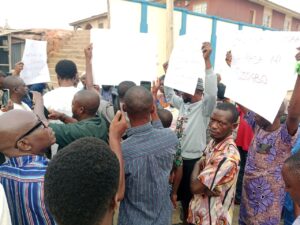
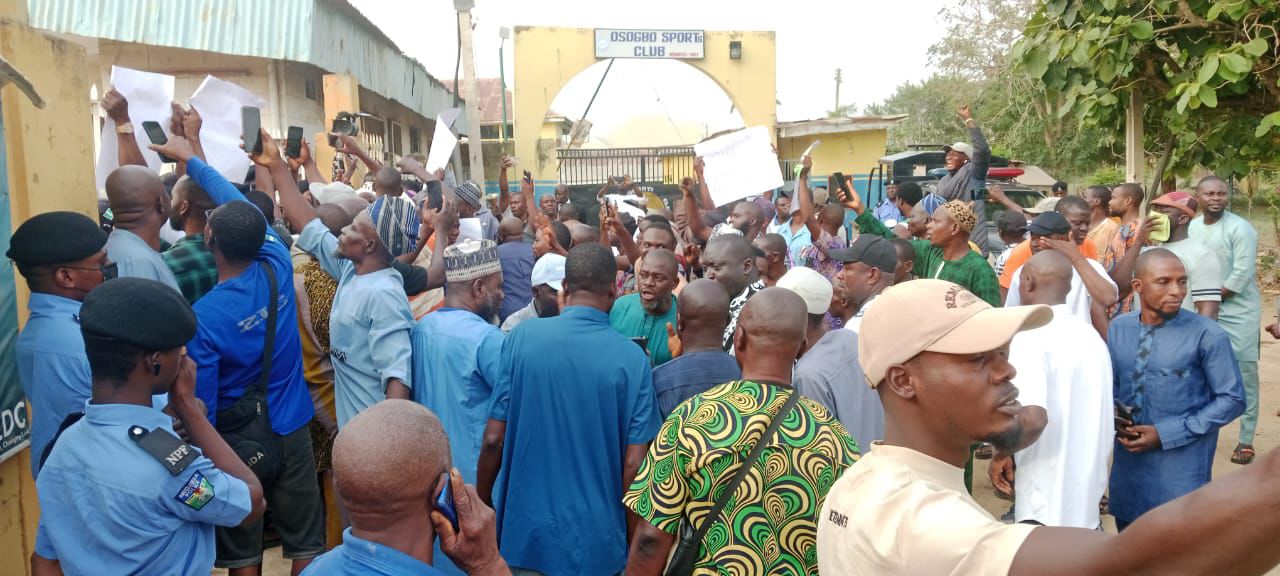
Tension mounted in Osogbo, the Osun State capital, on Wednesday as landlords and tenants from no fewer than 41 communities staged a peaceful protest over what they described as persistent epileptic power supply by the Ibadan Electricity Distribution Company (IBEDC).
The protesters issued a 72-hour ultimatum to the distribution company, demanding immediate improvement in electricity supply or risk further collective mass action.
The aggrieved residents converged at the popular Oke-Baale Roundabout before marching to the IBEDC office along Station Road, chanting solidarity songs and displaying placards with inscriptions such as “We Are Paying for Darkness, It Is Unfair,” “IBEDC, Restore Our Light, Darkness Is Threatening Our Security,” and “Authorities Must Act Now, Our Livelihoods Are Dying.”
The protesters lamented that erratic power supply has crippled businesses, worsened economic hardship and exposed communities to security risks due to prolonged darkness at night.
Speaking with journalists, the Secretary of the Federal Housing Estate Community, Ilesa Road, Osogbo, Olasanya Temitope, said communities including Owode Federal Housing Estate, the Air Force Base, Army Depot and several adjoining areas participated in the demonstration.
“For months now, we have not enjoyed stable electricity. They may restore power for 10 or 15 minutes and then it goes off again. Businesses have been paralysed, artisans cannot work, traders are struggling, and residents cannot enjoy basic comfort in their homes,” he said.
Temitope stressed that residents were demanding supply in line with their tariff classification, noting that they were being billed despite poor service delivery.
Another protester, Adewale Adewumi, warned that the situation poses a serious security threat, particularly as military formations in Osogbo are also affected.
“Depriving the Nigerian Army and the Air Force of electricity is a threat to national security. When they cannot operate optimally due to power failure, it affects training and their constitutional responsibility to protect Nigerians,” he said.
Band C Classification Sparks Anger
The protesters alleged that their communities were reclassified from Band A to Band C under the Service-Based Tariff framework of the Nigerian Electricity Regulatory Commission (NERC), but are not receiving the minimum hours of supply stipulated for Band C customers.
According to the residents, while Band A customers are expected to enjoy 20–22 hours of electricity daily and Band B between 15–20 hours, Band C customers are entitled to 12–16 hours per day.
“Instead, we get barely three to four hours for a few days and then total blackout for days. If Band C is entitled to 12 hours, then give us 12 hours uninterrupted,” Adewumi added.
United Communities Issue Seven-Day Notice
In a related development, residents under the umbrella of the United Communities also issued a seven-day ultimatum to IBEDC to restore them to Band A classification or face lawful collective action.
The resolution followed a meeting held on February 28, 2026, with representatives from Owo-Eba, Garage Ilesa, Tara, Oke-Baale axis, OSBC area, UNIOSUN axis, Air Force Base, Army Depot, Boredun, Coker, Odu, Omu and other affected communities in attendance.
Chairman of the United Communities, Comrade Sulaiman Ismail Buruji, described the situation as unbearable, alleging that some communities now receive barely four hours of electricity daily, with occasional total blackout.
“This falls far short of what is stipulated under the tariff framework. There are even reports that electricity meant for our communities is being diverted elsewhere. That is why people are angry,” Buruji said.
The communities noted that the development has adversely affected institutions and small-scale businesses, including the Osun State Broadcasting Corporation (OSBC), which was reportedly forced to cut down its transmission hours due to inadequate power supply.
They warned that failure to address their grievances within the stipulated timeframe would prompt lawful measures, including reconsidering operational access for IBEDC personnel in their areas.
Civil Society Groups Join Pressure
Meanwhile, civil society organisations under the Network of Civil Society Groups in Osun State have also given IBEDC a 48-hour ultimatum to improve electricity supply in Osogbo.
The groups criticised the Service-Based Tariff regime introduced by NERC, alleging that consumers were placed on lower supply bands without enjoying the guaranteed minimum hours of electricity. They demanded public disclosure of feeder classifications and greater transparency in electricity distribution.
They warned that failure to comply would lead to a peaceful mass protest at the company’s regional office.
Reacting to the growing outcry, IBEDC attributed the persistent low power supply across Osun State to inadequate gas supply to thermal power generating stations nationwide.
The company stated that Nigeria’s average available generation currently stands at about 4,300 megawatts (MW), significantly below installed capacity.
According to IBEDC, thermal plants which account for the bulk of Nigeria’s electricity generation require approximately 1,629.75 million standard cubic feet (MMSCF) of gas daily to operate optimally.
However, as of February 23, 2026, actual supply stood at about 692.00 MMSCF per day, representing less than 43 per cent of required volume.
The company explained that when generation drops significantly, the Independent System Operator implements load shedding to maintain grid stability, with energy dispatched in line with allocation percentages under NERC’s Multi-Year Tariff Order (MYTO).
IBEDC listed affected communities in the Osun Region to include Iwo, Okinni, Owode-Ede, Cottage, Ede Township, Odo-Ori, Ejigbo, Abeere, Oke-Baale, Oke-Ijetu, Ita-Olokan, Dada Estate, Ikirun, Iragbiji, Iree, Otan Ayegbaju, Iresi, Ila, Isare, Ipetu-Ijesa, Efon Alaaye and Ikeji-Ile, among others.
While expressing regret over the inconvenience, the company assured customers that it is engaging relevant stakeholders to improve energy allocation as soon as gas supply conditions improve.
However, residents insist that explanations alone are no longer sufficient, stressing that stable electricity supply remains critical to economic survival, security and social wellbeing in Osogbo and its environs.