By Steve Otaloro
On the 3rd of February, 1976, a new chapter was written into Nigeria’s federal history.
Out of the old Western State, and under the decisive leadership of General Murtala Ramat Mohammed, Ondo State was born- created to bring governance closer to the people, to recognise identity, and to unlock regional potential.
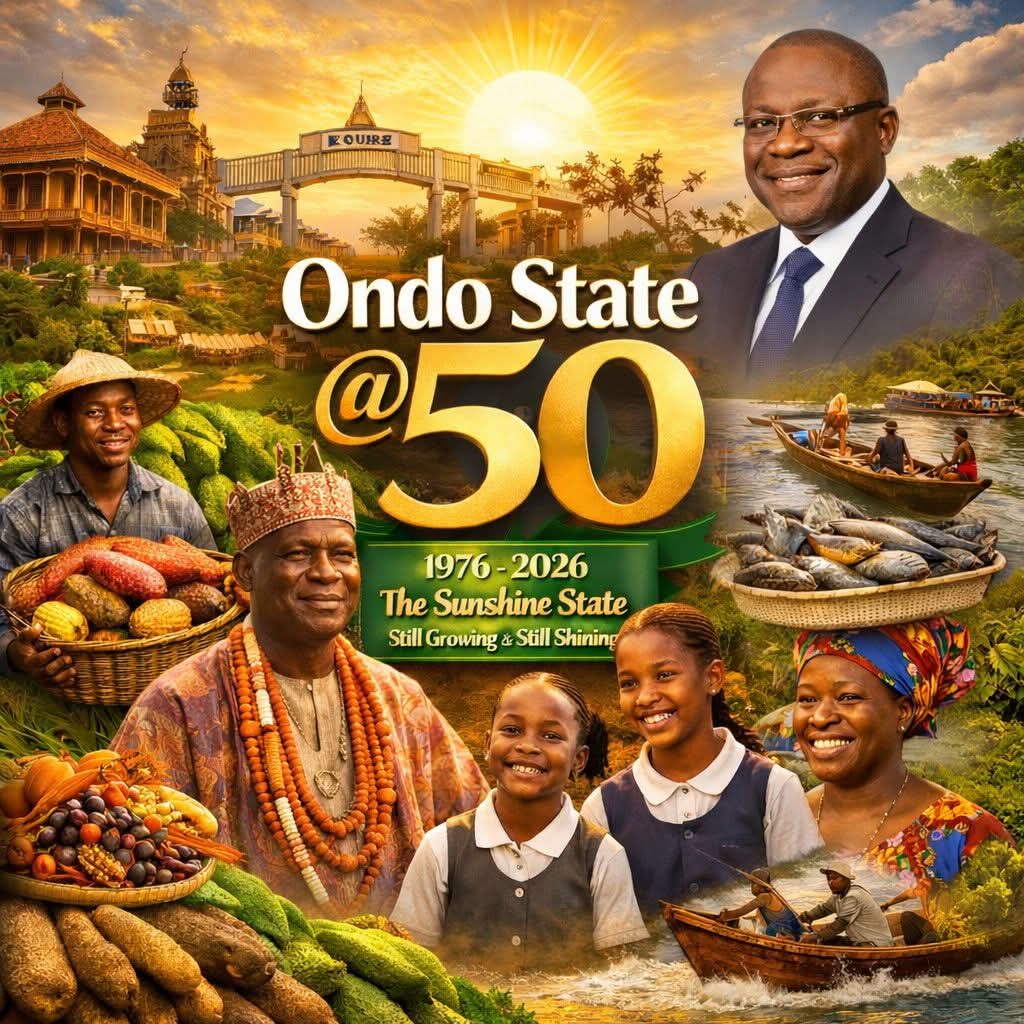
Fifty years on, this land stands proudly as the Sunshine State- a name that captures not only its radiant climate, but also the warmth, resilience, and optimism of its people.
Here, in the heart of Nigeria’s southwest, Ondo State unfolds as a tapestry of culture, labour, and heritage. Predominantly Yoruba, the state is home to diverse sub-ethnic communities whose histories intertwine yet retain distinct character.
In the north, the Akoko people, industrious and education-driven, anchor commerce and scholarship. In Owo, culture speaks in a unique dialect- shaped by centuries of interaction with the ancient Benin kingdom.
At the centre lies Akure, the state capital, and home of the Akure people- a people long recognised for political organisation, craftsmanship, and their role as custodians of governance and administration. As the seat of power, Akure stands as both a cultural nerve centre and a modern administrative hub, blending royal tradition with contemporary statecraft.
Across the central axis as well, the Ondo and Idanre peoples preserve powerful monarchical institutions and rich artistic legacies.
And to the south, along the Atlantic coast, the Ikale and Ilaje peoples live by the rhythm of the tides, sustaining age-old fishing traditions and maritime trade.
Ondo State is, at its core, a land that works. An agrarian stronghold, its economy is rooted firmly in the soil. Vast cocoa plantations-among the finest in Nigeria- stand as living monuments to diligence and foresight. From these farms came the wealth that once powered education, infrastructure, and social advancement. Alongside cocoa thrive yam, cassava, maize, rice, oil palm, rubber, and kolanut—crops cultivated by generations who understand the land as both heritage and responsibility.
Beyond the farms, the coastline tells another story. In Ilaje and Ese-Odo, fishing is not merely an occupation; it is a way of life. Here, the sea feeds households, markets, and regional trade, reinforcing Ondo’s place in the broader economic ecosystem of the southwest.
Yet, beyond geography and occupation lies a deeper identity.
Ondo state people are known for their forthrightness, enterprise, and unwavering belief in education as a pathway to progress. It is a society shaped by hard work, communal values, and quiet confidence.
As the Sunshine State marks fifty years of existence, it reflects on a journey defined by purpose- a state created not by chance, but by vision. A land illuminated by sunlight, sustained by labour, enriched by culture, and guided by resilience.
This is Ondo State. 50 years on- still growing, still shining, still true to its roots.