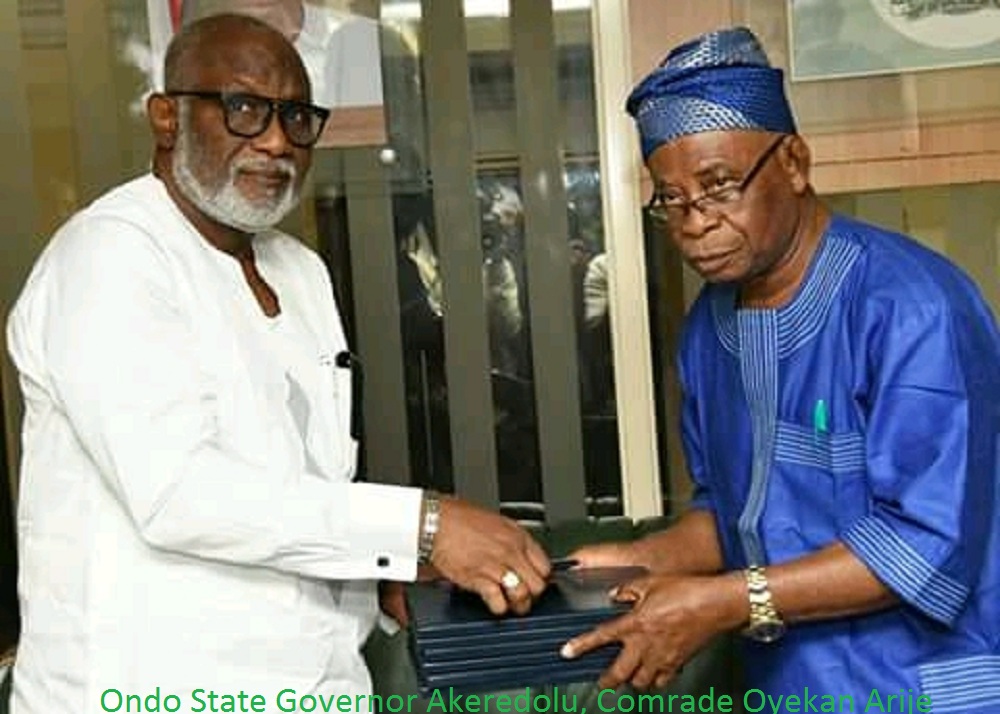
“Labour should insist that they want the emoluments of the workers, people who draw their income from the government till, they should negotiate their income, their salaries from the least paid to the highest paid, to the President because it is not their personal money. They would take imprest; they would corner the contracts; they have so many ways of amassing wealth. Labour should insist that enough is enough.”
The excerpt above contains some novel recommendations by veteran labour leader, and former two term NLC Chairman in Ondo State, Comrade Oyekan Arije, as solution to the lingering dispute between labour and the Federal Government. Besides he calls for a top to bottom negotiation of all the wages being drawn from government coffers, and the setting up by Governors of Cash Allocation Committees.
In this interview, he asks President Muhammadu Buhari to sack the security chiefs over their alleged inefficiency in handling the nation’s security challenges resulting in the killing of Nigerian soldiers like fowls by insurgents. The labour veteran, who is launching his autobiography, Footprints of a selfless servant, his fifth book, on December 13 in Akure, to mark his 80th birthday, also x-rays other burning issues of national interest.
Arije spoke with Banji Ayoola of The Radiance.
Enjoy…
How do you feel at 80?
I thank God. I feel fine health-wise, any other thing. I give glory to God.
From your journey so far, do you have any advice for the youths and the people of this country?
The youths and the elderly ones, we should learn how to be contented; and we should allow the Lord to take control of our lives; and whatever we do on earth here, we should remember that we would give an account one day.
Looking at happenings in the country, would you say that you are happy or sad?
I must be frank. I am not happy about the goings on in the country today. Murder here, kidnapping there, killings, Boko Haram, think of it. The country is not safe. And it appears that the government has been overwhelmed.
Corruption has taken over the country. It was in the papers yesterday (Monday November 26); and even on Sunday what this nation expended on military equipment since 1999.
Is it not interesting that our soldiers are still using obsolete equipment whereas annually money is budgeted for defence. Where has the money gone? To the extent that our soldiers are using obsolete weapons which render their flanks to danger. No wonder the Boko Haram and the Islamic State of West Africa have been overrunning our troops in recent times.
Another thing which makes me sad is the fact that the governors in this country said they were not going to pay the minimum wage of N30, 000.
In the first place, why should we have a minimum wage in the country and don’t have a maximum wage. What is the ratio between the highest paid and the lowest paid today. It is about ratio one to 1. 6 million. Shehu Sani exposed them, what they get. By the time you look at the ratio, it is about ratio one to 1. 6 million.
How do you expect a person to survive on N30, 000 today when the government appropriates N450 a day to feed a prisoner. At the rate of feeding a prisoner in a year, you would spend over N164, 000.
If the worker is to provide for his wife and two children, he would require N657, 000 for feeding alone at the rate of feeding the prisoner. And yet people are saying that N30, 000 which is N360, 000 per annum is too much.
Mark you, the prisoner would not buy clothes; he would not pay for medical treatment; he would not pay rent; he would not pay tax. But the worker on N30, 000 per month would pay tax, buy clothes, the children would go to school, all from N30, 000.
In May 1985 when we had the first minimum wage in this country, it was N125 per month. And that amounted to 195 dollars per month at that time because one dollar was 64 kobo. So if you convert 195 dollars to naira today, it is over N70, 000.
I have just done an article on this which I intend to give the labour people to argue their case. So it makes me sad. When I look back, it makes me sad because as it is today, what we are having in this country are slave wages and not minimum wages.
Labour is asking for N30, 000, but the governors are saying that they cannot afford this figure. What is the way out?
Labour should square it out with government. Enough is enough of the mess of the governors. The Governors Forum is unknown to Law. The Constitution does not provide for Governors Forum. It is a club. How can a club be dictating to the country.
If they cannot pay, then they should get out. As a matter of fact, the time is ripe now that labour should demand a top-bottom negotiation of wages. And the ratio between the less paid and the highest paid should be bridged. Then you would know that the governors would see reason.
Labour should insist that they want the emoluments of the workers, people who draw their income from the government till, they should negotiate their income, their salaries from the least paid to the highest paid, to the president because it is not their personal money.
They would take imprest; they would corner the contracts; they have so many ways of amassing wealth. Labour should insist that enough is enough.
But in your days, when the governors were unable to pay the new minimum wage labour asked for because of the lopsided revenue allocation formula, as it is happening today, this was not the style you adopted. We remember that you and the then NLC President, Comrade Hassan Sunmonu, went to President Shehu Shagari to demand for a review of the revenue allocation formula. Don’t you think this would be the best approach?
As a matter of fact, it is contained in the write up I have just done now.
In 1982 September, when we had a strike action in Ondo State, after concluding an agreement, I took the paper to Sunmonu in Lagos, and I convinced him of the need for a review of the revenue allocation formula, because of all the states in the federation at that time, – there were 19 states at that time – it was only Lagos and River States that were not owing workers.
In fact as they put it at that time, Imo had a special package referred to as Imo formula whereby they would pay levels 1 and 2 in one ministry and probably pay 8 t o 10 and leave the rest; and go to another ministry, pay 4 to 6 and leave the rest. That was what was called the Imo formula during the time of (Sam) Mbakwe.
By the time we argued this thing, Sunmonu agreed with me that there is a need to review the revenue allocation formula with Dr (Lasisi) Osunde wo was then the General Secretary.
Sunmonu put a call through to Shehu Musa who was then Secretary to the Federal Government to confirm he was in the office. And we went to meet him. Sunmonu raised the point, and he convinced Shehu Musa.
Without being on the programme of the President on that day, Shehu Musa took us to Shagari and Sunmonu marshaled the points; and Shagari asked the NLC to go and bring a memo for the revision of the revenue allocation formula.
So by the time we got back to the NLC Secretariat, Alhaji Sunmonu said ‘Ondo State, you initiated this thing; go and bring us a draft paper on the revenue allocation review demand.’
When I got back to Onde State, I met with the Governor, Chief Adekunle Ajasin, and I discussed with him. In fact he was surprised that within three days, I went to Lagos and had an audience with the President. He was surprised.
So he put up a five man committee to do a draft – Prof Sam Aluko, Mr A. J. Omiyale, J. Owoyemi, Ademua and myself.
Omiyale offered to do a draft for the committee to consider. He did a draft. The committee adopted the draft and we gave it to the Governor. He made some additions and it was turned over to the NLC; and I took the thing to Lagos.
That was what Sunmonu presented to President Shagari. And the presentation, after some weeks, they reviewed the state allocation from 24 percent to 30 percent in 1982.
As a matter of fact, the Federal Government asked the Ministry of Labour to collect data on the indebtedness of every state to the workers.
The Chief Labour Officer in Ondo State, by the time he made the request, and the Ministry of Finance sent circulars for this thing, I knew what it was meant for. So I advised my colleague accountants in the various ministries to put in everything including overtime allowance, hotel expenses and everything.
So Ondo State had N40 million grant, followed by Imo which had N30million, even Lagos had N5million. And the grant, it was supposed to be a loan initially; but the Federal Government wrote it off.
One thing that Ajasin did which other Governors did not do was that every month, the Cash Allocation Committee would sit down to order the priorities of what government income was to be spent on after the Ministry of Finance would have done its cash projections. NLC Secretary and Chairman were in the Cash Allocation Committee.
So we knew that government did not hide anything from us. Ajasin would chairman the meeting. Chief (Reuben) Fasoranti, the Finance Commissioner was there. Akosile, Finance Permanent Secretary was there. Akinyemi, the Accountant General of the state, myself and the Secretary of NLC were there.
We ordered the priorities together. In fact we were convinced that the state government could not meet its obligations in the areas of salaries payment.
That was what brought the idea to me that there should be a review of the revenue allocation formula which made me to meet Sunmonu to discuss this thing. And thank goodness it worked. Asa matter of fact I put it in my autobiography.
Would you advise labour to pursue the same course now?
As a matter of fact in the paper I have just put up which I intend to turn over to labour if they would make use of it, I said if governors are at home and in accord with the central fixture of the remunerations of the political class and others on the constituted salary scales, discounting the argument of the ability to pay, which consideration informs the equal pay for equal work between Governor Abdulaziz Yari of Zamfara, who is the chairman of the Governors Forum, and Lagos or River State Governor, why then should there not be a central fixture of the remunerations of the people below.
And I advised there that for equity, the governors should respect the humanity of the workers, while conscience should dictate a collaborative effort between the governors and labour to demand a review of the revenue allocation formula to secure a higher share and percentage of the common pot that is the Federation Account for the states.
That is what labour and the states should collaborate because the Federal Government is biting more than its fair share.
Rather than the governors saying they won’t pay, they should now learn to put up argument that the revenue allocation formula be reviewed to give them higher percentage.
Wage increase is usually followed by spontaneous increase in prices of goods and services, which wipe of the gains. What use would wage increase serve now?
There would be more money and it would be pumped into the economy if there is a readjustment of remunerations and you reduce the top because the top is too heavy, to add to those below. There should be a redistribution of the wealth of this country especially for people who earn from government workers.
If there is redistribution, there would be more money and it would enhance the economy of the nation.
What is your advice to the Governors on the Cash Allocation Committee of the Ajasin days?
In 2015, somebody requested me to assist (former Osun State Governor Rauf) Aregbesola when he had dispute with his workers. Among other things, I advised him to set up a Cash Allocation Committee where labour would be represented and that would afford labour to know what comes to the purse and how it is disbursed.
And I suggested to him that instead of coming to Ondo State to look for somebody who would help him, there is somebody here with him in Osogbo who is even better than myself. Alhaji Sunmonu is in Osogbo. He is from Osun State and he has retired back home.
I advised him to talk to Sunmonu. And that is why Sunmonu is the Chairman of the Cash Allocation Committee in Osun State today. The time of Aregbesola is over now. We don’t know what (Governor Gboyega) Oyetola would do.
But Sunmonu since 2015 has been in charge of revenue allocation in Osun State. As a matter of fact by the time the Chief of Staff who is now the present Governor, got the request, the letter appointing him to him, he told that well he could not take the appointment until he had discussed with the labour movement in the state if they wanted him to take up the appointment.
And they begged him to take it because they knew that they would benefit from it. And he confirmed from the National President of NLC and TUC, and they agreed that he should accept the offer.
He negotiated the 50%, 75%, 100% earning of workers in Osun State which probably doused the tension at that time. As a matter of fact, Sunmonu would be here for my book launch in December.
He is going to preside over the book launch. The thing is contained in the book. And he still confirmed to me that he is still the Chairman of the Cash Allocation Committee.
That is where the Governor is not going to hide anything because for governors who would put N2 billion for their security vote, they would not even want you to know how much comes in as IGR.
Sunmonu asked. How much do you generate a month for IGR. Can’t you generate up to N5 billion. If you can do that, your problem would be over. So they put him in charge of both the revenue generation and disbursement.
If the governors are open, workers would assist them to solve their problems. But because they are not open, that is why they don’t want workers to even know how much they earn.
A time was during the time of Ajasin that even though I was on level 12 at that time, the Accountant General sent me to Lagos to go and pursue the fate of our cash allocation for that month in December 1980 because he (Ajasin) was open.
Some governors would receive XYZ allocation from the federation account, they would declare XY to their workers. They would have an IGR of ABC, they would declare AB. So as a result they are not open. And to that extent they would not want the workers tto know what comes into the kitty.
But to an extent, I want to blame the workers for that because it is not the governor who collects the revenue.
The unions should have their tentacles in the appropriate places such that they can know what comes in by way of statutory allocation, loans, grants, everything and IGR.
During my time, without hassles, I would get the figures even before we started working together on the cash allocation because the governor was open, he had nothing to hide.
Apart from revenue allocation, wage increase and security challenges, what are the other problems confronting this country on which you would wish to advise?
I want to advise President Muhammadu Buhari to relieve the security chiefs of their positions because they have been spent, they are no longer improving, they are declining.
How can Boko Haram and Islamic State of West Africa be killing our soldiers as if they are killing fowls. The President should be more serious about the security of this country and he should not see only his kinsmen the Hausa Fulani as the only people who can guarantee security in this country.
It had never been so before his time that all service chiefs, all the security paraphernalia would be occupied by just one ethnic group. He should diversify.
Could we have glimpses of your book Footprints of a selfless servant, which you are launching on December 13?
I gave a good part of my life as a civil servant, trade unionist, statesman, even as a politician because I once contested the governorship election in this state.
I also recorded my Christian ministry. Of course I am a presiding pastor of a church organization.
And I gave some practical illustrations in that book to let the workers, especially the union leaders, know that they should be up and doing and move ahead of even the management in industrial relations.
I recalled when Nigeria wanted to aid South Africa during the apartheid system. The state government issued a circular directing that deductions be made from the salaries of all the workers for contributions to the South African Relief Fund.
The amount was not much, but because the issue was not discussed with the unions, the Labour Act stipulates that you don’t make deductions from workers salaries without involving them. They had done it without our contributions to it and I asked them to withdraw the circular. And it was withdrawn.
After it was withdrawn, we sat down, we even proposed a rate higher than what government proposed as contribution of workers to the South African Relief Fund.
When government wants to bring burden on workers, the union leaders have a duty to resist.
At a time again, government issued a circular for the deduction for street lights from the salaries of workers, and the thing covered people who were in stations where there were no street lights.
We wrote to government and asked it to withdraw the circular because it amounted to illegal collection. There should be no taxation without representation.
They did a similar one for the water corporation, not even minding the stations where the workers had no pipe borne water. They said they should deduct from everybody. The union objected to it and the circular was withdrawn.
Workers especially the leaders should be alive to their responsibilities to their members. They should not allow government to put every burden on the working class and they should be prepared to defend the right of the workers and that of the common people.
I remember when we were on a strike in 1981. I proved the case of the police. As a result when the then Head of Service asked the police to go and arrest me, they asked him ‘what crime did he commit.’
I drew the attention of the public to the fact that a police constable dog was fed with N540 a month whereas the handler, the police constable earned N105 less tax. A police ASP dog was fed with N840 a month whereas the Commissioner of Police at that time was on N811 per month.
When the police saw that I was even proving their case, by the time they asked them to go and arrest me, they asked ‘which crime did he commit.’ They didn’t touch me.
These things are revealed to serve as eye openers for the ruling class and the masses. I am quite sure, it is not eulogizing oneself, there is a lot which government can learn, and which union leaders can learn, which communities could also learn from.
Like for instance during the time of Governor Bamidele Olumilua, literally speaking, he turned to a class teacher because he wanted to explain certain things which workers accused the government of. He did it with the blackboard calculations. And yet we were able to puncture all he did.
He had to hold meetings with several segments of the state – the traditional rulers, religious leaders, road transport people, Farmers Congress, market women, students and so on and so forth.
But in the end, we put our case succinctly and the whole world agreed that the labour movement had done its home work.
Labour movement should do its home work properly before they go into any negotiation with government.
As I have said, this article that I have just written, labour should now demand a top-bottom negotiation and should take into cognizance the pay relativity between the lowest paid and the highest paid. It should not be more than ratio 1 to 100 at the most.
Between 1962 and 1991, the highest we had was ratio 1 to 37. During the Morgan Wages Review Commission, the lowest paid to the highest paid was 1: 37. But today, the ratio of what we have is incalculable.
These are the areas that labour should now put searchlight to expose the greed of the working class.
Could we have the profile of Comrade Oyekan Arije?
I am the son of a fisherman, and I grew up to be a fisherman. And even when I was schooling, I was still fishing.
I started my elementary school at the age when some people were already in the secondary school. I was above nine years old by the time I started my primary school.
I joined the civil service on May Day 1964. I rose through the ranks and I was retired because of union activities in 1993 by the Olumilua administration because of my position in the defence of the working class, and because I refused to compromise the due of the working class.
I got married at the age of 30 and I thank God I have a very pleasant, cooperating and understanding life partner. My family is blessed with six children and all of them are now grown up. I attained the age of 80 on September 18 this year.
I am also an author. The autobiography I am about to present to the public in some weeks time is my fifth publication. I have published four other books before, and I think this would be the last publication. I don’t want to write books after this book.
Do you have any further comment?
The further comment I may make is that labour should do their home work well eve ahead of management, and people who negotiate on the side of government should not always put up the spirit of they are against us. They should see reason in the demand of the working class.
Where the demand is not outrageous, for harmonious industrial relations, even management should now think of how to make their wo0rkers happy without even their demanding for it.
And I must not forget to say that it is a disservice to old men who pioneered the civil service if their pensions are not reviewed. You can’t believe that there are people who earn less than N3, 000 among the pensioners.
Government should consider the plight of the pensioners especially in a country that has no provision for social security, and knowing the fact very well that old people are vulnerable to age related illnesses.
As a matter of fact I look forward to the day when at least everybody who has attained the age of 70 and above should enjoy the facility of free medical treatment in government hospitals and part of the things we used to enjoy in the civil service during the colonial times.
Every public servant was entitled to free health services in government hospitals, maternities and dispensaries including the cost of drugs.
The only one that was not free was self inflicted illness like STDs, syphilis, gonorrhea. You pay for it because you inflicted it on yourself. And when you are pregnant, you pay for delivery fees and you pay for registration at antenatal clinics.
But even then under the hospital fees law of the old, anybody who is a worker in the hospital is entitled to free health. You would not even pay for drugs if you are a staff of the hospital.
Just of a sudden, government removed that benefit of the public servant. It should be restored. Even at that time for students, medical facility was free during the colonial era. It was part of the conditions of the workers free medical treatment.
It should be restored. And these are part of the things the unions should fight for because it is the right of the workers. It used to be so.
In the private sector, they have retainers. Private sector companies have retainers in private hospitals where their staff can go for treatment and they would not pay. The hospitals would debit the companies.
As a result such thing boosts the morale of the workers and the workers would be prepared to give of their best at any point in time, and would be interested in seeing that the establishment grows.
In areas like the internal revenue for instance, I think the time has come when government should give incentives to workers who perform well. Give them bonuses. It would encourage them to generate good revenue for government. Let me end it at that.