

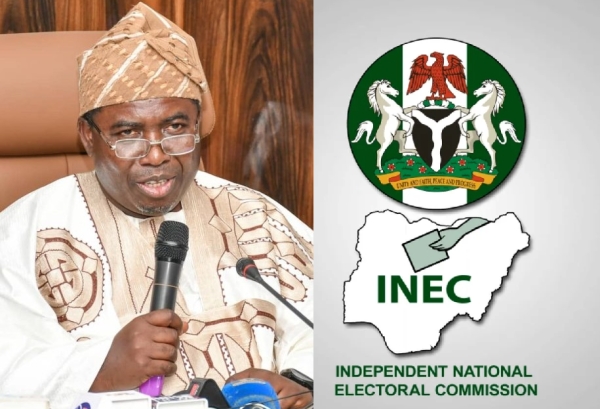
Chairman, Independent National Electoral Commission, Prof Joash Amupitan (SAN). Photo: INEC
The Independent National Electoral Commission has dismissed calls for the removal of its chairman, Prof Joash Amupitan (SAN), while addressing what it described as widespread misconceptions surrounding its planned nationwide voter revalidation exercise.
In a statement issued on Thursday night in Abuja and signed by the Chief Press Secretary to the INEC Chairman, Adedayo Oketola, the Commission said its attention had been drawn to “recent public statements by political actors alleging partisan bias, calling for the removal of the Chairman of the Commission on account of the decision of the Commission to obey the recent Court of Appeal Judgment.”
While acknowledging the right of stakeholders to express their views, INEC stressed that its operations and leadership structure are constitutionally protected.
“It is imperative to clarify that INEC is a creation of the Constitution of the Federal Republic of Nigeria. The appointment, tenure, and removal of the Chairman and National Commissioners are strictly governed by Section 157 of the 1999 Constitution (as amended),” the Commission stated.
INEC further emphasised the independence of its leadership, noting that “The Chairman does not hold office at the pleasure of any political party or interest group.”
It warned that “Any call for removal outside the established constitutional process is not only a distraction but a direct assault on the independence of the nation’s electoral umpire.”
Explaining its decision to comply with a recent Court of Appeal judgment, INEC said the move was necessary to avoid a repeat of past incidents.
“The Commission decided to comply with the Judgment of the Court of Appeal to avert a situation that occurred in Zamfara State and Plateau State where elected officials were removed by the Election Tribunal on account of the disobedience of Court Judgment,” it stated.
The Commission added that it was also acting in line with a preservative court order, noting that it did not want to disobey the directive preventing any action that could render ongoing Federal High Court processes nugatory.
INEC clarified that monitoring activities of the David Mark-led faction of the African Democratic Congress would amount to disobedience of that order.
The Commission further noted, “It was only on the 9th of September 2025 that INEC accepted and approved David Mark’s Exco, which was seven days after the matter was filed at the Federal High Court.”
It stressed the binding nature of appellate court rulings, adding, “Section 287(2) of the Constitution of Nigeria, 1999 mandates every person and authority in Nigeria not only to obey the Judgment of the Court of Appeal but also to enforce such Judgment.”
On allegations of undermining the multi-party system, INEC dismissed such claims, noting that the recent registration and recognition of the Democratic Leadership Alliance, the Nigeria Democratic Congress, and the National Democratic Party—bringing the total number of active political parties to 22—demonstrates its neutrality.
INEC maintained that it “remains a neutral regulator, not a participant in political competition.”
The Commission also reiterated its stance on internal party disputes, stating that it will not be drawn into the internal strife within political parties, nor allow itself to be used as a proxy for resolving organisational challenges that belong to the parties themselves.
Addressing concerns over the planned voter revalidation exercise, INEC cautioned against politicising the process.
“The decision to revalidate the Voters Register pre-dates the appointment of Professor Amupitan,” the Commission said.
The exercise, it added, is “a professional necessity to strengthen the integrity of the National Register of Voters” and is designed to “sanitise the register…executed in phases.”
INEC emphasised that the exercise is administrative, not a fresh registration, and is not targeted at any region, party, or demographic. It will be conducted uniformly across all Local Government Areas and Polling Units, with robust digital options for ease of access.
“The revalidation process will help confirm the status of registered voters, address issues arising from transfers, multiple registrations, and deceased persons, and enhance the reliability of voter data in Nigeria,” the Commission stated.
Highlighting its focus on upcoming elections, INEC said:
“The Commission is currently focused on the surgical precision required for the forthcoming Ekiti (June 2026) and Osun (August 2026) off-cycle elections. We will not be distracted by unfounded allegations of collusion or bias. Our allegiance remains solely to the Constitution and the will of the Nigerian people.”
Reaffirming its commitment to democratic principles, the Commission stated that its decisions are guided by law and due process.
“The decisions taken by INEC are based on thorough evaluations and aligned with the legal framework that governs our operations, including adherence to the Rule of Law,” it said.
INEC reiterated that calls for the resignation of Professor Amupitan are “out of place.”
The Punch


