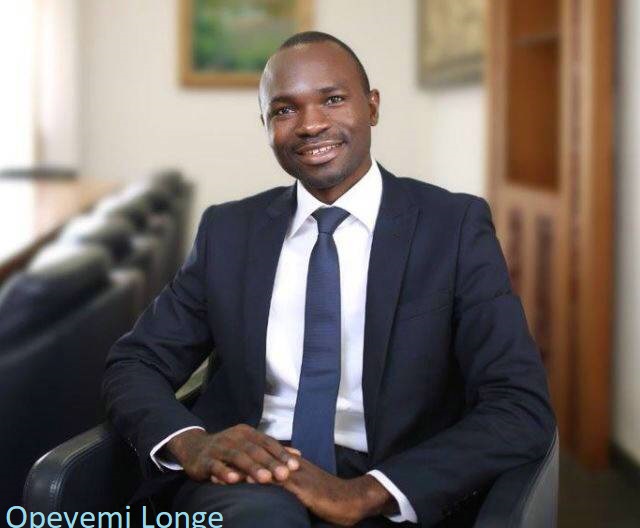

Opeyemi Longe is what we choose to call a triple treat or the gift that keeps giving. Or how else does one describe a young man who has literally scored a hat trick of successive first class degrees? Opeyemi graduated from the Adekunle Ajasin University, Akungba-Akoko, Ondo State, Nigerian Law School and the University of Oxford, all in excellent style, with first class degrees. In this interview with The Metro Lawyer’s (TML) Ogechukwu Ochuba, he shares how he did it, his plans and some advice for anyone aspiring for excellence.
Tell us a little about yourself.
I am the third child in a family of six and an indigene of Omuooke Ekiti in Ekiti State, Nigeria. I attended St Silas Anglican Nursery and Primary School and St Silas Anglican Secondary School both in Omuooke Ekiti for my primary and secondary education. I completed my study for a Law degree at the Adekunle Ajasin University, Akungba in Ondo State (AAUA) in 2012 after which I proceeded to the Abuja campus of the Nigerian Law School in 2013 for the professional training which qualified me to practice law in Nigeria.
In September 2017, I proceeded to the University of Oxford for a postgraduate degree in law. I have had the immense pleasure of very loving and supportive family. I similarly count myself incredibly lucky to have been raised by educated parents who also instilled adequate level of discipline reasonably sufficient to contain the typical juvenile excesses. I was also lucky to have been afforded the basic needs to lead a decent life growing up as a child.
How does it feel to graduate with a first class in University, Law school and now Masters? Were you expecting it?
The feeling is certainly an ecstatic one, and one which tremendously increased at each level of attainment. At the completion of my undergraduate studies, a first class degree felt good for at least two reasons; the joy of graduating on top of my class and more importantly breaking the jinx of a Law Faculty without any previous first class graduate.
I was happier when I graduated with the second first class degree at the Law School, especially as the overall best student in Nigeria, across the six campuses of the Law School. It was personally heartwarming but the greater excitement came from being able to prove skeptics, who doubted my first class degree at AAUA, wrong and also the pride this brought to my university, particularly its law faculty.
A Distinction here at Oxford brings much more joy and may be described, for want of better expression, as the icing on the cake of excellence. I feel a deep sense of academic fulfillment to have received a stamp of excellence not just in any university but the best university in the world.
On whether I expected these grades, I would say I did. Although I possibly did not expect such outstanding level of excellence at the Law School and at Oxford. It was easy for me to predict my grade at the university being a cumulative outcome of efforts spanning 5 years. However, both the Law School and Oxford were different being just a set of exams at the end of a session. At the completion of my qualifying exams at the Law School, I expected a first class outcome, even though I needed a first class grade on all the five modules I took, but the thought of being the best student nationally and with numerous prizes honestly never occurred to me.
My performance at Oxford is even more sterling when placed within the context of the requirements for a Distinction grade and the caliber of candidates on the master’s degree. The degree admits only the brightest students with outstanding first class law degrees across the world and to get a Distinction, candidates must attain a Distinction mark (a mark of 70 and above) in at least two of the four options and have no mark below 60. In my own case, however, I secured a Distinction mark in all of the four papers I took, exceeding the minimum university threshold and therefore a reflection of excellence at its finest. In addition, I was awarded the Winter Williams Prize for the best student in International Economic Law.
In all, even though I had always expected some level of excellent performance, the eventual outcomes were honestly unexpected.
Would you say it has been a smooth sail to achieving this feat? What kept you grounded and on the right path?
It would clearly be misleading to speak about a rosy journey coming this far. These excellent feats were products of a combination of consistent hard work, discipline and personal sacrifice. I have heard and read comments about being a genius and such comments simply made me laugh because that is not the case. Rather, I had always proceeded in the firm belief that nothing is impossible to get if you desire it and work well enough for it.
One significant thing I would say has kept me on this path is engaging with each task as a fresh undertaking to show excellence and develop strong intellectual capacity and not allow past achievements get into my head. I am aware this is one major reason why many people fail to be at their best and this is not just limited to academics. In my own case, I avoid such mentality like a plague and it has not been particularly difficult for me to do this because I thankfully found myself as just a star among the constellation of stars (and perhaps brighter stars) in the educational institutions I attended after my first degree. This gave me the needed humility to take on each new challenge.
For example, at the Nigerian Law School, I saw myself simply as a first class graduate of a State University among many first class graduates from several universities in Nigeria and overseas, which are positively rated ahead of my university. This was acute at Oxford, with a mix of highest-achieving candidates from their countries, with degrees from globally rated universities and some even with doctorate degrees. Against this background, it was just normal for me to understand that being the best in my previous background has no place in my current engagement but that I must rather work harder to demonstrate this fact. So in some sense, my personal commitment not to take pleasure in past achievements, influenced by the circumstances I found myself, is a key impetus that has kept me on track.
What would you say is your most significant achievement and what are your hopes for the future?
I would say my most significant achievement in academics is obtaining a master’s degree from Oxford with a Distinction. There is something more fundamental which underscores the importance of patience and focus and brings to fore the shame of a nation which does not reward excellence, especially academic excellence.
For three consecutive years after graduating from the Nigerian Law School in 2014, I applied to and was offered admission to study for a master’s degree both at Oxford University and Cambridge University, among other top UK schools. I could not take up these offers at each turn simply because I did not secure funding. This is troubling when placed in proper perspective. Here you have a citizen with an impeccable academic record, with double first class degrees in law up to the highest level of legal education in Nigeria, having graduated as a student with the overall best performance nationally in the 2014 Bar Examinations.
At each turn, I wrote appeal letters for financial support to the Government of my State and leading legal practitioners in the country with nothing concrete. Many of the emails I wrote simply went unacknowledged. One interesting but sad example was in 2016 when I met with the Deputy Governor of my State, Ekiti, who explained the inability of the government to offer financial support because of the much touted national recession at the time. It was hugely saddening for me to hear on the Friday of the same week I met with the Deputy Governor that the State Governor gave out Ten Million Naira at a social event in the State.
This sent a clear message of a system unprepared to reward excellence or one that would simply not reward anything that attracts no political capital or attention. Although I was ultimately unable to take up the offer in that year, I thankfully secured funding later from a charitable UK body and with support from family and family friends, the rest is now history.
My experience has challenged me to translate this strong intellectual capacity to outstanding excellence in my professional career. More importantly, I look forward to being able to support academic excellence in whatever way I can in Nigeria. Although my own experience reflects the shame of a nation, I hope I can in the near future change the narrative through my personal contribution and in any future public engagements.
What is your advice to law students who would like to be as academically successful as you?
The advice is self-evident. I have always believed that students know what they need to succeed in their academics and have simply chosen to ignore it totally or pay scant regard to it. Success comes through nothing but hard work and personal discipline.
I am a Christian and a strong believer in the power of God’s grace and prayer but prayer is never a substitute for hard work. Interestingly, the reality is that many students who succeed outstandingly do not even have any religion, at least from a global perspective.
What suggestions do you have for our educational institutions and the bodies in charge of them to improve the quality of the graduates they produce?
There are two things, at the very minimum, that are key for educational institutions – adequate funding and merit. It is common knowledge today in Nigeria that funding for our public universities falls significantly below global standards. It is even worse to note that the recruitment process for teachers and the admission process for students in many universities are not based on merit. In these circumstances, it would be foolhardy to expect quality from such a system. Just to give context to this, in my first application to the law faculty of a state university, I was denied admission even though I was top on the list of highest-scoring applicants and also an indigene of that State. I was only lucky to be admitted in the subsequent year by AAUA purely on merit.
Similarly, I received offers of admission from Oxford and Cambridge each and every time I applied simply on the strength of my academic records. So in a way, you cannot build something on nothing. Our government and those in charge of our educational institutions must wake up to this reality of insisting on merit and prioritizing massive investment in education through infrastructural development and research.
There must also be a deliberate effort to attract the best academics nationally and globally by offering decent remuneration. Sadly, the same government that failed in these responsibilities are quick to decry the quality of the nation’s graduates. Common sense dictates that your yields are as good as your investments.
The various governments and their agencies have simply shut their eyes to the apparent evidence that these same graduates do exploits when they go outside the shores of Nigeria. This is no magic but simply a product of access to conducive and convenient world-class facilities. Therefore, if we desire an improvement in the quality of our graduates, we need more funding for education but I doubt if this would happen soon since many of the children of those in government attend universities outside the country and are rarely affected by the sad reality in our public universities.
I should say, however, that some private universities are making giant strides to bridge this deficit although the understandably high fees charged by these universities would continue to shut out many bright students from average backgrounds from attending these universities.
Would you say you were the traditional “bookworm?” Apart from academics, what are your other areas of interest?
I doubt if I fit into the description of a traditional “bookworm” even if I will admit that I devote more attention to studies in each academic session, as a reflection of setting the right priority. Apart from this, however, I engage in other activities outside academics.
For example, as an undergraduate student at the university, I was involved in several societies and organizations and ultimately served as the Chief Judge of the Student Union Government in my final year. This was a leadership position that involved significant level of engagement outside academics. Recently at Oxford, I also volunteered for charities at different times.
Was the study of law your choice? What would have been the ideal alternative course for you?
Studying law was my personal choice. I say personal choice because my dad actually wanted me to study medicine. His rationale was that being a calm and coordinated child, I would make a successful medical doctor. He almost succeeded until the last year of my secondary education when I refused to register for science related subjects but opted to sit for subjects that would qualify me for admission to study Law.
I am happy with myself for this decision when I reflect on the journey so far and I think those traits my dad saw in me that shaped his resolve that I have bright prospects as a medical doctor are particularly helpful in my study of law till date. So I doubt if there is an ideal alternative for me outside law.
What excites you the most about the legal profession?
The nobility of the profession is a unique selling point for me. It is exciting to appreciate that people are eager to listen to what your views are on specific issues. This is significantly the case in the actual practice of law where your clients depend on your opinion to shape their steps and decision. This is also fairly applicable in the society at large. For me, this is a great burden imposed on a lawyer and that is why I find it most unfortunate when I listen to or read comments by lawyers, especially senior lawyers, which turn logic on its head simply because of financial or political considerations. I liken such an action to a cankerworm which is continuously chopping off the nobility of the profession.
How did you get funding for your master’s program?
As I noted earlier, the inability to obtain funding delayed my plan for a master’s program for three years. In 2017, however, I was lucky to be awarded a Dulverton Scholarship funded by the Dulverton Trust, an independent and charitable organization in the UK. This scholarship is usually awarded to students on the basis of academic merit. However, I did not specifically apply for the scholarship and this is because for over two thirds of Oxford scholarships, nothing more than the standard course application is usually required. In this way, admitted candidates are automatically considered for scholarships which they fulfil the eligibility criteria.
Do you think new wigs should undergo a period of pupillage and for how long?
I strongly believe new wigs need some period of pupillage and this is simply because the undergraduate study and the one-year professional training at the Law School do not prepare them sufficiently for immediate independent practice of law. Although we do not at present have a model of pupillage similar to what obtains in the UK, there is a similarity of sort with what obtains in practice, where new wigs first join a law firm rather than immediately set up a law firm of their own to practice law.
Of course, some have defied this logic and recorded historic successes but in many of such ended in a disaster evidenced by the less satisfactory performance of many advocates in our courts today and the poor quality of pleadings and written submissions. A carefully designed and compulsory pupillage would make a huge difference. In terms of duration, I would personally recommend a period of 2 years with adequate remuneration for such new wigs. Today, the remuneration in most law firms is, to say the least, appalling and is a major reason why some young lawyers prefer to start all alone. Sadly, this does not help in grooming quality advocates prepared to make significant contribution to the growth of our legal system.
Who are your role models in the profession?
In terms of specific names, I do not have a closed list of role models in the profession but I am rather influenced by many lawyers whose practice and advocacy reflect excellence.
What are your plans for the future?
Before now, I was involved in advising and defending multinational companies, financial institutions and government agencies in disputes subject to litigation and arbitration. At the moment, I plan to continue with this for some time with plans to pursue a doctoral programme at some point in the future.
The Metro Lawyer