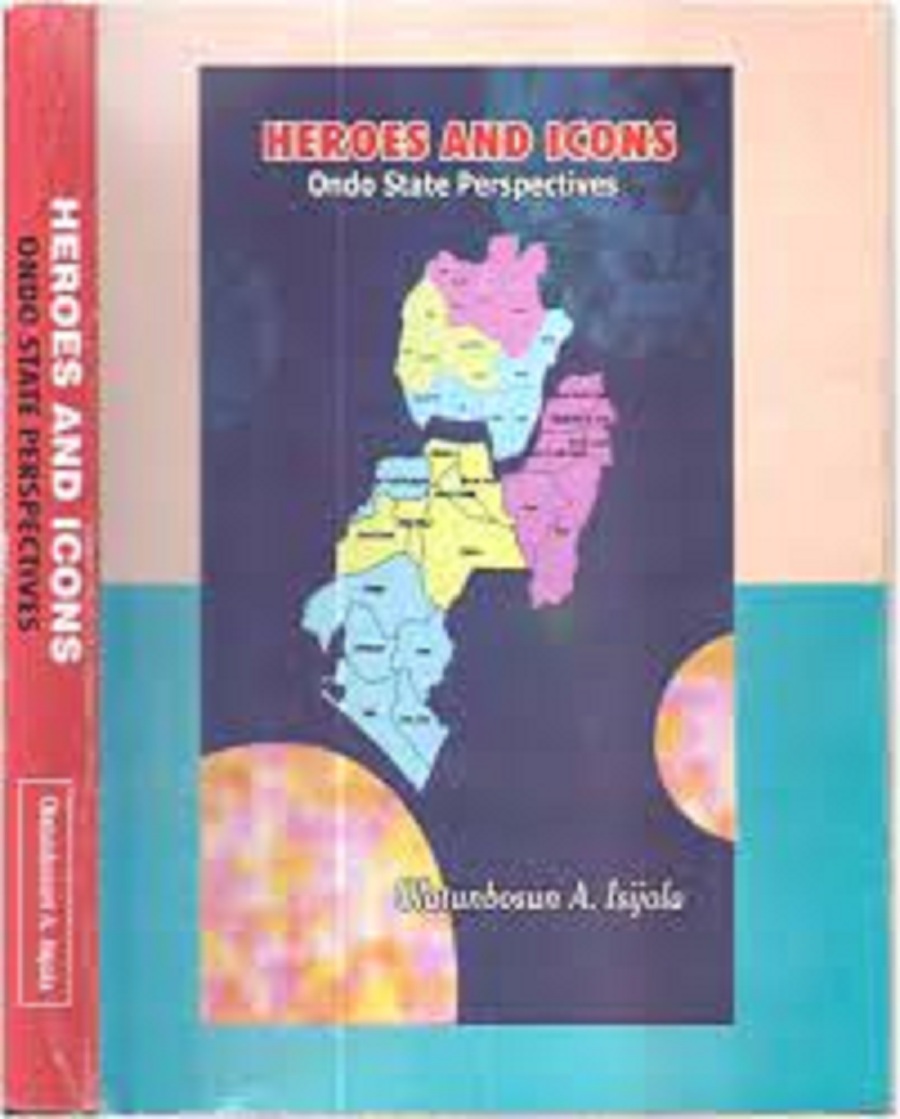
- Author: Olatunbosun Isijola
- Pages: 380
- A Review by Ajose Kudehinbu, NPOM, former Head of Service (HoS) Ondo State
Heroes and Icons, by Olatunbosun Isijola, if I remember, is the first of any such publication on Ondo State, including to a large extent, Ekiti State carved out in 1996. The book is a chronicle of data, information and commentary on the creation of Ondo State, its political actors and the bureaucrats, from the inception of the State to the present, forty-five years after the State was created.
The problem of our political evolution in Ondo State and possibly elsewhere, was to have carried on without the benefit of hindsight beyond the realization that Ondo was created in 1976 as contained in government documents and other publications.
Let me share a personal experience. My father had submitted to a Chieftaincy Review Panel – the Olayiwola Chieftaincy Review Panel – a family document, my grandfather collected in 1937 from the British Colonial Administration. Unfortunately, the Panel demanded the original document. When my father wanted his document back, it was found missing! All efforts to have the document back failed, to this day. My father passed on in 1996, at 96, unable to lay hands on a document his father kept since 1937. It was a question he asked until the last day: Jose, where is my document? Only his lawyer who facilitated the submission of the document, could answer that question. Not me!
With this unfortunate incident in mind, I wrote a memorandum, later in my Civil Service career, to my direct boss and Head of Service, Mr Akin Adaramola, on the need for the State Government to establish an Archive where important documents should be housed. The State Government Executive Council approved the suggestion. The decision was then forwarded to the Ministry of Information and Culture for implementation. Several years later, it is not clear whether or not that decision has been fully implemented.
Second example: Ondo State was going to take advantage of its crude oil production in order to remain a member of the the Niger Delta Development Commission (NDDC). It took a government team a visit to London to obtain all relevant documents with which to prove its case! It is all these lacunae in governance that Heroes and Icons, may have come to fill.
In Literature, a hero is often the most important character around whom activities in the narrative revolve. He is an admirable person, a courageous person of great accomplishments, who is sometimes oblivious of the risks and the dangers that line his path. Those dangers, which may bring him to a tragic end.
Olatunbosun Isijola identifies, in Heroes and Icons, all such people numbering 75, led by Chief G.B.A Akinyede, although Chief Seinde Arogbofa, a major participant in the fight for the creation of Ondo State, opined that the agitation for the State, less encompassing, got underway, a little earlier and was led by Chief M.A. Ajasin.
The heroes are all listed in the book. They include Chief Olu Akinfosile, Chief J.A. Ani, P. A. Akomolafe, Prince Deji Adegoroye, Chief E. O. Agagu, O. Bademosi, S. B. Aruwajoye, F. O. Akinsiku, A. B. Agunbiade, J. A. Akintoba, Chief Blessing Kayode, Chief R. F. Fasoranti, Chief Seinde Arogbofa, Prof. D. A. Ijalaiye, and a lot more. They were the heroes. In the words of the author, they pursued a definite and noble mission, that is, the creation of Ondo State.
The Icons – those who symbolized or drove the development of the State – in a seamless transition, took the baton from the heroes in different jurisdictions they found themselves. To lead the executive branch was Wing Commander Ita David Ikpeme, assisted by the first Secretary to Government & Head of Service, Chief T. A. Iwajomo. In the judicial arm was Dr. T. A. Aguda, as Chief Judge, the only other arm of Government that survived the Military Administration. In subsequent years, in the first democratic dispensation, Chief Ajasin led the executive arm as Hon. Bola Akingbade emerged to lead the Legislature. They all together with senior officials became Icons, although some of them, like Chief Ajasin, were also heroes by the categorization of the author.
Since Ondo State was created from the defunct Ondo Province which formed part of Western Region at the time, it has now become a distinct political entity brought closer to the people, for purposes of governance and administration. It has a capital city in Akure and is made up of 18 Local Governments. It has a governance structure made up of the three Arms: Executive, Legislature and Judiciary. Today, it can boast of the following institutions and more:
- Federal University of Technology (FUTA) Akure
- Adekunle Ajasin University (AAUA) Akungba-Akoko
- Olusegun Agagu University of Science & Technology, Okitipupa
- University of Medical Sciences, Ondo.
- Wesley University, Ondo
- Elizade University, Ilara-mokin.
- Achievers University, Owo.
- Adeyemi College of Education, Ondo.
- Rufus Giwa Polytechnic, Owo.
- Federal Polytechnic, Ile-Oluji.
- Public Service Training Institute (PSTI) Ilara-mokin.
The State has many secondary schools and several primary schools to serve a teeming population of school children. All of the foregoing efforts are geared towards developing the State now and in the future.
In the area of road infrastructure, the creation of Ondo State has seen the construction of motorable roads, to link the riverine parts of the State, for the first time, by road transportation. This came with the construction of the Igbokoda-Aiyetoro Road, with a spur to Araromi Seaside, in Ilaje LG. In many other parts of the State, roads are being dualized in Akure, Ondo, Owo and Ikare and to a smaller extent, Igbokoda. Oke-Alabojuto, in Ikare, Akoko NE LG has been brought down and made less hazardous to travel on, while Ore, in Odigbo LG. now enjoys an overhead bridge in order to remove traffic gridlock, minimize road accidents and facilitate road transportation in the area.There are other projects.
Deserving of a special mention is the Government Secretariat Complex, if mostly poorly maintained, that has served as hub of government or bureaucratic activities. It has been a great foresight of our heroes and icons.
In Part Two A of the publication, the author listed all the Chief Executives of the State, to the present time. There have been 17 of them, a mix of military and civilian. He listed also the Commissioners, the Heads of Service and the Permanent Secretaries. They are all people who have acted their parts in the history and the development of Ondo State.
You would decide then, ladies and gentlemen, whether in light of the volume of information in Heroes and Icons, the creation of Ondo State is justifiable or not.
The Ondo State Government has immortalized some of the players in the creation and the evolution of the State. This is a step in the right direction. It should please do more: l wish to suggest that the first Military Governor of the State, Wing Commander – at the time – Ita David Ikpeme be immortalized along with the first Secretary to Government & Head of Service, Chief T. A. Iwajomo. They set the State on a journey of no return. To their Administration belong many iconic projects, including the Secretariat Complex, ever so gigantic and beautiful!
I recommend also Dr T. A. Aguda who established our Judiciary and pursued the cause of justice to the satisfaction of all and sundry. There is also Chief Ade Adefarati, late Governor, who opened up the riverside of Ondo State and gave the State Oil Producing Areas Development Commission (OSOPADEC).
Finally, possibly in this gathering today, is Basorun Seinde Arogbofa, writer, School Principal Emeritus, tireless educationist, conversationalist, public commentator. He is both a hero and icon. Every indigene of the State should be permitted to write his name in gold or drag it in the mud!
Heroes and Icons is a must have for all indigenes of the State, who are desirous of knowing its beginnings and its evolution. It is a publication for historians and for Political Scientists and, of course, for the political class. It may not be a perfect book because it does contain some omissions which are inevitable in an ambitious publication of this nature. Yet, the book shows us where we are in terms of documentation and what purposes it serves in society.
It is Olatunbosun Isijola’s further contribution, in retirement, to his State for the benefit of this generation and the next.
Ajose Kudehinbu 10 June, 2021.