Former Commonwealth Secretary-General, Chief Emeka Anyaoku, on Friday called for credible preparations ahead of Nigeria’s 2027 general elections warning that the international community would be closely watching developments in the country.
He made the remarks in his chairman’s opening address at the 2026 memorial lecture in honour of the sage, Chief Obafemi Awolowo, held in Ikenne, Ogun State, to mark the 117th anniversary of the birth of the late nationalist and former Premier of the Western Region.
The lecture was organised by the Obafemi Awolowo Foundation.
Commenting on present-day Nigeria, Anyaoku said the country faced two pressing challenges: the growing political focus on the 2027 general elections and the persistent insecurity affecting several parts of the country.
He urged the Federal Government and the Independent National Electoral Commission (INEC) to ensure credible electoral processes, particularly in light of controversies surrounding the electronic transmission of results to the INEC Results Viewing Portal (IREV).
According to him, the global community would closely monitor the conduct of political campaigns, the electoral process and the final results, noting that Nigeria’s elections would inevitably be judged for their credibility by other nations, especially those with diplomatic missions in the country.
On security, Anyaoku lamented that more than a decade of kidnappings, killings and large-scale displacement had continued to devastate communities in states such as Zamfara, Kwara, Niger, Plateau, Benue and Sokoto.
He said the Federal Government was right to seek cooperation with friendly countries in tackling banditry and jihadist violence but cautioned that such partnerships must respect Nigeria’s sovereignty.
Welcoming dignitaries and participants to the annual event, Anyaoku joined the host, Ambassador Olatokunbo Awolowo Dosumu, in celebrating the enduring legacy of the nationalist leader whose birth in Ikenne, he said, had permanently placed the town on the map of Nigeria.
The elder statesman described Awolowo as one of the three founding fathers of modern Nigeria and a statesman whose record of public service continued to define the ideals of responsible leadership.
According to him, Awolowo’s roles as Premier of the Western Region, Leader of Opposition in Nigeria’s independence parliament and later Vice Chairman and Commissioner of Finance in the Federal Executive Council demonstrated why many Nigerians often describe him as “the best President Nigeria never had.”
Anyaoku noted that the enduring values associated with the late nationalist inspired the creation of the leadership award instituted by the Obafemi Awolowo Foundation 14 years ago to honour individuals who exemplify the ideals of discipline, integrity, competence, pro-people governance and patriotism.
He explained that he chairs the award’s selection committee, which works with a technical panel largely composed of university professors to identify deserving recipients who reflect the values associated with Awolowo’s public life and leadership philosophy.
Introducing the guest lecturer, Professor Wale Adebanwi, Chief Anyaoku praised the distinguished Nigerian scholar as an accomplished academic and prolific author with a remarkable international career.
He highlighted Professor Adebanwi’s academic journey through the Universities of Lagos and Ibadan before earning further distinction at Cambridge University.
Anyaoku also noted Adebanwi’s historic appointment as the first Black Rhodes Professor at St Antony’s College, Oxford University, and his current role as Presidential Penn Compact Professor of African Studies at the University of Pennsylvania.
The former diplomat digressed briefly to recount a personal experience tied to the University of Pennsylvania dating back 60 years.
He recalled being invited in January 1966 to address the university’s Society for International Affairs alongside a British diplomat while serving at Nigeria’s Permanent Mission to the United Nations in New York.
According to him, the discussion focused on the unilateral declaration of independence by the Rhodesian minority regime led by Ian Smith in November 1965. During the session, however, an audience member unexpectedly asked him to comment on reports of a military coup in Nigeria.
Anyaoku said he initially assumed the questioner had mistaken Nigeria for another country such as Algeria or the Republic of Niger, but the man insisted he had heard on the radio that a coup had occurred and that Nigeria’s Prime Minister, Abubakar Tafawa Balewa, was missing.
The veteran diplomat explained that he then requested a short break to contact Nigeria’s ambassador in New York before returning to inform the audience that “something unusual had happened” in his country, marking the moment he first learned of the January 1966 military coup.
Anyaoku concluded his remarks by inviting participants to focus on the day’s main highlight, the memorial lecture by Adebanwi, while expressing hope that reflections on Chief Awolowo’s legacy would continue to inspire principled leadership and national renewal in Nigeria.
Vote buying culture can’t produce good leadership —Adebanwi
Presenting the lecture titled ‘Politics as Future-Making: Awolowo and Leadership as Theory of Action’, Professor Adebanwi called on Nigeria’s political elite to rethink leadership through the philosophical and political legacy of Chief Awolowo, arguing that Nigeria’s crisis of governance stems largely from the failure to embrace a long-term vision of nation-building.
Adebanwi, a Guggenheim Fellow, and a Presidential Penn Compact Professor of Africana Studies at the University of Pennsylvania, United States, said Nigeria’s persistent instability, rising insecurity and governance failures reflect a deeper leadership crisis, stressing that Awolowo’s political philosophy provides a useful framework for addressing the country’s contemporary challenges.
He said vote buying culture among Nigerians cannot produce good and sustainable leaders for the country.
The don said the “pay me to vote for you culture” is depriving the country of the opportunity of producing good leaders.
According to him, the country has failed to produce good leadership because of some factors that include nature and dynamics of state composition, the nature of the political economy, the nature of social composition and the nature of elite composition.
Adebanwi explained that while the elite is mostly responsible for the absence of good leaders in the country, the masses as well cannot be absolved completely.
“Indeed, while much of the blame must go to the political class and the elite, the people-as-electorate cannot be absolved of their share of the blame. It is difficult for a pay-me-to-vote-for-you political culture to produce sustainable good leadership,” he said.
Speaking on the nature of social composition, he said, “The emergent social formation is a product of our collective refusal to transform the nature and dynamics of state composition and the political economy that have produced the current social dynamics.
“We have developed a beggarly culture which has not only deepened in the last few decades, particularly since the era of ‘settlement’ as a ‘directive principle of state policy’, but it has also been federalized and canonized. We have worked hard toward the near-total destruction of the ethical basis of public culture.
“We have taken the worst aspects of our socio-cultural notions and practices which have been exacerbated by the cultural ill-logic of oil wealth, and expanded and extended them while ignoring the best and the most positive aspects of existing ethno-cultural formations and practices.”
He however said finding solutions to the problems would involve adopting dome of the approaches of Chief Obafemi Awolowo.
According to Adebanwi, “Chief Awolowo already showed us the path. We need to adopt and adapt his methods, tactics, and strategies for the present and reverse-engineer how he delivered effective leadership and governance in the Western region.”
He stated that there could be no sustainable leadership in Nigeria if there is no true federalism, saying this would form the foundation upon which good leadership can stand.
The guest lecturer also advocated a new democratic constitution for the country as a step towards having sustainable leadership.
According to the scholar, politics must be understood not merely as the contest for power but as a deliberate effort to shape the future of society through vision, planning and responsible leadership.
Adebanwi argued that Awolowo’s life and career were devoted to what he described as “future-making,” a process that combines ideas, strategy and collective mobilisation to build a desired national destiny rather than simply reacting to existing problems.
He noted that despite the passage of decades since Awolowo’s death, the former Western Region premier remains central to Nigeria’s political conversation because of his commitment to social welfare, federalism and democratic ideals.
The lecturer warned that Nigeria’s present security environment, marked by insurgency, banditry, secessionist agitation and criminal networks, had been anticipated by Awolowo, who cautioned that the country could face grave consequences if its leaders failed to correct structural imbalances.
Adebanwi also criticised the tendency of political actors to remain trapped in historical grievances rather than focusing on building a better future, saying Awolowo used history primarily as a tool for designing the future.
He identified four major structural reasons why Nigeria has struggled to sustain good leadership: the composition of the Nigerian state, the country’s political economy, its social dynamics and the nature of its political elite.
On the structure of the Nigerian state, he said the colonial legacy created deep inequalities and regional tensions that have continued to shape governance and political competition.
He argued that the transformation of Nigeria’s economy from agriculture to oil dependency produced a “national cake” mentality that weakened fiscal responsibility and encouraged corruption among political elites.
Adebanwi added that social and moral decline within the public sphere has eroded values that once guided leadership in Nigerian societies, citing indigenous ethical ideals such as omoluabi, mutumin kirki and ezigbo mmadu as virtues necessary for building a healthy polity.
He also criticised what he described as the oligarchic nature of Nigeria’s political elite, which he said has historically undermined democratic progress and prevented the emergence of transformative leadership.
Despite these challenges, Adebanwi expressed optimism that Nigeria could still overcome its difficulties if leaders and citizens alike embrace Awolowo’s philosophy of disciplined leadership, visionary planning and commitment to collective welfare.
He stated that Awolowo’s enduring lesson for Nigeria is that political leadership must be rooted in the courage to imagine and actively build a better future for the nation.
In his remarks, Senator Gbenga Daniel said, “We must remember that to visit an argument about politics, an argument captured beautifully in the theme of this lecture, ‘Politics as Future Making: Awolowo and Leadership as Theory of Action’, to speak of Baba Awolowo, is to speak of a peculiar mind, one that refused to treat politics as improvisation, or leadership as a performance for applause.
“He saw politics as disciplined action rooted in ideas, animated by moral conviction, and directed towards a future that didn’t yet exist but could be built through vision and commitment.”
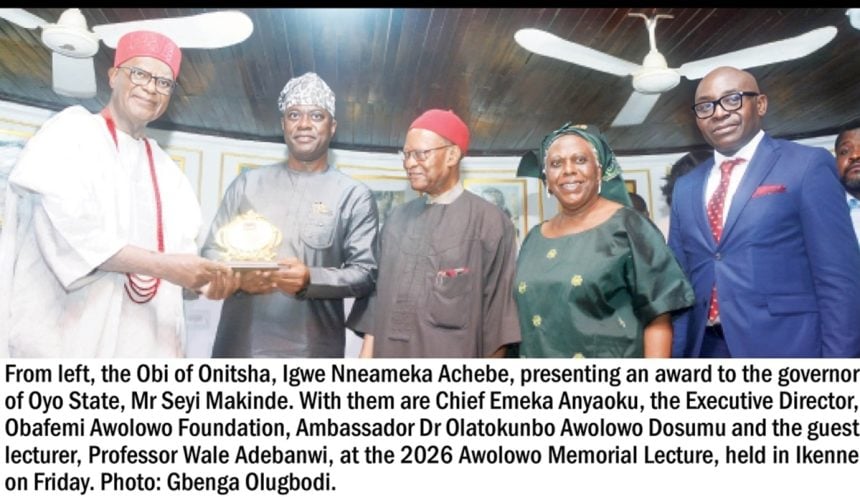
Scores of dignitaries were in attendance at the event. They included Oyo State governor, Mr. Seyi Makinde; Senator Gbenga Daniel; former governor of Osun State, Prince Olagunsoye Oyinlola and wife, Omolola; Ogun State governor, Prince Dapo Abiodun, represented by his deputy, Mrs. Noimot Salako-Oyedele; Senator Ibikunle Amosun represented by Hon Wale Ogunyomade; Ambassador Yemi Farounbi; Senator Gbenga Kaka; Senator Femi Okurounmu; Pa Ayo Opadokun; ex-Osun State governor, Ogbeni Rauf Aregbesola represented by his son, Kabiru Aregbesola; and Aare Kola Oyeweso.
Others were Chief Olabode George; the Aare Onakakanfo of Yorubaland, Chief Gani Adams; Secretary to the Ogun State Government, Mr Tokunbo Talabi; the Bishop of Methodist Church Nigeria, Remo Diocese, Rt Revd Bamidele Ibikunle; Professor Anthony Kila, Chief Mrs Bola Doherty, Professor Adebayo Williams and Mrs Funke Egbemode.
The Orangun of Oke Ila, Oba Adedokun Abolarin and the Olubadan of Ibadanland, Oba Rashidi Adewolu Ladoja, who was represented by the Aare Alasa, High Chief Ademola Odunade, were also at the event.
Others were: the Onwolu of Irolu, Oba S. A. Adeyiga, Oba Onakade Adeyinka and Odofin Sonyindo Sagamu, Oba M. S. Lasisi, Chief Niyi Akintola (SAN), Chief Pekun Awobona, Dr Ebun Sonaya, Mrs Adebola Babatunde, Omoba Adebayo Odubona, Professor Iyabo Abiodun-Runsewe, Dr Femi Majekodunmi, Mrs Buky Tunde-Oshunriwa, Chairman Ilisan Development Association, Aare Wemmy Osude and Mr Tola Mobolurin.
Other dignitaries there include Mr Adewole Adebayo, Honourable Ladi Adebutu, Bishop Ayo Ladigbolu, Chief Soname, Professor Akinyemi Onigbinde, Professor Oladapo Afolabi, Professor Williams Kola, Yetunde Ajasin, Chief Dr (Mrs) Sade Ajasin, High Chief Tokunbo Ajasin, Mr Laolu Akande, Dr Festus Adedayo, Dr Rita Okonoboh and Dr Kehinde Oyetimi.
Also, there were members of the management of the ANN PLC led by the managing director, Mr Edward Dickson and Consultant, Dr Segun Olatunji. Others are: Mr Sina Oladeinde, Dr Lasisi Olagunju, Mr Peculiar Adegbite, Mrs Toyin Ibitunde and Dr Biodun Awolaja.
Tribune