

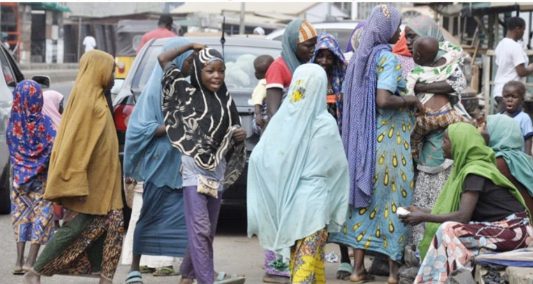
Rising security and welfare concerns have emerged in Akure, the Ondo State capital, following the increasing number of Almajiri children, both boys and girls, roaming major streets, markets and residential areas without supervision.
Rising security and welfare concerns have emerged in Akure, the Ondo State capital, following the increasing number of Almajiri children, both boys and girls, roaming major streets, markets and residential areas without supervision.
Findings by THE HOPE revealed that the almajiris, most of whom are of school age, are regularly seen at strategic locations such as Oja-Oba, Old Garage, Cathedral, Isinkan, Arakale, Ijoka, major bus stops and along busy traffic corridors within the metropolis, raising questions about their safety, public security and the long-term implications for the state.
Residents who spoke with our correspondent warned that unless the challenge of the swelling population of uneducated and unskilled children is addressed, the possibility of a serious security threat in the future is imminent.
Speaking on condition of anonymity, a security expert described the situation as a “silent emergency.”
He warned, “Any society that allows a large number of children to grow up without education, skills or proper social orientation is planting seeds of insecurity. In the next 15 to 20 years, the consequences may be difficult to contain.”
Further investigation showed that many of the almajiri children survive through street begging and menial jobs, exposing them to exploitation, abuse and possible recruitment into criminal networks.
A resident, Mr. Temidayo Borokinni expressed fear that the situation is already affecting safety within the state capital.
He enthused, “Seeing them all over Akure metropolis is embarrassing and disturbing. The situation poses risks to residents and passersby. Most of them are not in school during the day, and at night they litter the places where they sleep or stay.
“We are not saying these children are criminals, but leaving the mon the streets without any form of structure is dangerous, for them and for everyone. Prevention is cheaper than crisis management.”
Also speaking, Comrade Lawrence Adebayo lamented what he described as the unchecked influx of Almajiri children into Akure.
“This is a terrible development, both for the future of the children and for the state. Almajiris have a history of petty stealing, which may later graduate into more serious criminal activities if nothing is done,” he lamented.
Adebayo called for proper profiling of the children and their parents, stressing that those found within the community should be enrolled in schools or trained in vocational skills.
He said, “They are already part of the society. Government should identify them, enroll them in schools or introduce them to trades and crafts.”
Community leaders and civil society groups have also urged the Ondo State Government to urgently map the population of almajiri children within Akure metropolis, establish rehabilitation and educational centres and strengthen inter-state collaboration to address the root causes of the problem.
They further called on security agencies and social welfare departments to intervene proactively before the situation escalates into a full-blown security challenge.
As Akure continues to grow as an urban centre, residents insist that decisive action taken now could prevent future instability and ensure lasting peace and safety in the state.
Reacting to the development, the state Commissioner for Women Affairs, Dr. Seun Osamaye said the Ondo State Government has adopted what it describes as strategic and humane measures to address the growing presence of street children, particularly those migrating from the Northern parts of the country.
The commissioner noted that there has been a noticeable increase in the number of such children in Akure, the state capital.
She said, “Most of these children are from the Northern parts of the country, and recently there has been an increase in their number in Akure. While this poses a challenge, the government must approach the issue with sensitivity and caution to avoid appearing insensitive to the poor and vulnerable.”
She said that Ondo State is widely regarded as one of the most peaceful and secured states in the country – a reputation she noted has inadvertently contributed to the influx of vulnerable children seeking refuge within its borders.
Osamaye explained that many of the children, commonly referred to as almajiris, are either orphans or from indigent families lacking sustainable means of livelihood, a situation that compels them to resort to street begging for survival.
She stated that the administration is approaching the development with sensitivity, given the vulnerability of the children involved, and commended Governor Lucky Orimisan Aiyedatiwa for what she described as strategic leadership and policies aimed at sustaining peace and safety across the state.
The commissioner explained that the Ministry of Women Affairs operates a dedicated unit tasked with addressing the situation and ensuring that the children do not pose a threat to public safety or disrupt law and order.
She disclosed that ministry officials conduct routine visits to identified locations to engage the children, assess their conditions and provide necessary support.
She enthused, “In some cases, we have encountered individuals with mental health challenges. Such persons are evacuated, given medical attention and where possible, reintegrated into society or reunited with their families.”
Osamaye further stated that the ministry works in collaboration with security agencies and social welfare departments to trace the origins of the children and ensure appropriate monitoring.
She observed, however, that many of the children often flee upon sighting government officials, while their parents or guardians remain concealed nearby.
The commissioner stressed that tackling the problem requires collaboration with relevant stakeholders, including civil society organisations, non-governmental organisations and security agencies, such as the National Agency for the Prohibition of Trafficking in Persons (NAPTIP).
She also cited partnerships with international organisations committed to child protection and the eradication of child labour.
Osamaye lamented that language barriers frequently complicate communication, as many of the children do not understand the local dialect.
She added that the ministry continues to sensitise parents, particularly mothers, on the importance of education and skill acquisition, noting that the state government provides free vocational training programmes aimed at economically empowering women.
She averred that empowering women will enhance their capacity to cater adequately for their children and reduce dependence on street begging.
Despite these interventions, the commissioner acknowledged that some families remain reluctant to embrace educational and vocational opportunities, opting instead to depend on begging for survival.
She reaffirmed government’s commitment to addressing the situation through sustained intervention, strategic partnerships and empowerment initiatives.
The Hope.


