The need to restructure Nigeria into a better federation that takes adequate care of all the component units indiscriminately was again stressed on Thursday in Akure the Ondo State capital.
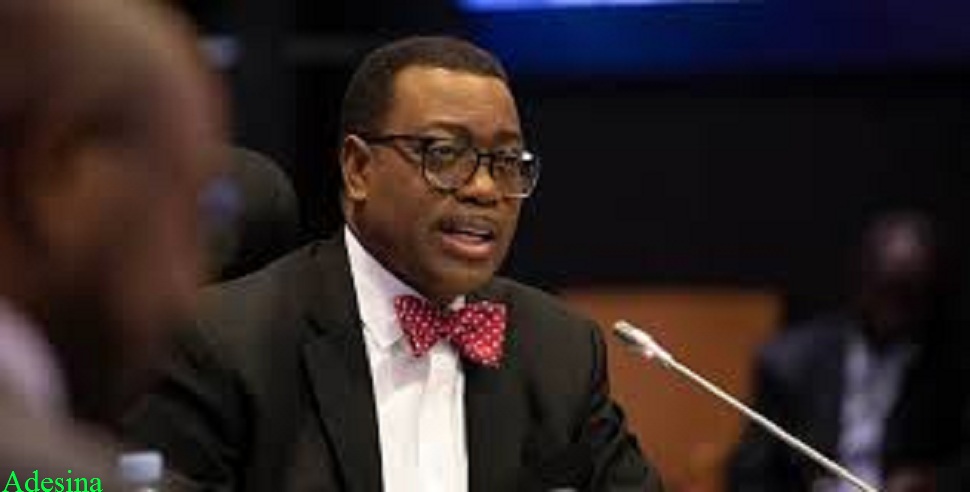
This call reverberated in a thought provoking lecture titled: “Towards a New Nigeria: From Federal Fatherism to a Commonwealth”, and delivered by the President of African Development Bank, AfDB, Dr Akinwumi Adesina.
The lecture was part of the second term inauguration of Governor Oluwarotimi Akeredolu, SAN, for a second term as governor of the Sunshine State.
Adesina, a development economist, praised Akeredolu for what he described as his exceptional achievements in education, agriculture, road infrastructure and industrial development.
He likened the Governor’s second tenure to the fourth and final lap of a 400 meters race saying: “You must now run for the home stretch with your eyes fixed on the finished line that is ahead of you. It is a race for legacy. A legacy for you, a legacy for the people of Ondo State.”
Quoting The State of States Report of 2018, Adesina said: “Ondo State is rich in resources. Consider that it has the second largest deposits of bitumen in the world. With an estimated 37 billion barrels of bitumen reserves, the bulk of which is found in Ondo State. This vital resource remains untapped in Nigeria.”
He lamented that the Nigerian State has the irony of importing what it has in abundance, leaving its own resources untappe, noting: “This can be seen in the case of Ondo State that has a large deposit of bitumen, yet its roads have in the past been barely tarred with the same resource it has in so much quantities.”
He said that “the total value of bitumen reserves in Nigeria could be worth up to $1.5 trillion. With an estimated 16 billion barrels in Ondo State, the potential state wealth from bitumen alone could be worth $657 billion. The paradox however is that Nigeria spends over N300 billion importing bitumen.”
With the stunning statistics he provided, Ondo State has enough to catapult it into economic limelight, while making it the economic leader of every other states in Nigeria and the darling of investors from all over the globe.
Adesina rolled out another statistics, stating that the vast deposits of bitumen can help Ondo State break into the asphalt market that is estimated to be worth $10 billion globally by 2022. He added that it could become a leading exporter of bitumen into the Africa continental Free Trade Area.
While noting that the Sunshine State has several other resources, one of which is gas, Dr. Adesina stated that it is not enough for a State to have natural potential, saying “nobody eats potential.
Ondo State’s wealth is not seen, as the guest speaker noted, because it is locked underground. The state ranks 13th of the top 20 states in Nigeria in terms of its GDP, estimated at $8.4 billion.
However, as the agricultural economist pointed out, Ondo State suffers from a collective problem of states in the Nigeria federation depending on the centre because that is where all the resources are located.
He said, “with stupendous resources, all concentrated at the centre, states are ever dependent on the centre. With the magnetic field of federal revenue allocations, states are constantly pulled powerlessly into perennial dependency.”
This made him to suggest that for states in Nigeria to survive and thrive, they must become financially independent of the centre in Abuja.
He drew a contrast between Nigeria’s federalism and that of the United States, where Nigeria borrowed a leaf from.
According to Adesina, states in the US generate the bulk of their revenue from taxes, while federal grants account for only a small fraction of the resources of the states. On the contrary, federal revenue allocations are the lifeline of state governments in Nigeria, “cut it off and 92 percent of Nigerian states will fail.”
The guest speaker gave a stunning proposition that only three states, which he did not disclose, can survive without a Federal Revenue Allocation. The verdict of the agricultural expert was that, “This is a federalism of dependency.”
This, the expert connected with the fact that Nigeria depends on crude oil for over 70 percent of its government revenue. According to him, because of that, any decline in the price of oil creates fiscal volatilities that reverberate across the states.
Adesina therefore recommended greater independence for states. He said, “What’s needed is greater economic and fiscal autonomy for the states. The issue is less about State or regional autonomy, but financial and economic viability of Nigerian constituent states.
While noting that the Nigerian system is not federalism but fatherism, Dr. Adesina said, “The agitations for decentralisation can be understood when viewed in the light of a craving for greater autonomy.”
He further revealed that political autonomy is meaningless unless it is backed by greater self reliance at the state level. He stated that Nigeria tends to copy systems that are not well suited to our context.
According to him, component units in the United States are able to get internally generated revenue from tax, but that has not been the case in Nigeria that has an estimated 87 million people living in extreme poverty.
In the words of the AfDB boss, “you cannot tax people who can barely afford to eat. This debilitating poverty makes the country highly vulnerable to social and political risks and it provides fodder for anti-social behaviour and recruitment by insurgents and terrorists.”
He further said that poverty provides supermarket for terrorists. Nigeria’s level of indebtedness stands high at N22 trillion, the debt stock of states is over N4.1 trillion and over 55 percent of youths are unemployed.
While noting that all these factors have done Nigeria more harm than good, Adesina said that people must be allowed space to express themselves. “If nations and states are about people, then the people’s hopes, aspirations and demands must be heard.”
Adesina said, “sometimes, leaders think all is well when it is not! One of the great dangers of leadership is to rely on others to tell you what is going on.” He therefore put a great responsibility on leaders to connect with their people and communicate effectively with them.
While pointing out that democracy is more than the right to cast a vote, but citizens also have the right to hold their governments accountable. Adesina advocated citizens accountability forums, of which transparency would be the core.
He also said that participatory tax based financing systems demand participatory governance. In line with that, Adesina said low tax rates in Nigeria, compared to other African and non African countries is no justification for to keep increasing tax.
He further stated that governments in Nigeria have been transferring their responsibility to citizens. This can be seen in the way Nigerians have had to provide electricity (through power generating sets), security and boreholes for themselves.
In the words of the guest speaker, “boreholes are not the way to provide water in the 21st century. Every household should have pipe borne water!”
The guest speaker also recommended that governments should set high performance targets for public service and be held accountable. If the people do not see tangible delivery in terms of improved quality of services, they should demand for them.
Adesina expressed that there is an urgent need to diversify the source of financing states across Nigeria. While disclosing that the value of Diaspora remittance to Nigeria in 2019 was $24 billion, compared to crude oil export at $48 billion, Dr. Adesina said, “Nigerians in the diaspora are Nigeria’s new oil.”
Adesina said on behalf of the Nigerian citizens the need for good roads. “While many roads are federal roads, the challenge is that they pass through States’ boundaries. The poor condition of some of the federal roads negatively affect the economies of the states.” He therefore said that we must learn from others and deliver quality infrastructure faster.
The AfDB boss also advocated public-private partnership for all major infrastructure projects.
His words: “The federal government could also allow states to own these roads by delegation. This will allow the states to support their construction by utilising development finance institutions to provide cheaper sources of finance to complete these roads.”
Another thought expressed by the guest speaker was that states also can become more financially autonomous through greater fiscal prudence. “If states focus on unlocking the huge resources they have, based on areas of comparative advantage, they will rapidly expand wealth for their people.
As a matter of fact, Dr. Adesina said, “Restructuring should not be driven by political expediency, but by economic and financial viability.” He added that, “Economic and financial viability are the necessary and sufficient conditions for political viability.”
Quoting Adesina, “The stronger the states or regions, the stronger the federating units. In the process, our union would be renewed. Our union would be stronger. Our union would be equitable. Our union would be fully participatory. We must be audacious.”
In line with that, Dr. Adesina also said, “Instead of a Federal Government of Nigeria, we could think of the United States of Nigeria or the Commonwealth of Nigeria. The old will pass away for the new.”
This will be an all inclusive Nigeria that is beyond religion, region, ethnicity and class or social status