By Steve Otaloro
A nation’s greatness is measured not merely by the wealth beneath its soil, but by the infrastructure upon which its people build prosperity. History has repeatedly shown that every major economic power first laid steel before it accumulated wealth. Railways are not simply transportation systems; they are the arteries through which commerce, industry, agriculture and national integration flow.
This is why President Bola Ahmed Tinubu’s commitment to railway infrastructure deserves serious attention beyond the daily noise of partisan politics. His administration has continued and accelerated strategic rail investments that possess the capacity to fundamentally alter Nigeria’s economic trajectory.
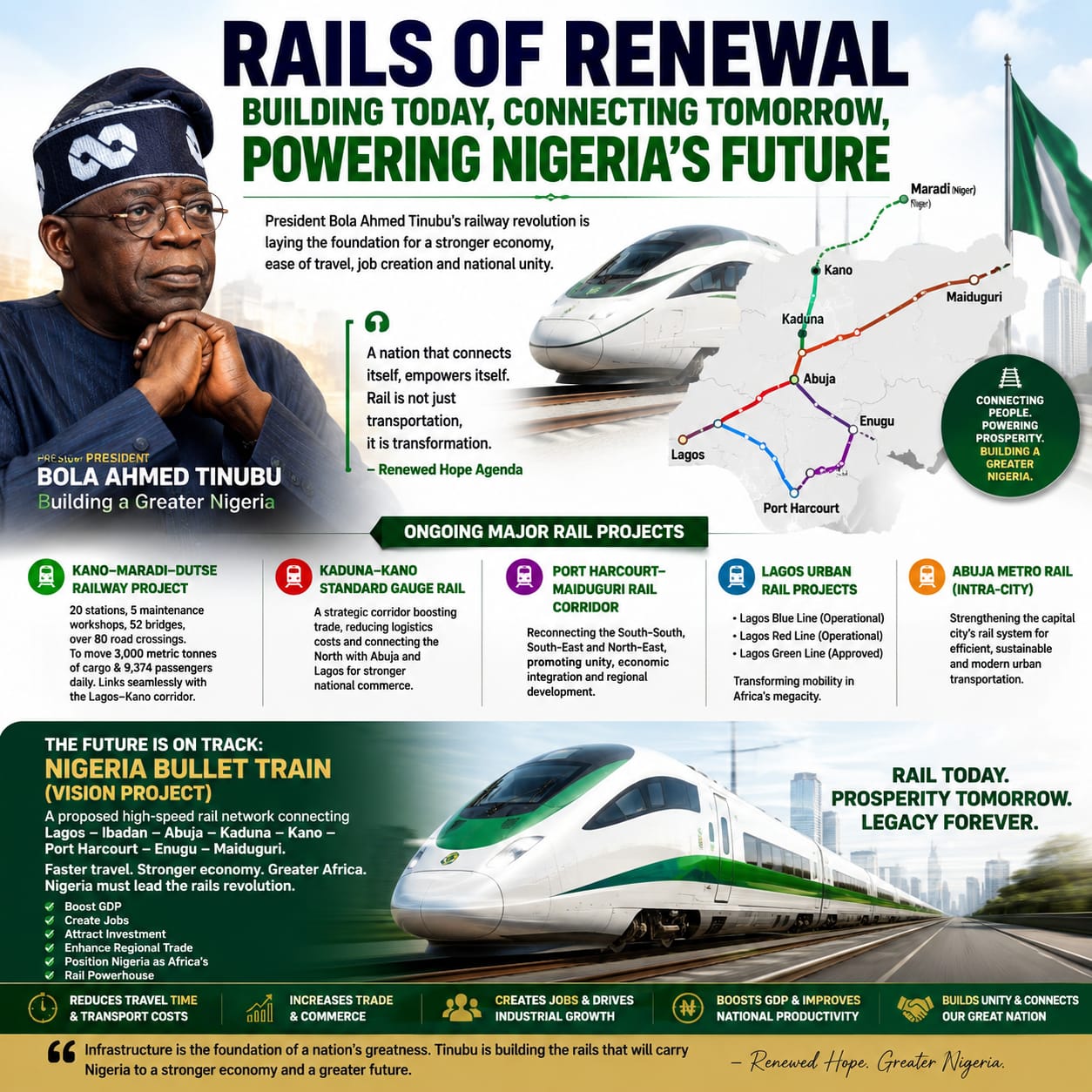
The steady progress at the Kano-Maradi-Dutse Railway Project exemplifies this national vision. With 20 stations, five maintenance workshops, 52 bridges and over 80 road crossings under construction, the corridor is projected to move nearly 3,000 metric tonnes of cargo and over 9,000 passengers daily while connecting seamlessly to the Lagos-Kano standard gauge network. It is not merely a railway; it is an economic corridor designed to stimulate trade, manufacturing and regional integration.
Likewise, significant progress has been recorded on the Kaduna-Kano Standard Gauge Railway, one of Nigeria’s most strategic transport links. Upon completion, it will connect northern commercial centres more efficiently with Abuja and ultimately Lagos, reducing logistics costs and strengthening national commerce.
Equally important is the continuation of the Port Harcourt–Maiduguri Eastern Railway Corridor, which remains central to reconnecting the South-South, South-East and North-East through modern rail transportation. When fully realized alongside the western corridor, Nigeria will possess one of Africa’s most comprehensive standard gauge rail systems.
Within Lagos, Nigeria’s commercial capital, the transformation is already visible. The operational Lagos Blue Line and Lagos Red Line have become practical demonstrations of modern urban rail transportation. The approved Lagos Green Line represents another bold expansion that will further decongest Africa’s largest city while improving productivity and quality of life.
The Abuja Metro Rail, although requiring expansion and modernization, remains a critical intra-city rail asset. With renewed investment and integration into wider transport planning, the Federal Capital Territory can evolve into one of Africa’s most efficiently connected administrative capitals.
Recent Federal Executive Council approvals for major rail investments in Lagos, Kano and Kaduna reinforce the administration’s long-term commitment to expanding urban rail systems across Nigeria’s major economic hubs.
Critics often ask whether Nigerians can “eat roads” or “eat railways.” Such questions misunderstand the economics of national development. Farmers eat because produce reaches markets efficiently. Manufacturers prosper because raw materials move cheaply. Businesses expand because logistics costs fall. Investors arrive because infrastructure reduces operational risk. Infrastructure itself may not be consumed, but it creates the conditions that sustain every productive sector of the economy.
China’s economic rise was built upon high-speed rail. Japan transformed its economy through the Shinkansen. France, Germany and Spain invested heavily in rail before becoming industrial giants. Nigeria cannot realistically aspire to become Africa’s leading economy while relying predominantly on highways for freight movement.
The next frontier should therefore be even more ambitious; Nigeria should begin planning for a national high-speed (bullet train) network connecting Lagos, Ibadan, Abuja, Kaduna, Kano, Port Harcourt, Enugu and Maiduguri. Such a project may appear ambitious today, but every transformational infrastructure project once seemed impossible before becoming reality. Planning today creates opportunity tomorrow.
A future bullet train network would dramatically reduce travel time, stimulate tourism, attract foreign investment, encourage regional commerce and position Nigeria as Africa’s undisputed leader in railway technology. As population growth continues, high-capacity rail transportation will become an economic necessity rather than a luxury.
Rail infrastructure is ultimately an investment in time. Every hour saved in transportation becomes an hour gained in productivity. Every container moved by rail instead of road lowers business costs. Every railway station creates new commercial activity. Every kilometre of track extends the reach of national development.
President Bola Ahmed Tinubu’s railway agenda therefore represents more than construction projects. It represents an attempt to reposition Nigeria for the demands of a twenty-first-century economy.
Politics will always produce disagreement, but history judges leaders by enduring infrastructure rather than temporary applause. Roads deteriorate without maintenance. Buildings age. Governments come and go. Yet railway corridors often continue serving generations long after those who conceived them have left office.
If sustained with discipline, transparency and continuity, Nigeria’s expanding railway network could become one of the defining infrastructure legacies of this era-one that not only eases travel but strengthens national unity, boosts GDP, lowers logistics costs, enhances regional trade and firmly establishes Nigeria as one of Africa’s foremost rail transportation powers.
– Steve Otaloro is a media and public affairs analyst, political communicator, and public policy commentator with a keen interest in governance, infrastructure development, national security, and strategic communications. He writes extensively on public policy, leadership, and nation-building, advocating evidence-based discourse and sustainable development as catalysts for Nigeria’s progress.
#RenewedHopeAgenda
#RailwayRevolution
#InfrastructureDevelopment
#NigeriaRising
#EconomicGrowth
#TransportRevolution
#BuildingTheFuture
#GreaterNigeria
#RenewedHope
#SteveOtaloro