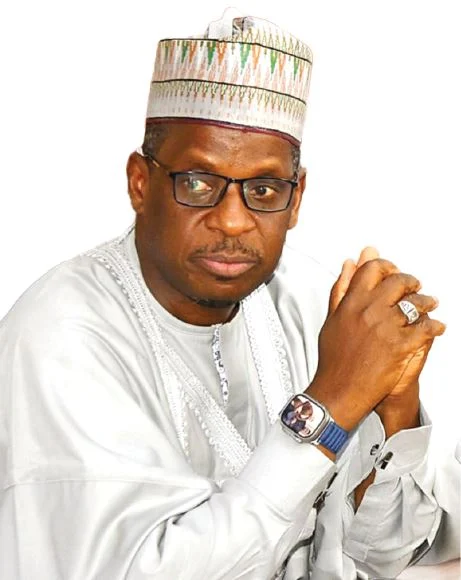
Ali:
Managing Director of the News Agency of Nigeria, Ali M. Ali, who clocked 60 on June 7, 2026, tells Gift Habin about his life, career, and experiences spanning journalism, leadership, and public service
Looking back at your formative years, what were some of the defining experiences that shaped your character and ambitions?
Well, looking back, I would say my upbringing was quite interesting in that I had multiple socialisation experiences. At one point, I was with my parents; at another, I was with my grandparents.
My father worked in a federal agency, so that also exposed me to different environments.
I spent part of my early life with my grandparents in the walled city of Kano, which was a very conservative setting. That period shaped me in many ways.
While growing up with my grandparents, I started my primary education.
I remember that on our way back from school at that time, we were sometimes stoned because we attended Western schools after Arabic school. This was in the 1970s.
In the walled city of Kano, I initially started at what they called “Kukar Bulukiya.”
I actually took myself there as a child because I was fascinated by Western education. I used to go to school on my own, even before being formally registered.
Later, I was officially enrolled at Jakara Primary School in Kano. At some point, I joined my parents in Lagos.
That was when I had a brief stint at a Catholic school called St. George’s. But we had to return to Kano after General Murtala Muhammed was assassinated in 1976. I was barely 10 years old then.
How did these experiences shape your character?
All of these gave me exposure that I would not ordinarily have had. While in Lagos, I encountered different cultures and had to adapt quickly. I could barely speak or understand English at the time, but over time, I picked up, along with other languages, because we were living in a cosmopolitan environment.
My childhood was a mixed experience. I was always fascinated by television and wanted to become a newscaster. Most of my idols were on television at the time.
I grew up watching people like Peter Enahoro and Julie Coker, among others, and they made a strong impression on me.
My interest in journalism actually began in secondary school. I studied sciences, and my father initially wanted me to become a medical doctor. But my fascination with journalism and broadcasting was irresistible, so I eventually moved from sciences to humanities.
I was among the leading students, particularly in language. I was the best in English and won several essay and writing competitions. In the debating society, I was always among the best. Because of my exposure, I was seen differently in various environments.
I had friends across different cultures, and I learnt early on to see the world in broader terms, not in black and white, but like a rainbow. You learn to appreciate different cultures and languages.
I attended Rumfa College in Kano. It is a unity school that has produced many prominent Nigerians, including the late General Sani Abacha and the late Emir of Kano, Ado Bayero. Rumfa College is nearly 100 years old. It was established in 1927 as a unity school where children from both rich and poor backgrounds studied together.
We all blended, and many of us remain friends to this day. We were taught by foreign teachers, and my set produced outstanding individuals, including military officers such as former Chief of the Naval Staff, Vice Admiral Awwal Gambo (retd.), among others.
We also produced academics such as Professors Abdurrahman Sheshe, now the Chief Medical Director of Aminu Kano Teaching Hospital, Kano; Faruk Sarkin Fada; and many others.
I later attended Bayero University, Kano, for my first degree in English. I was advised to study the language first before the technicalities. I had a strong flair for writing and communication, and even in secondary school and university, we were already writing for magazines and newspapers.
At the university, I honed my writing skills further. I remember an article I wrote in The Guardian in the mid-1980s under the Campus Experience column. I earned about N100 then, which was a lot of money. More importantly, being published in The Guardian as a student was a major achievement.
Which other key people served as your support system while growing up?
My grandparents were there. My maternal grandfather was a merchant and a very generous man. No matter how wealthy you were, whenever you visited him, he would still give you something. It was he who once said, because I was always asking questions, I would either end up working with the BBC or become a lawyer.
I was always asking questions. I think that prophecy was fulfilled because, in 1992, I almost got into the BBC Hausa Service, but for one or two reasons, it did not work out.
He was part of my support system. Then there were community influences as well. Back then, every child belonged to the community, so there was always support.
My peers were also fiercely competitive. If someone scored 70 per cent, you wanted to score 80 per cent. We pushed each other. Looking back, it yielded results. Many of them went on to become permanent secretaries, army generals, academics and so on.
Some of my older cousins also played important roles in my upbringing. So, yes, that support system was very strong.
How did you meet your wife, and what role has she played in your personal growth and professional development over the years?
I never thought she would become my wife. We were family friends. She actually saw me as a big brother. She was much younger, and I thought of her as a younger sister.
There is about a 10-year age difference between us. But eventually, things changed, and we ended up together. I never imagined we would marry. But life happened, and I am grateful for how it happened.
We got married, and about six months later, my mother passed away. My wife played a central role in supporting me during that period.
I tell my children that when they want to get married, they should listen to their parent’s advise. Love is important, but in the long run, it takes more than love to have a successful marriage.
We have been married for 27 years now. We have three children: two boys and a girl. One is a medical doctor, and the youngest is a 400-level law student.
I always say I am married to journalism because journalism has always been my first love. Even my wife knew that, and it took her a while to adjust.
When we started courting, I was already an editor of a newspaper at 29 years old, the Sunday Triumph, Kano.
It was a demanding life. I used to see her only during the day and rarely in the evening, as was the custom. She has been a pillar of support.
When I moved from Kano to Lagos around 2000/2001, she took care of the children while I worked.
My wife later went back to school, earned her degree and a postgraduate qualification, and became a chartered accountant. She is very tenacious and resourceful.
What happened while you were working in Lagos?
I was in Lagos working while she was in Kano. I moved into the Lagos press, first to The Independent newspaper as the pioneer Group Politics Editor and later to ThisDay as Associate Editor. It gave me a different exposure to journalism. I had to understand the Lagos-Ibadan press.
However, in 1996, I attempted to join the News Agency of Nigeria while still at Triumph, but I was advised to remain where I was. Looking back, that decision made sense. But 27 years later, I eventually became Managing Director of the same agency.
I have worked across about five newspapers and edited about three titles. I have met great minds in journalism, including the founding Chairman and Editor-in-Chief of the ThisDay Media Group and ARISE News Channel, Nduka Obaigbena, as well as the founder and Chief Executive Officer of Cable Newspaper Limited, Simon Kolawole, Eniola Bello, and Festus Eriye.
I drank from the fountain of their knowledge. I was an editor at Leadership Newspaper and the Chief Executive Officer of People’s Daily Newspaper. All of that shaped my career. I was also a media adviser to two governors in Kano and Bauchi states.
As the Managing Director of NAN, what achievement are you most proud of and why?
Maybe you should ask the staff. It may sound immodest for me to say this is something I have done. But if there is one thing I believe we have achieved, it is trying to ensure that we respond to news outbreak quickly, professionally, ahead of the competition, and with accuracy.
I do not know whether we have fully achieved that because there are times when I see what others are doing. Some of them are not really our competitors because they do not have the huge bureaucracy we have at NAN.
You cannot compare bloggers with a wire service. We are a news hub; we are a news agency.
But my feeling is that this is a question you should ask the staff. What I believe we have done is galvanise a shift in attitude in how we treat stories, how we react to the news environment, and how we work together and blend into one NAN family. We are focused on chasing the news, breaking the news, and reporting factually without being sensational.
We frame the news responsibly. They say bad news is good news. That is the nature of the business. But we have a way of presenting the news, even when it may be unpalatable to the government, despite being wholly government-funded. We see the cup as half full rather than half empty. That is part of our reportorial philosophy.
For example, we have made efforts to expand our reach by broadcasting in local languages. We started with Hausa, and you would be surprised by the number of people who now visit our Hausa portal to read our stories.
At the moment, we are facing some challenges that have slowed progress, but once resources become available, we intend to launch services in Igbo and Yoruba as well.
The idea is to reach people who prefer to consume news in their native languages rather than in English.
We have also focused on developing what I call “super reporters.” These are journalists who can do everything. With media convergence today, one person can handle text, audio, video, and digital content. We now have a viable NAN multimedia unit with a growing and appreciable following. In fact, it has already begun generating revenue.
When we took charge, some of our social media platforms did not exist. We established them. We launched NAN on TikTok, and we continue to grow our following there.
We also strengthened the agency’s X handle, although that remains a work in progress. Our online presence has improved as well.
If you look at our website analytics and reports, you will see that NAN is now among the most visited news platforms. We monitor performance closely and assess feedback every day, asking ourselves how well we are doing and where we can improve.
Of course, sensational news often attracts attention. But at NAN, we insist on cross-referencing and double-checking information before we hit the publish button because people rely on us as a primary source of news. That responsibility is something we take very seriously.
The media landscape has actually changed. How has NAN adapted to remain relevant and competitive in this digital age?
News is not what it used to be. In the past, we knew that news was a perishable commodity, but there was still exclusivity. You could have a story, keep it to yourself, investigate it thoroughly, and enjoy the luxury of time before publication. But now, there is virtually no local news that remains exclusive for long.
The media landscape has changed greatly. Social media and citizen journalism have taken that edge away from mainstream media. What we try to do, however, is break stories as they happen.
As much as the social media space and citizen journalism are always in a hurry, we try to give our own version of the story with the proper framing, context, and perspective.
At NAN, we have an array of professionals who are well-grounded in journalism. We have seasoned reporters and experienced editors, and that remains NAN’s edge over its competitors. We have seasoned reporters, seasoned editors, and a strong editorial process. Like any bureaucracy, NAN’s gatekeeping process has several layers.
But even with those layers, gatekeeping is one of our strengths. That is why, for many people, until a story appears on NAN, they do not fully trust it. It is something we value and cherish greatly.
What do you consider the biggest challenge facing journalism in Nigeria today, and what practical steps can be taken to address it?
The biggest challenge, really, is quackery. Too many people think they are journalists when they are not. You see, in classical journalism, my understanding is that if you are a thoroughbred journalist, you do not approach stories with preconceived opinions.
Your reporting is not opinionated; you work with facts. But these days, television journalism, especially broadcast journalism, has increasingly become showbiz. As a result, what we now have, even among people presenting themselves as journalists and anchors, are often advocates rather than reporters.
So, in my view, the biggest threat to journalism is not digital media, the digital space, or technology. It is quackery, that is, people who have no business being behind a microphone or in front of television cameras. That is why professionalism is especially important in broadcast journalism.
In print journalism, there is usually an expectation of a certain level of editorial discipline. Of course, I am not saying the media should not hold the government accountable.
Part of the constitutional responsibility of the media is to scrutinise government, investigate its actions, and ask difficult questions. That is an essential part of the profession, but there is a thin line.
For a long time, there has been an academic debate about the nature of the media itself. Is it primarily a business or a social service? If it is a business, then it inevitably operates within certain commercial constraints and limitations.
However, beyond those business and legal realities, the biggest challenge facing journalism remains the growing presence of unqualified practitioners. Citizen journalism has made the situation even more complicated.
Today, we have social media influencers who are often perceived as journalists. Some members of the public even mistake them for journalists. The same applies to many on-air personalities. Being an on-air personality does not automatically make someone a journalist.
Journalism requires training. There are standards, responsibilities, and ethical obligations that come with holding a public platform in trust. You are not at liberty to simply project your personal opinions and biases.
Unfortunately, I see this even within sections of the mainstream media, especially during periods of conflict and crisis. You can see it in the headlines, in the framing of stories, and in the angles that are chosen. In some cases, there is very little regard for professional ethics.
Even if you have received professional training, the moment you allow yourself to become a prisoner of prejudice, sentiment, or personal bias, you cease to uphold the standards of the profession. In that sense, you are a quack.
At 60, what motivates you to continue serving in a demanding leadership role?
Well, the motivation, I think, deep down, is that you still want to attain the heights reached by your mentors. You look at the people who inspired you, and some of them are still active. You want to continue striving towards the standards they set. Also, in a way, you become a mentor yourself.
Some of the tributes I have seen suggest that there are people who look up to me as a mentor. So, you want to inspire them as well. As you rightly said, it is a tough and demanding job. If you consider news surveillance alone, it is extremely tasking.
I rarely have time for myself. I am constantly checking and monitoring what is happening. It is amazing how, whenever there is a major development, a disaster, or a security breach, people immediately call you for confirmation. All of these things keep you motivated.
Funnily enough, in this job, I do not feel 60. Certainly, I do not feel my age. I often think back to 30 years ago when I celebrated my 30th birthday. At the time, I was the editor of the Sunday Triumph. I remember it vividly. I had just turned 30 and was working on a production day.
I remember thinking to myself, “How would it feel to be 60?” Back then, 60 seemed so old. In fact, when I started my career, my first boss had just turned 40. I was 23 at the time, and I remember saying to him, “Sir, you mean you are 40 years old? You’re old!”
The irony is that when I turned 40, he was 57, and he reminded me of that conversation.
Now I am 60, and he is still alive. God bless him, Ado Umar Muhammad. He was my first boss at The Triumph, and he treated me like a younger brother. We related very well, and he remains one of the people who influenced me greatly.
Another major influence on my career trajectory is Garba Shehu, who was the Senior Special Assistant on Media and Publicity to the late former President Muhammadu Buhari. He had a profound impact on my professional life.
When he came across some of my articles in The Guardian while I was still a student, there was an embargo on employment at the time, around 1989 or 1990. Yet he went from pillar to post trying to help me.
What made it remarkable was that he did not know me from Adam. He did not know me personally in any way. That experience has shaped how I relate to people, especially professionals. You do not have to know anyone personally to deserve an opportunity.
Even here, we have recruited people without them knowing anybody in management. We recruit based on merit and ability.
Interestingly, since my first job at The Triumph, I have never formally applied for a job in the media. I was always approached and invited to join organisations.
I find it strange when people begin lobbying for beats, positions, or transfers. In this organisation, one of the quickest ways to attract negative attention from management is to lobby for anything.
Let your work speak for you. That is the only way a system can be protected from total degeneration.
That is one of the reasons I admire The PUNCH. It has set a standard. There are media organisations today that consciously model aspects of their management style after The PUNCH.
For over 50 years, The PUNCH has remained remarkably consistent. I remember attending its 50th anniversary celebration in 2024. Looking at its history and how it evolved from the vision of its founders, you can see the consistency: employing the best people, training them, and setting standards. It is something worthy of admiration.
What advice would you give to young journalists who aspire to build impactful, credible, and ethical careers in the media industry?
They should first expand the frontiers of their knowledge. Knowledge and perseverance are key. There is no lift or elevator to the 12th floor in journalism. You have to take the staircase. There are no shortcuts. You have to pay your dues, do the work, respect ethics, and stay focused.
Do not be confused. There is a world of difference between a social media influencer and a journalist, especially now. I see some journalists becoming social media influencers. To me, that is not their primary job.
However, if you are a journalist, you will naturally influence people through your work.
The Punch