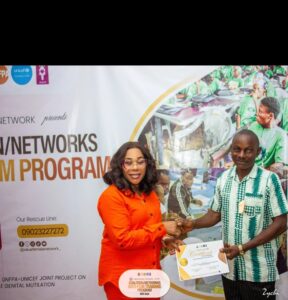
Osun State Correspondent of The Hope, Michael Ofulue receiving his certifcate from UNFPA/ UNICEF leader, Mrs Uzoma Adedeji for participating in a three-day program of violation/ network Ant-Female Gender Mutilation FGM, in Osogbo, the state capital
By John Dike, Osogbo
Experts, gender advocates, health professionals and other stakeholders have condemned the persistent practice of Female Genital Mutilation (FGM) in Nigeria, describing it as an inhuman, harmful act that continues to endanger the lives and wellbeing of women and girls.
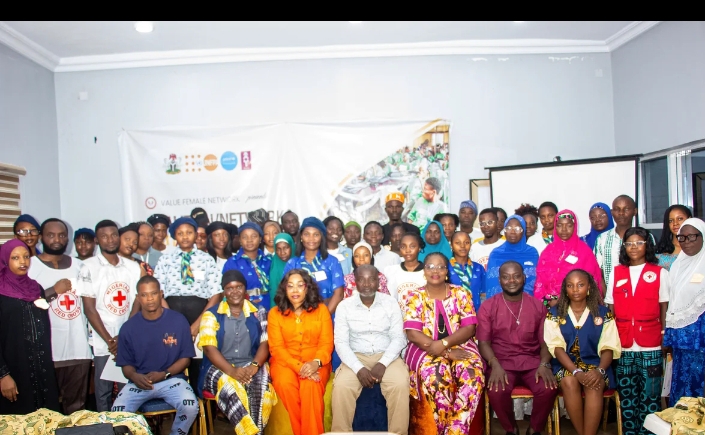
The condemnation came during a three-day Network/Coalition Anti-FGM programme organised in Osogbo by the Value Female Network with support from the UNFPA/UNICEF Joint Programme on the Elimination of Female Genital Mutilation.
The programme, which also focused on Comprehensive Sexuality Education (CSE), brought together civil society organisations, government officials, media practitioners, development partners, youth groups, religious leaders, traditional institutions, healthcare professionals and community stakeholders to deliberate on practical approaches to ending FGM and other harmful traditional practices in Osun State and Nigeria at large.
Speaking during the opening session, facilitators and stakeholders unanimously described FGM as a harmful practice that violates the rights, health, dignity and emotional wellbeing of women and girls.
According to the facilitators, Comprehensive Sexuality Education goes beyond discussions about sex and includes emotional wellbeing, self-esteem, gender equality, reproductive health, personal hygiene and protection against abuse.
They noted that many adolescents remain vulnerable to abuse, exploitation and misinformation because reproductive health discussions are often treated as taboo in many communities.
The experts argued that educating young people with scientifically accurate information would help them make informed decisions, protect themselves from abuse and reject harmful traditional practices.
A representative of the Osun State Ministry of Health, Mrs. Tolulope Agborere, who declared the programme open, urged participants to ensure that the knowledge acquired during the training is shared widely across schools, religious centres, communities and grassroots associations.
She noted that increased grassroots awareness would contribute significantly to reducing the prevalence of FGM in society.
According to her, local communities remain central to the fight against harmful traditional practices because they possess a better understanding of the beliefs and social pressures sustaining such acts.
Mrs. Agborere called on traditional rulers, religious leaders, parents, teachers and community influencers to become more actively involved in protecting girls and women from abuse and violence.
One of the major highlights of the programme was a presentation by the Director of Gender Affairs at the Osun State Ministry of Women Affairs, Children and Social Welfare, Mrs. Lola Adewale, who dismissed the belief that FGM prevents promiscuity among women.
According to Adewale, there is no scientific, medical, psychological or religious evidence supporting such claims, describing the practice as a dangerous misconception that has caused pain, trauma and death for many women and girls over the years.
“FGM is the cutting off of the female genitalia. The belief that it prevents promiscuity is a myth because promiscuity is a matter of the mind — what a person thinks and chooses to do,” she stated.
Adewale further described FGM as an unholy act with no health or moral benefit for women.
She warned that the practice exposes girls and women to severe physical, emotional and psychological trauma.
According to her, some of the immediate and long-term consequences of FGM include excessive bleeding, severe pain, infections, urinary complications, reproductive health disorders, childbirth complications, emotional trauma and, in severe cases, death.
She explained that many victims continue to suffer psychological pain and emotional scars long after the procedure has been carried out.
The gender expert added that survivors often experience depression, anxiety, fear and relationship difficulties because of the trauma associated with the practice.
Despite the challenges, Adewale noted that Osun State has recorded significant progress in reducing the prevalence of FGM through sustained advocacy campaigns and collaborative interventions involving government agencies, civil society organisations, traditional institutions and international development partners.
She disclosed that the prevalence rate of FGM in Osun State, which stood at 76.6 per cent in 2013, has dropped to 21.6 per cent, according to the National Demographic Health Survey.
According to her, the progress recorded in the state demonstrates that sustained awareness and community engagement can produce meaningful results.
She commended advocacy groups and grassroots organisations for their continued commitment to ending harmful practices affecting women and girls.
Also speaking during the programme, the UNFPA Gender/FGM Analyst, Mrs. Uzoma Ayodeji, described coalition groups and community networks as powerful instruments for social transformation and grassroots mobilisation.
Ayodeji explained that the persistence of FGM is largely sustained by silence, societal pressure, fear of rejection and deeply rooted cultural beliefs passed down through generations.
According to her, many families still engage in the practice because they fear discrimination or exclusion from their communities.
She urged participants to demonstrate empathy and support towards survivors of FGM while maintaining strict confidentiality regarding victims’ identities and personal experiences.
Ayodeji also urged advocacy groups, coalition networks and stakeholders not to relent in their awareness campaigns and behavioural change programmes aimed at ending the practice permanently.
She stressed that many rural communities still lack adequate information about the dangers associated with FGM and encouraged participants to become active ambassadors against the practice within their communities and institutions.
She warned against the stigmatisation of survivors and emphasised the need for rehabilitation, counselling and psychosocial support services for victims of harmful traditional practices.
Ayodeji, who also serves as the South-West Team Leader under the United Nations Joint Programme on the Elimination of Female Genital Mutilation, described coalition groups and community networks as critical frontline partners in the campaign against FGM.
She explained that the training programme was organised to strengthen the capacity of coalition networks and equip them with advocacy skills needed to sensitise communities effectively.
According to the team leader, coalition groups possess extensive grassroots structures capable of reaching large numbers of people across communities.
“One thing about coalitions and networks is that they have the reach and very strong associations. In Nigeria, they are frontline actors because when they gather nationally, they have the numbers.
“That is why we felt that sensitising and training them is important, so that they can return to train their people and reach their various communities because we cannot reach everyone and we cannot be everywhere,” she said.
The team leader added that the trained networks would help amplify anti-FGM campaigns and effectively deliver advocacy messages at the grassroots level.
The programme also trained participants on advocacy strategies, communication techniques, reporting mechanisms and child protection approaches necessary for combating FGM and other harmful practices.
Participants were equipped with practical knowledge on identifying vulnerable groups and supporting victims of abuse within their communities.
Earlier in his remarks, the Programme Manager of Value Female Network, Samuel Abimbade, explained that the initiative was designed not only to sensitise participants but also to train them as advocates who would transfer the knowledge gained to their various communities.
Abimbade said empowering people with accurate information and advocacy skills would strengthen community-driven campaigns against FGM and other harmful gender-based practices.
He stressed that protecting girls and women requires collective responsibility and stronger collaboration among civil society organisations, schools, parents, healthcare workers, religious institutions, traditional leaders and government agencies.
According to him, sustainable social change can only be achieved through continuous education, community engagement and effective policy implementation.
He further called for stronger support systems for survivors of gender-based violence and harmful traditional practices.
Abimbade expressed optimism that the training would strengthen ongoing advocacy campaigns against FGM across Osun State and the South-West region.
“We have made some progress. Osun State used to have about 76 per cent prevalence, but it has dropped to about 20 per cent now, and we are hopeful that by 2030 we will achieve zero per cent prevalence. That is the goal.
“We want to thank the Osun State Government for giving us the opportunity to carry out this programme because without their support, we would not be here. We appreciate the collaboration with the Ministry of Health and the Ministry of Women Affairs.
“I also want to thank everyone and appreciate Value Female Network for being an implementing partner in pushing this programme forward,” he stated.
Some participants described the training as enlightening, informative and timely.
They noted that FGM remains one of the most dangerous and deeply rooted harmful traditional practices affecting millions of girls and women despite years of awareness campaigns.
According to stakeholders, the practice continues to thrive because of cultural misconceptions, silence, fear, ignorance and long-standing societal pressure passed down through generations.
The programme also served as a platform for participants to exchange ideas, strengthen advocacy networks and develop community-driven strategies for combating FGM while promoting reproductive health education and the protection of women and girls.
Participants commended the organisers for creating an avenue for open discussions on sexuality education, reproductive health and harmful cultural practices.
.
They pledged to intensify grassroots sensitisation campaigns against FGM while promoting healthy living standards, gender equality and reproductive health education across communities.
The coalition reaffirmed its commitment to sustained advocacy, awareness creation and grassroots mobilisation aimed at protecting girls and women from harmful traditional practices and ensuring safer and healthier communities across Osun State and Nigeria.