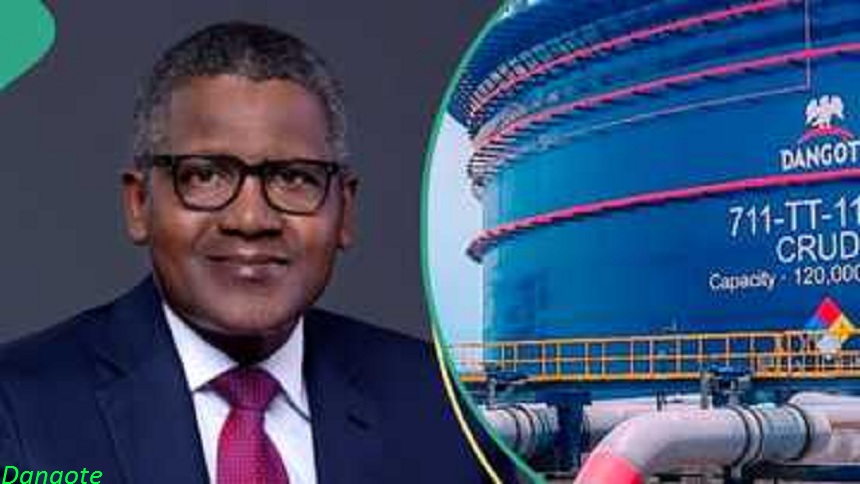
The President of the Dangote Group, Alhaji Aliko Dangote, has said the group rejected requests by the Nigerian National Petroleum Company Limited to increase its 7.25 per cent stake in the Dangote Petroleum Refinery.
Dangote stated this in an interview with the Chief Executive Officer of the Norwegian Sovereign Wealth Fund, Nicolai Tangen. The interview was monitored by one of our correspondents on Wednesday.
This came as findings showed that petrol supply from the $20 billion Lekki-based refinery rose to 3.18 billion litres in the first quarter of 2026, while imports fell sharply to 965.52 million litres.
Further findings indicated that the average domestic ex-depot petrol price from the Dangote refinery across January to March 2026 was about ₦1,000 per litre. This implies that the multi-billion-dollar plant supplied over N3.2tn worth of petrol domestically during the review period.
Also, the war between the United States and Iran, and its resultant disruption of the oil sector and other sectors, has led to increased revenue for the Dangote refinery, as the plant has raised its refined petroleum products export.
According to Dangote during the interview, the NNPC’s offer to increase its 7.25 per cent stake in the refinery was rejected because the company is planning to go public and give other Nigerians the opportunity to own shares in the plant.
It was reported that in 2021, the NNPC acquired the 7.25 per cent stake in the refinery for $1bn, with an option to acquire the remaining 12.75 per cent stake by June 2024. But the national oil firm reneged on its decision.
During the interview with the Norwegian Sovereign Wealth Fund CEO, Dangote revealed that the national oil company had made attempts to acquire more stakes in the refinery, but this was turned down.
Responding to questions about what could be the biggest risks to his businesses, Dangote mentioned civil war and government policy inconsistencies, saying, “Actually, if there are civil wars, which is not in the offing at all.
“The other biggest risk is government inconsistencies in policies, and we are addressing that one because if you look at our refinery, the national oil company already owns 7.25 per cent, and they are trying to buy more. We are the ones that said no; we want to now spread it and have everybody be part of it.”
Recall that the NNPC, under the former Group Chief Executive Officer, Mele Kyari, reduced its stake in the refinery from 20 per cent to 7.25 per cent. Aliko Dangote made this public in 2024. He disclosed that the NNPC had only a 7.2 per cent stake in the refinery and not 20 per cent as many Nigerians believed.
“The agreement was actually 20 per cent, which we had with NNPC, and they did not pay the balance of the money up until last year; then we gave them another extension up until June (2024), and they said that they would remain where they had already paid, which is 7.2 per cent. So NNPC owns only 7.2 per cent, not 20 per cent,” Dangote stated in 2024, to the surprise of many Nigerians.
Speaking further during the latest interview, the billionaire businessman said shareholders can get their dividends in dollars. “What we are announcing is that when you invest in any of our businesses going forward, in cement or in the refinery, in petrochemicals, in fertiliser, we guarantee to pay you a dividend in dollars because we are very well into exports. 80 per cent of our revenue will be in dollars,” he said.
To raise funds for building the refinery, Dangote said he got a lot of support from various financial institutions, including Nigerian banks.
According to him, the initial plan was to fund most of the construction work “from our internally generated funds”, but because of naira devaluation, the group “had to rely on Afreximbank, Africa Finance Corporation, Zenith Bank, Access Bank, UBA and a couple of the local banks, but of course we also have a very good relationship with the Standard Bank of South Africa and, at the beginning, Standard Chartered Bank of the UK”.
He maintained that the company was lucky and what happened when the plant was completed “turned out to be much more than our own expectations”.
In the interview, Dangote disclosed how he sold his properties in the United States and the United Kingdom to settle in Nigeria.
“When I decided to go into the industry, you know what I did? I sold all my properties in the US. I had two houses in the US, big mansions, and I had a house in the UK. I wanted to really sit in Nigeria and concentrate.
“You know, sometimes when you own a holiday home anywhere, you have to create that time to go and use that property. So, now my life is very simple. Wherever I go, I use hotels; I pay. When I leave, nobody will call me and say I have a burst pipe or something is wrong. So I’m committed to what I do, and I just don’t do things; I always create a vision.
“It’s just like now; we created a vision for 2030. So, I know I have a target to meet. I just don’t do business. All my businesses are targeted,” he said.
On how he decides which business to venture into, the business mogul replied, “I first of all look at what we need as a people? What is it that we are supposed to be producing, and we’re importing? So we do what you call ‘backward integration’. We produce what the people need, and we are now producing things that when you wake up as a human being every morning, you must use part of what we produce,” he said.
While defending why the NNPC reduced its planned stake in the Dangote refinery in 2024, the NNPC’s former spokesman, Olufemi Soneye, said it was to invest in compressed natural gas stations.
N3.2tn petrol supply
Petrol supply from local refineries rose to 3.18 billion litres in the first quarter of 2026, while imports fell sharply to 965.52 million litres, according to data from official documents of the Nigerian Midstream and Downstream Petroleum Regulatory Authority analysed by The PUNCH.
Although the NMDPRA documents did not directly name Dangote refinery in the first-quarter supply table, industry records show that it is the only refinery in Nigeria currently known to be producing Premium Motor Spirit on a commercial scale.
The agency’s fact sheet also listed Dangote among Nigeria’s active refineries and separately tracked its PMS performance. The figures showed that Nigeria’s total petrol supply stood at 4.14 billion litres between January and March 2026, with local refinery supply accounting for 76.7 per cent, while imports contributed 23.3 per cent.
This marked a major shift from the first quarter of 2025, when domestic refineries supplied 1.99 billion litres, while oil marketers imported 2.43 billion litres. Total supply in Q1 2025 stood at 4.42 billion litres.
For a proper year-on-year comparison, The PUNCH converted the 2025 figures from the average daily supply provided by the NMDPRA into monthly volumes by multiplying each month’s million litres per day by the number of days in the month and then by one million. This became necessary because the 2026 report provided actual monthly litre volumes, while the 2025 data was presented as daily averages.
The analysis showed that local refinery supply jumped by 59.2 per cent from 1.99 billion litres in Q1 2025 to 3.18 billion litres in Q1 2026. Importation, however, dropped by 60.2 per cent from 2.43 billion litres to 965.52 million litres.
Despite the increase in local refining, total petrol supply declined by 6.2 per cent year-on-year from 4.42 billion litres in Q1 2025 to 4.14 billion litres in Q1 2026.
In January 2026, local refinery supply stood at 1.24 billion litres, importation was 698.19 million litres, while total supply reached 1.94 billion litres. This translated to a daily average of 40.07 million litres from local refining, 22.52 million litres from imports, and 62.59 million litres in total supply.
Compared with January 2025, local refinery supply rose by 109.8 per cent from 19.1 million litres per day, while imports fell by 8.8 per cent from 24.7 million litres per day. Total daily supply also increased by 43.2 per cent from 43.7 million litres per day.
In February 2026, local refinery supply dropped to 824.45 million litres, while imports collapsed to 85.10 million litres. Total supply fell to 909.55 million litres. On a daily basis, local refinery supply averaged 29.44 million litres, imports averaged 3.04 million litres, and total supply averaged 32.48 million litres.
This showed that while local refinery supply was 18.7 per cent higher than the 24.8 million litres per day recorded in February 2025, imports crashed by 88.9 per cent from 27.5 million litres per day. Total supply also fell by 37.9 per cent from 52.3 million litres per day in the same month of 2025.
In March 2026, local refinery supply recovered to 1.11 billion litres, while importation rose to 182.24 million litres. Total supply stood at 1.29 billion litres. This amounted to daily averages of 35.87 million litres from local refining, 5.88 million litres from imports, and 41.75 million litres in total supply.
Compared to March 2025, local refinery supply increased by 56.6 per cent from 22.9 million litres per day, while importation fell by 79.5 per cent from 28.7 million litres per day. Total supply declined by 19.1 per cent from 51.6 million litres per day.
Month-on-month, total petrol supply fell by 53.1 per cent from 1.94 billion litres in January 2026 to 909.55 million litres in February, before rising by 42.3 per cent to 1.29 billion litres in March.
Local refinery supply also fell by 33.6 per cent between January and February, before rising by 34.9 per cent in March. Imports declined by 87.8 per cent in February but increased by 114.2 per cent in March.
The NMDPRA’s April 2026 FAAC report showed that PMS supply rose from 909.55 million litres in February to 1.29 billion litres in March, representing a 42.29 per cent increase. It also showed that PMS distribution through truck-out fell from 1.59 billion litres in February to 1.47 billion litres in March.
The figures indicate that Nigeria’s petrol market is becoming less dependent on imports, with domestic refining now providing the bulk of the national supply.
However, the decline in total Q1 supply suggests that increased local refinery output has not fully translated into higher overall petrol availability compared with the same period of 2025.
The PUNCH earlier reported that Nigerians consumed about 4.93 billion litres of Premium Motor Spirit (petrol) to fuel various economic activities in the first quarter of 2026, according to an analysis of the Nigerian Midstream and Downstream Petroleum Regulatory Authority’s downstream fact sheet monthly data.
It revealed that this amount represents a 7.4 per cent increase from the 4.59 billion litres recorded in the corresponding period of 2025.
The Puncj also reported that the Dangote Petroleum Refinery exported about 434 million litres of Premium Motor Spirit (petrol) in March 2026, as the facility diversified its customer base after significantly outpacing domestic consumption.
The report indicated that the refinery, owned by Aliko Dangote, operated at an average capacity utilisation of 93.62 per cent, reinforcing its position as the dominant supplier of refined petroleum products in Nigeria.
In earlier remarks reported in 2025, the Dangote group chairman, Aliko Dangote, asserted that the refinery had sufficient refined products in storage to meet domestic needs, saying:
“Right now, we have more than half a billion litres in storage. The refinery is producing enough refined products, gasoline, diesel, and kerosene to meet all of Nigeria’s needs.”
Commenting in an earlier report, renowned energy economist Professor Wumi Iledare, noted that Nigeria’s reliance on imported petrol has declined but has not been eliminated. He also warned against claims that fuel importation has ended following increased domestic supply from the Dangote Petroleum Refinery.
In a personal note titled “Dangote Refinery, Petrol Imports, and Market Reality,” Iledare said recent assertions that Nigeria no longer imports petrol reflect “understandable optimism” but overstate the economic reality of the downstream oil market.
“Recent claims that petrol importation into Nigeria has ended because Dangote Refinery now meets domestic demand reflect understandable optimism, but they overstate economic reality.
“Dangote Refinery has significantly improved domestic supply conditions and reduced Nigeria’s marginal reliance on imported petrol. However, neither Dangote refinery nor petroleum marketers determines national supply outcomes,” he said.
The Chief Executive Officer of petroleumprice.ng, Jeremiah Olatide, recently said that Nigeria’s domestic refining capacity has grown significantly.
Olatide described the development as a major milestone in the country’s long-standing quest to reduce dependence on imported petroleum products.
661,000bpd output
Also during the latest interview, Dangote revealed that his refinery is now operating at 661,000 barrels per day. This was even as he recounted the gains of the US-Iran war for its refinery and fertiliser business.
Dangote boasted that the company has proved its capacity by building a refinery of that magnitude in Nigeria, commissioning it, and running it above its 650,000 bpd nameplate capacity.
With this, he said financial institutions would be ready to support the group whenever the need arises.
“The refinery has been tested. We have now processed even crude at 661,000 barrels a day. So we have demonstrated that capability. Now, a lot of financial institutions are saying that, ‘Yes, if it is you doing this project, we are there to back you because we know that you can deliver; you have the capacity, you have the knowledge, and you have the experience,” he said.
Asked to speak about the impact of the Middle East crisis on his businesses, Dangote recounted the gains of the war, which has sent energy prices high across the globe.
To Dangote, there were windfalls as the demand for fuel rose globally, even with the prices. According to him, fertiliser has risen from $400 to $850 per tonne. Polypropylene went up from $900 to about $3,000. Dangote added that most Nigerian plastic companies would have shut down by now if not for his polypropylene.
“The effect of the war on our businesses is more beneficial than a downside because today, fertiliser is in very high demand. In February, before the Middle East crisis, urea was selling for about $400 a tonne. Today we are selling a tonne of fertiliser for $850, and we are actually oversold. In plastics, polypropylene has moved from $900. In the UK today, it is about $3,000.
“And if not because of the polypropylene we are producing today, all the plastic industries in Nigeria would have shut down because there’s nowhere you can even get it. Our aviation fuel is oversold till the middle of July, and we’re producing 20 million litres of jet fuel a day,” Dangote disclosed.
Speaking about crude supply, Dangote said, “We source about 56 per cent from Nigeria and some from Angola. We buy quite a bit from Angola, we buy from Libya, and we buy from the US. At one point, we were doing about seven to eight cargoes of WTI from the US. But we’re getting more of Nigeria’s crude now. We have to now buy 21 cargoes every month. That’s how big we are. And we’re more than doubling the refinery. You know, in the next 30 months, we will be at 1.4 million barrels per day, which is huge.”
Aliko Dangote named a category of those he called the ‘Mafia,’ trying to sabotage the refinery.
“The Mafia are the people who are actually benefiting because Nigeria was giving out almost $10bn every year as a subsidy. There are shippers who are making tonnes of money. There are traders who are making a lot of money buying crude and sending us refined products. There are also the local people; because it was subsidised, very few people are getting allocations. So they are making billions of naira. So, these are the people that did not want us to settle down because they believed that we were coming here to displace them, and of course, that’s what we have done now,” he said.
He added that plans are underway to sell stakes and inject about $45bn into the businesses for a target of $100bn revenue by 2030.
“We are coming up with selling part of the business, getting more investors into the business, and also making sure that we continue to grow the business. Cement production is going to 100 million tonnes. In cement, we don’t even need much money; we are getting financing, and the cash generation is very liquid.
“So, we’ll be able to actually fund this $45bn, which will eventually take us to $100bn of revenue, because our target is to get to $100bn by 2030, with a market valuation of maybe more than $250bn, because as we speak today, last year, our EBITDA was $3bn, but the target by 2030 is to be 10 times that amount, to be at over $30bn of EBITDA,” he stated.
The Punch