

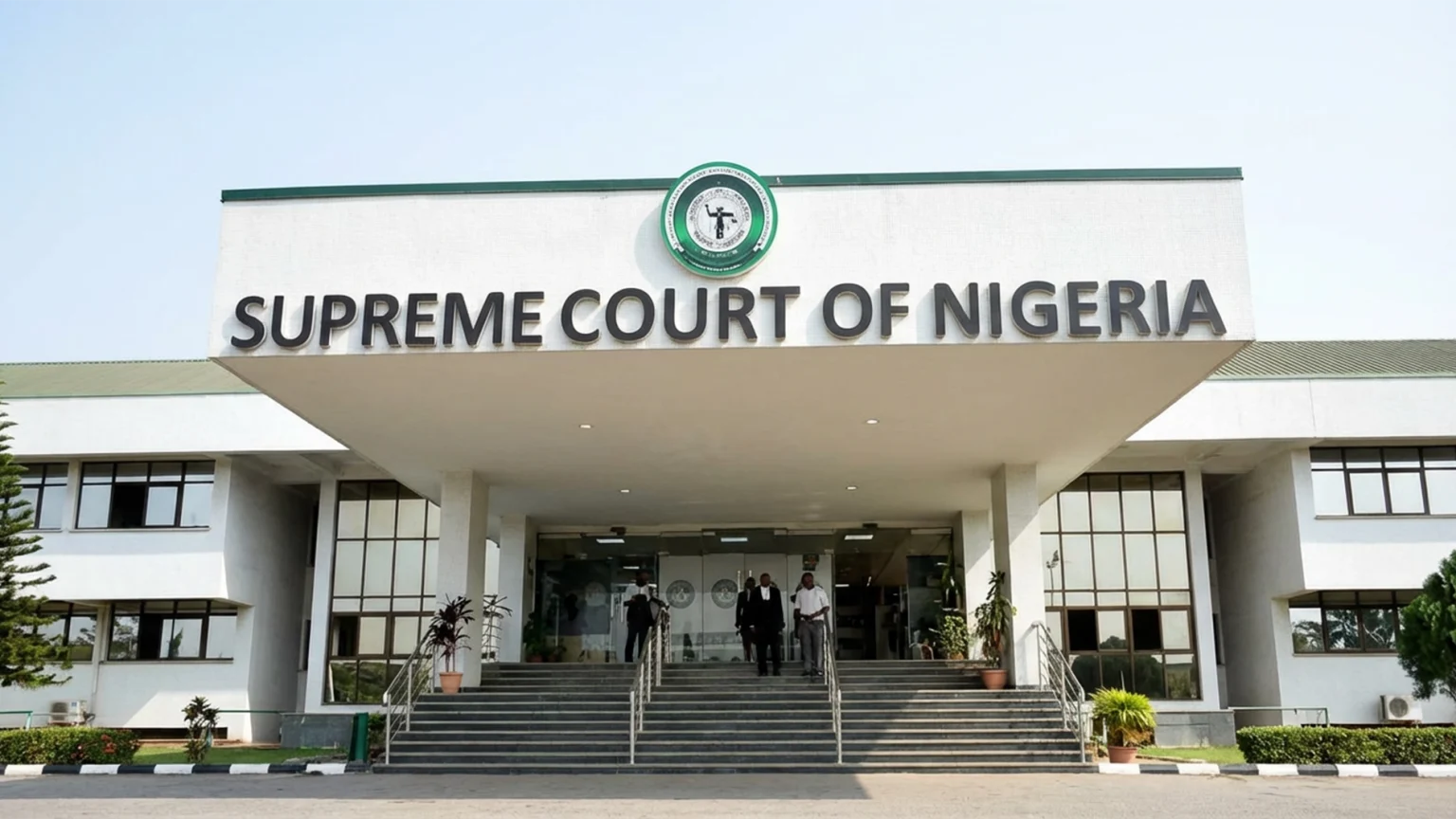
• Apex court to decide leadership tussle amid conflicting lower court rulings
• High Court bars INEC, halts caretaker congresses, affirms state executives
• INEC’s de-recognition move deepens party’s leadership crisis
• Kachikwu hails ruling, rejects parallel structures within party
• Nwosu warns polls may not hold if ADC is left off ballot
• Aspirants intensify consultations despite unresolved leadership dispute
The African Democratic Congress (ADC) confronts a decisive moment today, with the Supreme Court set to rule on its leadership tussle, against the backdrop of a Federal High Court judgment that has already barred disputed congresses and reinforced the authority of elected state executives.
The apex court is set to deliver judgment in a case that centres on rival claims to the party’s national leadership by factions aligned with former Senate President David Mark and contender Nafiu Bala Gombe.
The Guardian learnt that the court notified the parties yesterday of the date fixed for judgment.
The court fixed 2:00 p.m. for the ruling, which political stakeholders and legal observers say could determine the stability of the party’s internal structure ahead of the next electoral cycle.
The appeal, marked SC/CV/180/2026, arose from conflicting decisions of the Federal High Court and the Court of Appeal on who should be recognised as the authentic leadership of the opposition party.
Senior lawyer Shaibu Aruwa had earlier written to the Chief Justice of Nigeria, urging the apex court to expedite judgment. In a letter dated April 22, 2026, the counsel to the party warned that delay could expose the ADC to what he described as a “grave and irreversible risk” of exclusion from the polls.
The appeal involving Mark and Bala Gombe, alongside four others, was heard on April 22, with judgment reserved.
According to the letter, the Independent National Electoral Commission (INEC), acting on an earlier Court of Appeal ruling, had moved to de-recognise the ADC leadership, leaving the party without a recognised structure.
Aruwa said the development had created a constitutional and political crisis capable of undermining the party’s preparations for the 2027 elections.
“My Lord, the ADC’s ability to comply with these statutory requirements to participate in the 2027 General Elections is wholly dependent on the timely delivery of the judgment in the instant appeal,” the letter stated.
He added that unless judgment is delivered promptly, millions of Nigerians aligned with the party risk disenfranchisement.
“This would deny them their constitutional right to freely associate and contest elections through a political party of their choice,” he said.
Court bars INEC from ADC caretaker congresses, restrains Mark, affirms state executives’ tenure
Tiday’s anticipated Supreme Court verdict follows Justice Joyce Abdulmalik’s ruling, which barred the Independent National Electoral Commission (INEC) from recognising or participating in any congress organised by a disputed caretaker leadership of the African Democratic Congress.
Abdulmalik of the Federal High Court, Abuja, also restrained former Senate President David Mark and other party figures from interfering with the functions and tenure of elected state executives.
The ruling followed an originating summons filed by Norman Obinna and six others on behalf of ADC state chairpersons and executive committees.
They challenged the legality of actions taken by a caretaker or interim national leadership.
The plaintiffs argued that the caretaker body lacked the constitutional authority to organise state congresses or appoint committees for that purpose. They asked the court to affirm their tenure and stop any parallel process.
In her judgment, Justice Abdulmalik noted that she found “the issue in the originating summons meritorious”.
She said the germane issue was whether the second to sixth defendants, including Mark, had constitutional or statutory authority to assume the powers of an elected state organ of the ADC, whose tenure is constitutionally guaranteed.
According to her, Section 223 of the 1999 Constitution provides that political parties shall conduct periodic elections on a democratic basis, while Article 23 of the party’s constitution provides that national and state officers shall hold office for a maximum of two terms of eight years.
Abdulmalik therefore said that “the question is whether there is any infraction committed by Mark and co-defendants when they convened meetings and appointed a body known as a congress committee to organise state congresses.”
On the issue of the internal affairs of political parties raised by the defendants, she noted that “the law is settled that courts will not interfere. However, where there is an allegation of breach of constitutional or statutory provisions, the court has a duty to intervene.”
“Where a party alleges that its constitution has been violated, the court is bound to adjudicate. Any argument that this court lacks jurisdiction on that basis fails,” she ruled.
She held that political parties must comply strictly with their constitutions and that courts can intervene where there is a breach of constitutional or statutory provisions.
She found that the procedure adopted by the defendants, including the appointment of a “congress committee”, is not recognised by the party’s constitution.
The judge ruled that the tenure of state executive committees remains valid and must be allowed to run its course. She said only those elected structures have the authority to organise state congresses.
The court set aside the committee’s appointment and restrained INEC from recognising any congress organised by it.
The court also restrained Mark and other defendants from organising congresses or conventions outside the provisions of the party’s constitution.
The judge further restrained them from taking steps that could undermine or disrupt the authority of the state executive committees.
The suit was instituted by way of originating summons by the plaintiffs, led by Obinna and six others. They sued on behalf of state chairmen and executive committees of the ADC.
The defendants include the ADC, David Mark, Patricia Akwashiki, Bolaji Abdullahi, Ogbeni Rauf Aregbesola, Oserheimen Osunbor, and INEC.
The plaintiffs challenged the legality of caretaker or interim national working committees and urged the court to restrain INEC from recognising or participating in any congress organised by the caretaker committee.
The plaintiffs contended that, under the party’s constitution and the 1999 Constitution (as amended), the tenure of state executive committees subsists until valid congresses are conducted, and that any attempt to bypass them undermines internal party democracy.
However, the defendants, in preliminary objections, counter-affidavits and written addresses, urged the court to dismiss the suit.
Mark and others argued that the matter relates to the internal affairs of a political party, is not justiciable, that the plaintiffs lack locus standi, and that the suit is incompetent.
Before delivering judgment, the court also ruled on the preliminary objections and counter-affidavits filed by the defendants.
On jurisdiction, Justice Abdulmalik held that “the subject matter of the plaintiffs’ action pertains to the affairs of INEC,” and therefore falls within the jurisdiction of the Federal High Court under Section 251 of the Constitution.
On the argument that the plaintiffs failed to exhaust internal dispute resolution mechanisms, the judge declined to uphold the objection at that stage. She held that determining that issue would amount to deciding substantive questions prematurely.
On locus standi, she held that “the plaintiffs’ locus standi and capacity emanate from the alleged violation” and that they share a common grievance, making the representative action proper.
Consequently, she held that the objections lacked merit and were resolved in favour of the plaintiffs.
ADC to review judgment after court halts disputed caretaker congresses
THE African Democratic Congress has directed its legal team to review the judgment affecting the party’s state leadership structure.
In a statement signed by the party’s National Publicity Secretary, Bolaji Abdullahi, the ADC said it would study the judgment before taking further steps.
“The attention of the African Democratic Congress has been drawn to media reports that the Federal High Court, presided over by Hon. Justice Joyce O. Abdulmalik, has sacked the elected, but yet to be inaugurated, State Chairmen of our party,” Abdullahi said.
He added that the party had earlier clarified that the congresses did not affect the tenure of current state executives, who would complete their term before newly elected officials are inaugurated.
“Nevertheless, the leadership of the ADC has instructed its legal team to review the said judgment and advise the party appropriately,” he said.
Kachikwu hails ruling as restoration of order
REACTING, former presidential candidate of the African Democratic Congress, Dumebi Kachikwu, welcomed the Federal High Court judgment, describing it as a restoration of constitutional order and legitimacy.
Kachikwu said the judgment affirmed his position that the ADC could not be controlled through unconstitutional structures or parallel arrangements.
“This judgment is a clear vindication of our consistent position that the African Democratic Congress is not for sale and cannot be captured through unconstitutional means,” he said.
“The court has affirmed that due process and the party’s constitution remain supreme.”
He described the annulled congresses as an attempt to impose illegitimate leadership on the party, adding that judicial intervention had halted the process.
“The so-called congresses have been nullified. That is the reality. Those who attempted to impose themselves on the party have been checked by the rule of law,” he said.
Kachikwu also criticised the faction linked to former Senate President David Mark, stating that efforts to control the party structure had failed.
“The ADC is not for sale. These attempts to hijack the party have failed woefully. What we witnessed was an illegal process that has now been corrected by the court,” he added.
He urged party members to remain calm and united, noting that internal consolidation remains necessary ahead of future political contests.
“This is not the end of the journey, but it is an important correction. We must remain united and disciplined as we rebuild the party,” he said.
Kachikwu added that the party would participate fully in the 2027 general elections and field candidates across all levels, including the presidency.
“There is no doubt about our participation in 2027. The ADC will be on the ballot across all levels,” he said.
On opposition realignments, he cautioned against coalitions driven by ambition rather than ideology, stating that any alliance must be grounded in national interest and reform-focused principles.
“Nigeria needs a clear departure from recycled politics. Any coalition must be rooted in values and a genuine desire for national renewal,” he said.
The ruling is expected to influence internal alignments within the ADC, particularly on leadership recognition and engagement with INEC, as stakeholders reposition ahead of the 2027 electoral cycle.
ADC founder warns 2027 polls may not hold without party on ballot
IN a related development, the founding National Chairman of the African Democratic Congress, Ralph Nwosu, has told party members that the 2027 general elections may not hold if the party is excluded from the ballot.
Nwosu also said the opposition party has built the support needed to unseat President Bola Ahmed Tinubu in 2027.
He spoke yesterday in Abuja at the party’s National Secretariat during the ADC Youths Champion and Prospective Legislative Summit organised by the office of the National Youth Leader.
According to him, the party has recorded significant growth through its coalition efforts, adding that as of Tuesday evening, some serving senators in the ruling All Progressives Congress and other parties were still in talks with ADC leadership about joining.
The event brought together young aspirants contesting various positions across the country, alongside party leaders, and focused on strengthening youth and women’s participation in public leadership.
Nwosu said the coalition followed due process in taking over the party and attributed current challenges to what he described as a culture of impunity in Nigerian politics.
“The culture in place is dirty. It’s very difficult to change the culture but we will continue working very hard to do so once we are determined. You don’t need a million people to do it; you just need a few determined minds,” he said.
“With the number we have today in ADC, what we have achieved by the Coalition is phenomenal and no matter how anybody thinks they can knock this down, they cannot. To knock this down will be almost as knocking our democracy down and God will not allow that.”
He added that the party had put in place strategies to withstand political pressure, alleging that those in power often act to retain control when their tenure is nearing its end.
“The time is over for Tinubu politically, and he must go. The time is over for Akpabio, and they must go,” he said, referring to Senate President Godswill Akpabio.
Nwosu said the party’s membership drive had gained traction, claiming millions of Nigerians had indicated interest in joining.
“The statistics are already there in our portal. I think we’re already recording over five million people who are desirous to pay money and to become members of ADC. By the time the registration closes down, we will have a minimum of 11 million people who are ready to contribute money,” he said.
He also alleged that despite challenges from the government, more lawmakers were considering joining the party.
“All I know is that Tinubu and Amupitan cannot conduct any election in this country if ADC is not on the ballot,” he added.
Atiku visits Amaechi in Abuja as ADC aspirants intensify consultations
MEANWHILE, former Vice President Atiku Abubakar yesterday visited former Minister of Transportation Rotimi Amaechi at his residence in Abuja, as consultations deepen among presidential aspirants on the platform of the African Democratic Congress (ADC).
Atiku, who disclosed the visit on his X handle, said both men held discussions ahead of the party’s presidential primary, amid ongoing efforts to resolve its leadership dispute in court.
“Today, I had an engaging and fruitful audience with my dear brother, H.E Rotimi Amaechi, @ChibuikeAmaechi, at his residence in Abuja. Amaechi is a statesman whose distinguished service as a two-time Speaker, two-time Governor, and two-time Minister continues to echo in the annals of our national life,” he said.
“I remain deeply grateful for the warmth, grace, and generosity of spirit with which he received me and my delegation.”
Both Atiku and Amaechi are leading presidential aspirants within the ADC.
The visit comes as another aspirant, Peter Obi, continues consultations across the country.
On Monday, the 2023 presidential candidate of the Labour Party led Igbo leaders to the Abuja residence of former President Goodluck Jonathan. Obi said the meeting formed part of ongoing engagements with former national leaders regarding his presidential ambition.
On Tuesday, the former Anambra State governor visited Seyi Makinde in Ibadan, where he said discussions focused on national issues, democratic direction, and the need to build a more inclusive, secure and economically viable Nigeria.
Bode George urges respect for rule of law, says opposition not enemy of state
ALSO, elder statesman and chieftain of the Peoples Democratic Party, Bode George, called for adherence to the rule of law and constitutional limits on leadership, stating that opposition parties remain an essential component of democratic governance.
In a statement yesterday, George said, “The right of opposition voices to organise, to speak, and to contest power is not a privilege granted by those in authority; it is a constitutional necessity. To suppress dissent or undermine opposition structures is to erode the very framework that legitimises governance.”
He stated that democracy is sustained by strong institutions, constitutional governance and the protection of opposition voices, noting that structured disagreement contributes to political stability and accountability.
According to him, opposition parties provide a mechanism for checking those in power and offering alternative ideas for national development.
George warned that efforts to silence dissent or weaken opposition structures would reduce public trust and weaken the legitimacy of democratic governance.
He added that leadership must operate within constitutional boundaries, stressing that no individual, regardless of position, should function above the law.
He said power must remain subject to legal restraint and authority must be accountable within constitutional limits, adding that democracy develops through structured disagreement where opposition strengthens stability.
Referencing the Magna Carta of 1215, George said history shows that authority is subject to legal limits and accountability to the people.
He noted that even rulers who once exercised absolute authority accepted constraints on their power, adding that modern governance requires strict adherence to constitutional provisions.
George said national progress depends on strong institutions and adherence to established laws rather than individual authority.
He urged political actors to uphold fairness, respect opposing views and maintain constitutional order, stating that abuse of power presents a risk to democratic stability.
“In moments such as this, when the health of a nation’s democracy is under scrutiny, it becomes necessary to return to the foundational principles that govern civilised societies,” he said.
“One of the most enduring of such principles is embodied in the Magna Carta—the Great Charter of the year 1215—which established a truth that has shaped democratic systems across centuries: No authority is above the law. This principle is not merely historical; it is the bedrock upon which modern democratic governance rests.”
The Guardian


