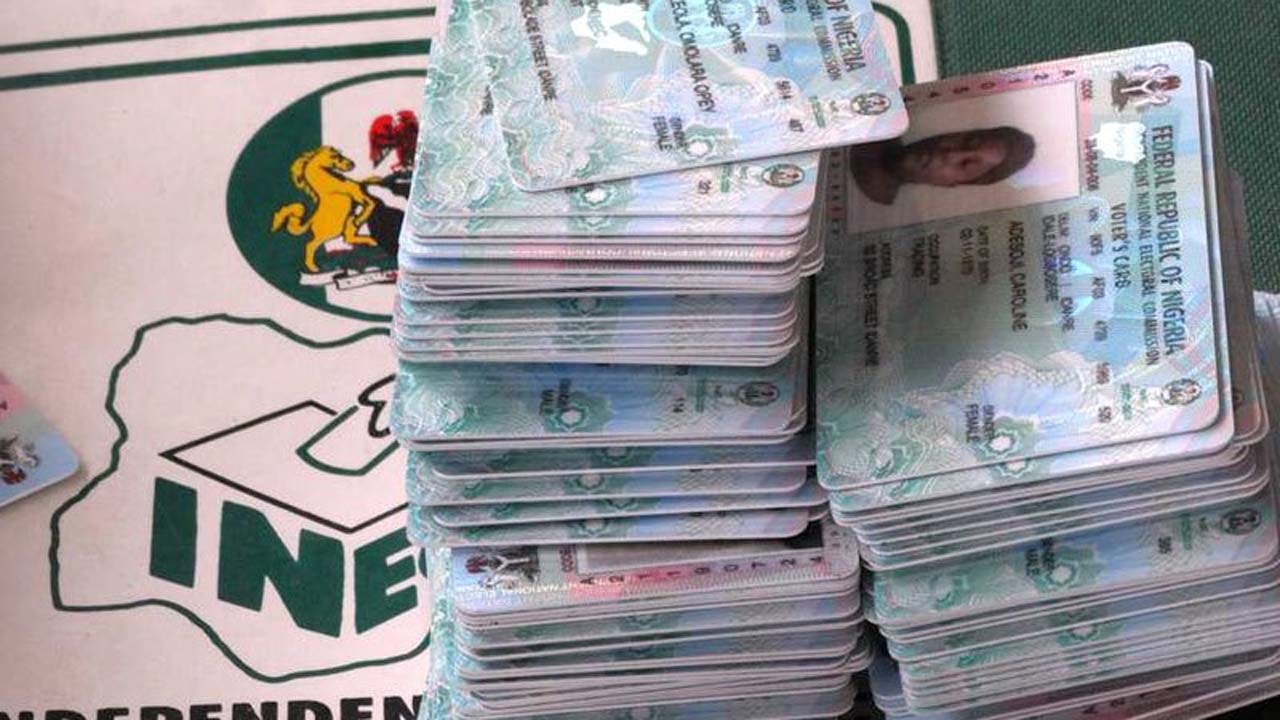
Permanent Voter Cards
The African Democratic Congress, the Peoples Democratic Party, the Obidient movement, and civil society groups on Sunday warned that the implementation of the voter revalidation exercise by the Independent National Electoral Commission could disenfranchise the electorate and damage public trust.
The ADC spokesman, Bolaji Abdullahi, in an interview with The PUNCH, pointed out that rural dwellers may be disenfranchised, citing challenges of access and awareness in remote communities.
The PDP Publicity Secretary, Ini Ememobong and Obidient movement National Coordinator, Yunusa Tanko, questioned the feasibility of the exercise, arguing that it may not achieve its intended purpose given current logistical constraints.
Civil society organisations equally warned the exercise could erode public confidence in the electoral commission and weaken trust in the electoral process, underlining widespread concern about both timing and execution.
Meanwhile, a former INEC official, Oluwole Uzzi, said the commission has the legal authority to conduct voter revalidation exercises, but cautioned that the timing of the exercise raises concerns ahead of elections.
The electoral body had announced plans to commence a nationwide voter revalidation beginning from April 13 to May 29, 2026, and aimed at removing ineligible entries and strengthening the integrity of Nigeria’s electoral process.
In a public notice issued via its official X handle on Friday, the commission said the exercise would target the removal of “null and ineligible voters, such as deceased, non-Nigerians, underage, and multiple registrations,” in line with legal provisions.
INEC clarified that the exercise is not a fresh registration but is specifically for voters who registered between 2011 and 2024. “The exercise is part of the commission’s efforts to revise, update, clean and strengthen the integrity, accuracy, inclusivity, and credibility of the national register of voters ahead of future elections,” the notice stated.
The timing of the exercise, less than nine months to the 2027 polls, has further heightened apprehension about its potential impact on voter turnout.
However, in a letter dated April 4, 2026, and signed by its Secretary, Rose Oriaran-Anthony, the commission directed all RECs to suspend preparations for the exercise, including sourcing personnel and getting INEC Voter Enrolment Devices ready.
“RECs are also directed to step down all publicity and arrangements for the voter revalidation exercise and await further directives from the commission,” the notice stated.
The letter, titled, ‘Notice of Meeting with Resident Electoral Commissioners (Virtual)’,’ also said the meeting with RECs earlier scheduled to be held physically on Thursday, April 9, at 11:00 a.m. will now be conducted virtually via Zoom.
“Further to the notice of meeting dated April 3, 2026, please be informed that the meeting of the commission with Resident Electoral Commissioners scheduled for Thursday, April 9, 2026, at 11:00 a.m. will now be held virtually via Zoom,” the notice read.
The commission advised RECs to remain in their respective states and await login details, which will be shared once arrangements for the virtual meeting are concluded.
The commission added that all publicity and preparations for the voter revalidation exercise should be put on hold pending further directives.
Reacting, the National Publicity Secretary of the ADC, Abdullahi, questioned the feasibility of the exercise, especially for rural dwellers.
He said, “How does INEC expect Nigerians to carry out the revalidation exercise in all the polling units, wards, local governments and states in the first place? Even getting people to register is difficult.
“I am happy that all of us are seeing the direction the country is going now. How do you ask villagers and those in rural areas to validate online nine months before the election? These are people who may not even have money to eat. You are asking them to abandon their jobs to go to polling units and INEC offices to join a queue.
“They just don’t want to go to the election. It is as simple as that. This is just a case of the opposition talking.”
On his part, the National Publicity Secretary of the PDP, Ememobong, said the timing is inappropriate and urged the commission to concentrate on more pressing matters.
“Exercise from the outset, the timing of the exercise is very wrong. The voter register has been there since the last general election, and they have not thought of what to do with it. So, to do that revalidation at this time, when they know how difficult it is for people to even register, is a further attempt in the INEC/APC political playbook to ensure a coronation, a president, an uncontested presidential election, and that’s what it is. So what’s the hurry? If you couldn’t do it early, then you leave it.’’
He continued, “They attempt to do that in addition to their political party monitoring exercise, which they are now going to do. They’ve issued a statement that they’re going to be visiting political parties to check whether they’ve been paying rent, whether they own the facility, and all that. Why? Very closely, they should be concentrating on electoral logistics.
“In a small area council election in Abuja, INEC had performed poorly in logistics, and instead of preparing for logistics, how does the revalidation of voters help? How does checking up on political parties help?
‘’At the end, we suspect that what INEC wants to do is to deregister opposition political parties that are not in bed with them or not in bed with the APC. Therefore, we are saying that it is a misplacement of priority for INEC to do this, instead of concentrating on getting logistics right.”
Similarly, the faction of the ADC led by Nafiu Gombe described the timing as inappropriate, warning that the technical requirements could exclude many Nigerians from the process.
Bala’s Chief of Staff, Bala Sani, disclosed this in a phone interview with The PUNCH.
“It is a bad time. The timing is not convenient for Nigerians to even do their voter registration alone if you also factor in the fact that our people are villagers because revalidation has to do with ICT.
“It is too technical. You are expected to attach your NIN. When you go to an average village in this country, how many of the people even have this NIN? They have the voter card but not the NIN. And you are saying it is mandatory to bring your voter card this time.
“Honestly speaking, many people will be disenfranchised in the 2027 election. They should have done this at least two years before the election. And it has to be a continuous process.
“For example, I asked an INEC staff member: Let us assume I attained the age of 18 three months ago or last year, and I registered when the exercise started. Do I need to do revalidation again? He said, yes. Honestly, I am confused.
“INEC should suspend it and allow us to do this election with our previous voter’s card. We will have enough time to do this immediately after the 2027 election. For us in the ADC, we see it as an attempt to disenfranchise Nigerians in this election,” he stated.
Also weighing in, the National Coordinator of the Obidient Movement Worldwide, Yunusa Tanko, warned that the exercise could further erode public trust in the electoral system.
“With all levels of sincerity, what is the process of revalidation? That means you have to present your old card for confirmation to ascertain whether it exists or not.
“At this point in time, over 98 million people are registered as voters, but only 25m voted in the past election. Even at that, INEC has disenfranchised millions of registered voters.
“Therefore, a revalidation will further reduce the number from the existing 25m to probably a million or two people. This is because the people are already seeing INEC as unfair and don’t have trust in them. In fact, many will not even bother to do any revalidation exercise.
“There is already mistrust in the system. People don’t trust INEC to hold a fair and credible election.”
He alleged that the revalidation exercise is a tactic by the ruling party to suppress and reduce votes for opposition parties.
Tanko added, “If INEC is serious about any revalidation process, it should have been a four-year plan that should be cascaded down to the grassroots. So, this particular attempt is one of the gimmicks by the ruling party and the people in government to annihilate and reduce the number of people who plan to vote for the opposition parties.
“So, we condemn it in totality, and I know many Nigerians will also never be in favour of it because it is not done with good intentions. It is the right thing done at the wrong time. It is only being done to discourage people from voting for the person of their interest.
“It is totally unacceptable to us. INEC shouldn’t throw this country into the fire. Already, the people are angry.”
Also, civil society organisations raised concerns about trust, logistics, and the broader implications for Nigeria’s electoral process.
The Executive Director of the Civil Society Legislative Advocacy Centre, Auwal Rafsanjani, criticised the move, warning that it could further erode public confidence in the electoral body.
He said, “Well, our call is for the electoral commission to do everything possible to restore confidence in the Nigerian voters. The recent action of INEC is further discouraging and demoralising many Nigerians to have confidence in the sincerity of INEC to conduct free, fair, and credible elections.”
Rafsanjani noted that the timing and preparedness for the exercise were inadequate, arguing that the commission lacked both the manpower and technological capacity to execute it effectively.
He noted, “This exercise that they are doing, they should know that is humanly going to be extremely difficult for them to conduct it successfully, given the fact that the time framework is very short, and that they did not also have the human personnel to carry out this, and even the technology that will have to be utilised is also coming up with a lot of challenges.”
The director further stressed that elections should be treated as an ongoing process rather than a rushed event, cautioning that the current approach could lead to confusion and disputes.
According to him, “Many Nigerians are alleging that it is a calculated attempt to defraud them or to disenfranchise them from participating in the electoral process.”
Also weighing in, the Country Director of Accountability Lab Nigeria, Friday Odeh, described the exercise as necessary, but insufficient to address deeper issues of voter apathy and distrust.
Odeh argued, “I think it’s necessary, but again, the necessity does not negate the fact that there’s still a trust problem with INEC.”
Odeh highlighted the gap between voter registration figures and actual turnout in recent elections, noting that revalidation alone would not inspire greater participation.
“If you do revalidation, which is a ‘necessary evil’, if I may call it that, that leads into voting, it doesn’t build the trust gap that is affecting voters of a party in the long term.”
He urged INEC to prioritise rebuilding public trust ahead of future elections, adding, “If they can get about 50 per cent of voters on their registers on the next election or the 2027 election, I think that should be the plan.”
The Executive Director of the Centre for Anti-Corruption and Open Leadership, Debo Adeniran, rejected the justification for the exercise, describing it as unnecessary and burdensome.
Adeniran said, “Well, definitely, there is sufficient time. That is unnecessary.”
He submitted that the concept of a Permanent Voter Card should not require periodic revalidation, suggesting that existing systems already accommodate cases such as lost or damaged cards.
He explained, “But when they said something is permanent, it is not supposed to be subjected to periodic re-evaluation or revalidation. That means that they didn’t think out the strategy before they adopted it.”
He further criticised the exercise as placing undue strain on citizens, particularly in a system where record-keeping challenges persist.
Reacting, a former Director of Voter Education at the Independent National Electoral Commission, Oluwole Uzzi, said the commission has the constitutional and legal authority to conduct voter registration and revalidation, but raised concerns about the timing so close to elections.
In an interview, he noted that although the commission can validate or invalidate voter cards, questions have been raised about whether the exercise is being carried out at the right time.
“Well, let me put it this way. INEC has the right to conduct voter registration. So, it can choose to validate or invalidate voters’ cards and stuff like that. So, constitutionally, INEC has the right to do that. It has the Legal right to do that,” he said.
He, however, stressed that the timing of the exercise remains a contentious political issue, with many stakeholders expressing reservations.
“So, whether it’s an opportune time to do that is a totally different issue. That’s a political issue. Legally, it has the right, but politically, a lot of people have their doubts about what’s being done at this very time. Obviously, it ought to have started much earlier,” he added.
Uzzi pointed out that the ongoing Continuous Voter Registration had been in place for months, raising questions about why revalidation efforts were being introduced at this stage.
“Now CVR has been going on for several months. Why are you just doing it at the time of CVR? Well, you heard the INEC chair say that there was no budget for it. So, let me put it this way,” he said.
He further warned that implementing such a process just months before an election could create avoidable tension and doubts among political actors and the electorate.
“Just a few months to the election, it’s not an opportune time to do this, and they have a valid argument in that regard. But this is a real issue,” Uzzi stated.
The former INEC official also emphasised the need for broader consultation with political stakeholders to ensure transparency and public trust in the process.
“Whereas, they have a right to do that. It’s a real responsibility, and people feel that there should be a lot more consultation with the people who represent the political parties and everything else. You know, a lot of people are caught unaware, but the truth is that this issue has been on for a long time to clean up the register. We do have a list of registers that we need to clean up, but is it the correct time? That’s the issue now.’’
The Punch